Food inflation: what our readers think

Loading article…
With grocery prices up 3.5% year over year (April 2026, Statistics Canada), food inflation remains one of the top concerns for Canadian consumers. To better understand how this pressure is felt day to day, the Milesopedia editorial team surveyed a portion of its community between June 1 and 8, 2026.
Our survey covers two areas. First, perceptions of rising prices and their impact on household budgets. Second, the use of rewards programs as a strategy to offset these costs. To compare the options mentioned below, you can also consult our page on the best credit cards and our selection of the best cards for groceries. Here are the key findings.
| Finding | Share of respondents |
|---|---|
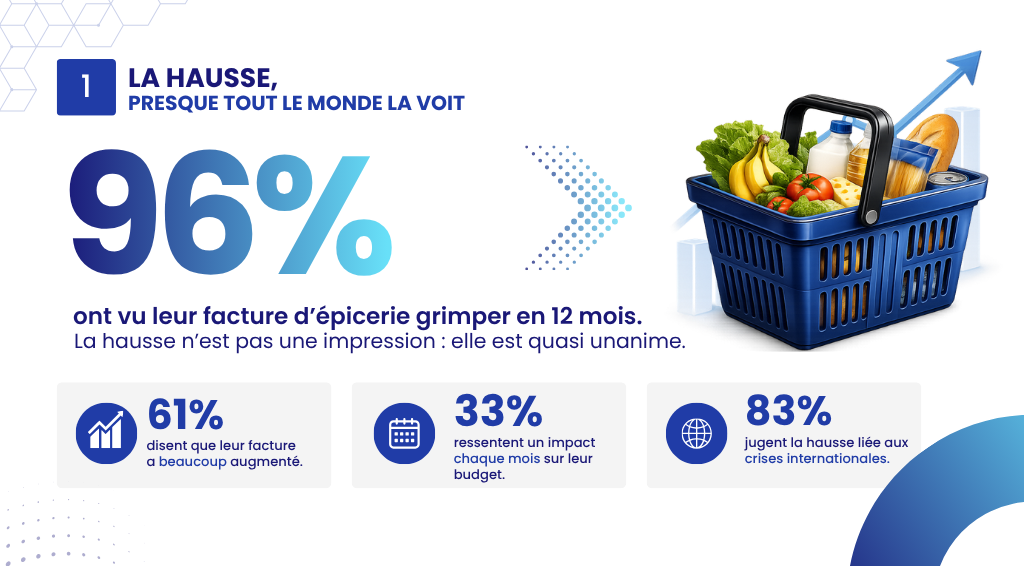
| Have seen their grocery bill increase over 12 months | 96 % |
| …including “increased a lot” | 61 % |
| Have changed their shopping habits | 70 % |
| Are very familiar with rewards programs | 94 % |
| Use a program every time they shop for groceries | 85 % |
| Believe programs offset little or none of the increase | 49 % |

The finding is widely shared: nearly all respondents feel the rise in grocery prices. Its impact on budgets is often considered manageable, but it is very real in everyday life.
Perceptions of the increase are almost unanimous over the past 12 months. Six out of ten respondents (60.5%) believe the cost of their basket has increased a lot, while 36% say it has increased a little. In total, more than 96% therefore report an increase. Conversely, only 1.5% find their basket stable, and 2% are unsure.
| Change in grocery basket over 12 months (N = 203) | No. | % |
|---|---|---|
| It increased a lot | 123 | 60,5 % |
| It increased a little | 73 | 36 % |
| I couldn’t say | 4 | 2 % |
| It stayed the same | 3 | 1,5 % |
While the increase is nearly universal, its impact on finances varies from one household to another. Half of respondents (50.2%) describe a moderate impact: they notice the increase but adjust without too much difficulty. However, 33% feel the effects each month on their budget (responses “significant” and “very significant” combined). At the other end, only 16.7% report little or no impact.
| Impact on monthly budget (N = 203) | No. | % |
|---|---|---|
| Moderate: I adjust without too much stress | 102 | 50,2 % |
| Significant: I feel it every month | 60 | 29,6 % |
| Low: a few extra dollars | 21 | 10,3 % |
| None: no impact | 13 | 6,4 % |
| Very significant: difficult choices | 7 | 3,4 % |
In other words, the situation is not yet forcing most households into difficult choices. Nevertheless, pressure from grocery costs remains very present and widely felt.
In the face of rising prices, consumers do not just observe: they also adapt their behaviour. More than seven out of ten respondents (70.1%) have changed their shopping habits, including 10.7% in a significant way. The majority (59.4%) describe small adjustments, a sign that adaptation is happening in small steps rather than through radical changes. Conversely, nearly three out of ten (29.9%) have not really changed their habits.
| Have you changed your habits? (N = 197) | No. | % |
|---|---|---|
| Yes, a little | 117 | 59,4 % |
| No, not really | 59 | 29,9 % |
| Yes, a lot | 21 | 10,7 % |
As for the strategies adopted, respondents primarily favour those that optimize their shopping without turning everything upside down. Comparing prices between retailers comes out well ahead (71.1%). Next are store brands (39.1%), then coupons and discount apps (34%). More restrictive approaches remain in the minority: 24.4% cut back in certain categories, and only 9.6% changed their preferred retailer.
| Habits adopted (N = 197, multiple choice) | No. | % |
|---|---|---|
| Compare prices between retailers more | 140 | 71,1 % |
| Buy more store brands | 77 | 39,1 % |
| Use coupons or discount apps | 67 | 34 % |
| Cut back in certain categories (meat, fresh… ) | 48 | 24,4 % |
| Buy in bulk or larger formats | 35 | 17,8 % |
| Changed preferred retailer | 19 | 9,6 % |
Beyond the increase already observed, it is above all the future trend that worries people. More than three quarters of respondents (77.6%) say they are fairly or very concerned about another increase in the coming months, including 23.5% who are very concerned. Conversely, fewer than one in four (22.5%) say they are little or not at all worried. Food inflation is therefore not seen as a temporary phenomenon, but as a lasting concern.
| Concern about future trends (N = 196) | No. | % |
|---|---|---|
| Fairly concerned | 106 | 54,1 % |
| Very concerned | 46 | 23,5 % |
| Slightly concerned | 39 | 19,9 % |
| Not at all concerned | 5 | 2,6 % |
First, let us recall that members of the Milesopedia community are more familiar than average with rewards programs, credit cards, and optimization strategies. The data that follow therefore reflect the views of already experienced users, not those of the Canadian population. That is precisely what makes their findings revealing.
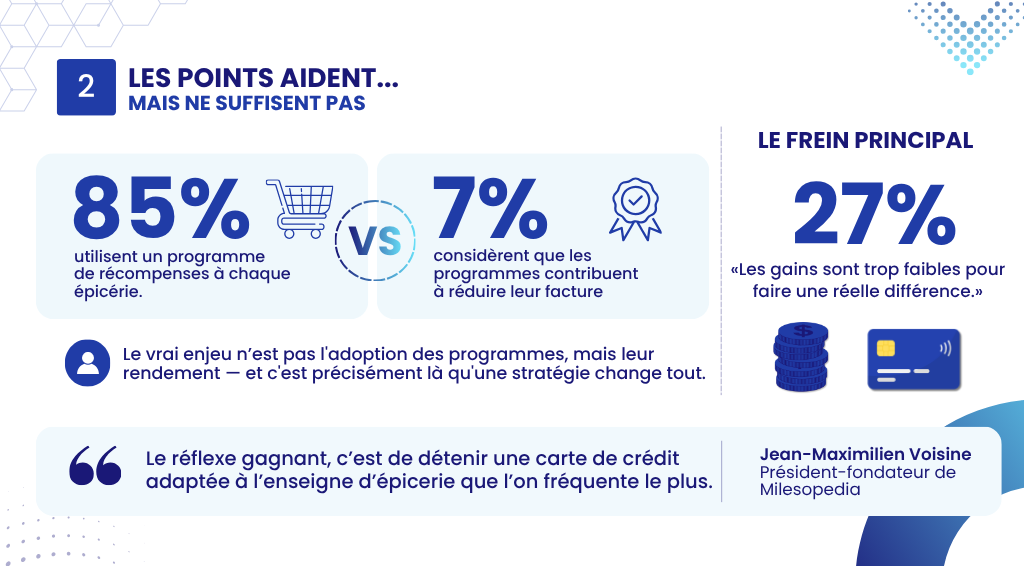
Grocery store programs are widely known among our respondents: more than nine out of ten (93.9%) say they know them very well or fairly well, including 51.8% very well. Yet despite this familiarity, they remain skeptical about these programs’ ability to offset the increase. Nearly half (49.5%) believe they help very little or not at all, and only 7.1% feel they reduce the bill significantly. These programs are therefore seen as a useful supplement rather than a real solution to inflation.
| Do programs offset the increase? (N = 196) | No. | % |
|---|---|---|
| Yes, a little | 81 | 41,3 % |
| Very little | 71 | 36,2 % |
| Not at all | 26 | 13,3 % |
| Yes, a lot | 14 | 7,1 % |
| I don’t know | 4 | 2 % |
Contrary to some common beliefs, complexity or lack of trust are not the main barriers. The majority (64.5%) report no particular obstacle and believe they already use these programs well. Among those who do point to a barrier, the main criticism concerns the value of rewards: nearly a quarter (27.4%) consider the gains too small to make a real difference. Time required and complexity come far behind.
| Main barriers (N = 197, multiple choice) | No. | % |
|---|---|---|
| No barrier, I already use them well | 127 | 64,5 % |
| The gains are too small | 54 | 27,4 % |
| It takes too much time | 16 | 8,1 % |
| I don’t know how much I really earn | 15 | 7,6 % |
| I find it too complicated | 7 | 3,6 % |
| I don’t trust it | 1 | 0,5 % |
So the real issue is not adoption, but the return. And that is precisely where a strategy changes everything.
Let us be clear: earning points does not lower the shelf price. But that is not the right way to measure their value. A point is deferred value: earned well and redeemed well, it comes back as grocery discounts, travel credit, or cash back. The real question is not “do points erase inflation?”, but “am I leaving money on the table every week?”. Here are the five levers that make the difference between passive use and a real strategy.
The issue raised by our respondents—“the gains are too small”—therefore mainly describes passive use. When activated, these five levers turn anecdotal points into tangible, redeemable value.
The most effective strategy is to combine the retailer’s loyalty program with a credit card that matches your shopping habits: the right card in the right place.
Points don’t work miracles: even the most organized individuals struggle to offset the increase. However, paying with the right card, in the right place, means $400 to $600 annually staying in a family’s wallet. The winning strategy is to hold a card suited to the retailer one frequents most, whether it’s Maxi, IGA, Metro, or Costco. The problem is not knowing the programs; it’s knowing how to derive concrete daily savings from them.
Jean-Maximilien Voisine, President-Founder of Milesopedia
Not all programs are equal, and their effectiveness often depends on the retailer you shop at. By pairing a retailer’s loyalty program with a credit card suited to it, you maximize your rewards and recover a meaningful share of your spending. Here is an overview of the best combinations.
| Retailer / Profile | Recommended card | Program | Grocery benefit |
|---|---|---|---|
| Maxi | National Bank World Elite Mastercard | PC Optimum | Boosts PC Optimum promotions within the Loblaw ecosystem. |
| IGA | Scotiabank Gold American Express® Card | Scene+ | Accelerated earning of Scene+ points that can be used for groceries. |
| Metro | American Express Cobalt Card | Moi | One of the most rewarding cards in Canada for food purchases. |
| Metro (no fee) | moi RBC Visa Credit Card | Moi | No annual fee, to earn Moi points easily. |
| Costco | Rogers World Elite Mastercard + Executive membership | Rogers Rewards + Costco | Up to 4% combined return on Costco purchases. |
| Loblaw customers (Maxi, Provigo, Shoppers Drug Mart…) | World Elite Mastercard PC | PC Optimum | Enhanced earning across the entire Loblaw ecosystem. |
| Versatile (groceries + gas) | Neo Mastercard World Elite | Neo Rewards | Attractive rewards with many food and gas partners. |
In practical terms, a family that spends about $800 per month on groceries, or $9,600 per year, can recover between $400 and $575 per year in rewards with a card suited to its main retailer, without changing what is in the basket. These gains do not fully offset the increase, but they do reduce part of it in a concrete and lasting way.
If you find points too complicated, cash back cards solve the problem: the return is credited directly to your statement, with no calculations or redemptions. Three cards dominate the grocery category. Here is what they earn on a $9,600 annual budget ($800 per month).
| Card | Rate on groceries | Rebate on $9,600/year | Annual Fee |
|---|---|---|---|
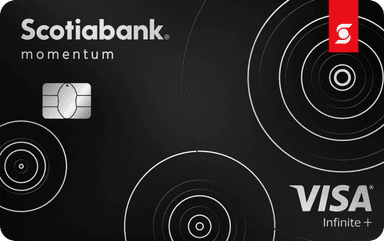
| Scotia Momentum® VISA Infinite +* Card | 4% (no cap on groceries) | $384 | $120 |
| CIBC Dividend® Visa Infinite* Card | 4% groceries and gas | $384 | $120 |
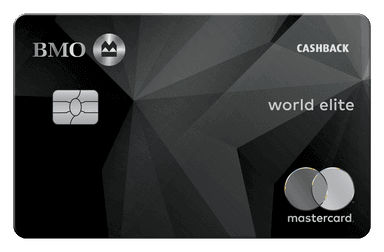
| BMO CashBack® World Elite®* Mastercard®* | 5% (on the first $500/month) | $336 | $120 |
The 5% from the BMO CashBack World Elite Mastercard offers the highest rate, but it only applies to the first $500 in groceries per month; beyond that, the return drops to 1%. For a family spending $800 per month, the Scotia Momentum Visa Infinite +* and the CIBC Dividend Visa Infinite at 4% with no cap therefore yield a bit more over the year.
Another advantage of these three cards: they are Visa and Mastercard, accepted everywhere, whereas American Express cards are refused at some retailers. First-year free offers are regularly available: check the current terms before applying.
| Credit card | Annual fee | Welcome offer | |
|---|---|---|---|
| $191.88 | |||
| $120 | |||
| $0 | |||
| $0 | |||
| $0 | |||
| $0 | |||
| $0 |
Two rules frame this strategy:
That is the difference between collecting points and getting real value from them.
This survey aims to document perceptions of food inflation among consumers already familiar with rewards programs, and to measure to what extent they use them as a mitigation tool. Data were collected between June 1 and 8, 2026.
Our survey shows it clearly: food inflation is felt by almost everyone, and concern is mainly about what comes next. Even the most experienced consumers consider rewards programs insufficient on their own. However, the issue lies less with the programs than with how they are used.
By stacking rewards, choosing the right card for their store, and strategically redeeming points, a household can get back several hundred dollars per year. To go further, compare the best credit cards for groceries and explore the loyalty programs tailored to your habits. And until July 31, 2026, try your luck in the KOHO “10 Years of Groceries” contest, which offers a chance to win $500 in groceries per month for 10 years. To receive our weekly analyses, subscribe to our newsletter.
Discover all our tips for saving on groceries in these articles:
Finally, to discover the best credit cards for groceries, consult our regularly updated ranking to help you make an informed choice:
According to Statistics Canada (April 2026), grocery prices increased by 3.5% year over year. In our survey, 96% of respondents report an increase in their basket over 12 months, including 61% who describe a sharp increase.
Not entirely. Nearly half of our respondents (49.5%) believe they offset very little or none of the increase. However, they remain a useful supplement: when used well, they can help you recover several hundred dollars per year.
It depends on your main retailer. The American Express Cobalt Card works well at Metro, the Scotiabank Gold American Express Card at IGA, and the National Bank World Elite Mastercard at Maxi. Compare options on our best cards for groceries page.
A family that spends $800 per month, or $9,600 per year, can recover between $400 and $575 per year with a card suited to its retailer, without changing its shopping habits.
It means earning, on the same purchase, points from the retailer’s program and rewards from your credit card. These two gains add up at every checkout.
No. It is a non-probability convenience sample of 203 Milesopedia community members, who are more informed than average. The results are indicative and descriptive, not generalizable to the Canadian population as a whole.
on BMO's website
Our reviews and rankings are based on an objective assessment. Advertisers do not influence our content. We may receive compensation through some links; our analysis and opinions remain independent.