Canada is among the world’s most sought-after destinations: the Rockies, Montreal, Vancouver, the Maritimes, the Far North. Before you pack, one question deserves an honest answer: does your medical coverage actually work in Canada?
For most foreign visitors, the answer is no, or not enough. Canada’s health system does not cover tourists, visiting families, super visa holders or newcomers awaiting provincial coverage. Each service is billed at its real cost, and those costs are high.
Why Canada bills at the real rate
Canada’s health system is public, but it is not universal for everyone. Free access is reserved for Canadian citizens and permanent residents holding a valid provincial health card. For anyone outside that category, health facilities issue a bill at the uninsured rate.
These rates vary by province, but they give a concrete idea of the financial exposure. At the CHU de Québec, the published rates for people not insured by RAMQ are as follows:
Emergency triage only: $183.48
Emergency services (per 24-hour period, before doctors’ fees): $1,182.66
Day surgery: $5,248.89
Intensive care hospitalization (per day): $15,207.00
Standard hospitalization (per day): $5,775.00
On top of this come doctors’ fees, medical imaging, lab tests and medication, billed separately. A fracture requiring surgery followed by five days in hospital can easily exceed $40,000 in a Canadian hospital.
If you are planning an interprovincial trip as a Canadian resident, the coverage stakes are different but real: our guide on RAMQ and travel outside Quebec details what your provincial plan covers (and does not) in other provinces.
The limits of your home insurance
Many visitors leave assuming their national insurance or supplemental plan protects them abroad. That assumption is often partly wrong, and sometimes entirely wrong in Canada.
Several national plans reimburse care abroad, but only based on the rates in effect in the home country. Reimbursement for a night in intensive care calculated on the rates of a European or Asian health system bears no relation to a Canadian hospital bill. The difference is entirely on the patient.
Before you leave, three checks are essential with your usual insurer:
Does the policy cover care in Canada specifically, or only certain countries?
Is reimbursement calculated on Canadian rates or on your country’s rates?
Is medical repatriation to your country included, and up to what maximum amount?
Credit card insurance: useful, but limited
Several premium credit cards include travel medical insurance, including some Canadian and international cards. This coverage is useful for short stays, but it comes with conditions that often surprise travellers.
The most frequent restrictions:
Conditional activation: coverage applies only if you used the card to pay part of the trip (tickets, hotel, transport). A visitor arriving to stay with family, with no prior spending on the card, may not be covered.
Limited duration: most cards cover 15 to 60 consecutive days. A three-month stay on a super visa far exceeds that cap.
Pre-existing condition exclusions: diabetes, hypertension, heart disease and other chronic conditions are often excluded, or subject to prior declaration with restrictive conditions.
Insufficient ceilings: some cards cap medical coverage at $250,000 or $500,000 CAD. For a prolonged stay with a serious condition, that ceiling can be reached.
Uncertain medical repatriation: the terms for covering a medical flight vary widely from one card to another.
Our valuationMilesopedia first-year estimateFirst-year valueAnnual fee rebated$150Total$150Rewards on your spending are not included. The calculator that adds them from your own profile is on the card's page.
With Milesopedia, take advantage of an exclusive offer: your first-year annual fees are refunded with the National Bank World Elite Mastercard. This offer is exclusively available on the Milesopedia network, from June 30 to November 4, 2026.
Refund of the first-year annual fee (a $150 value) for the primary cardholder. This fee is charged to your new card account, then refunded as a credit on your statement within five months of opening your account, provided it remains open and in good standing.
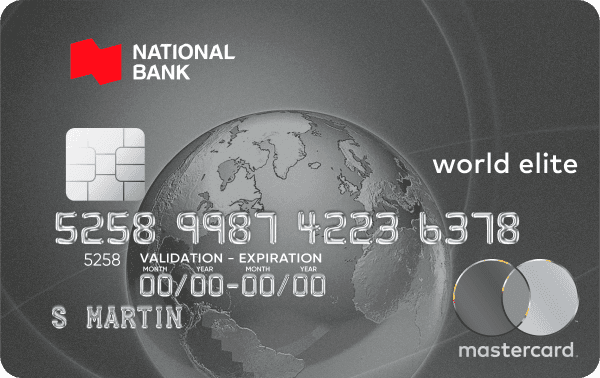
The National Bank World Elite Mastercard is the best Mastercard credit card offered by NBC.
With this card, you earn up to 5 points per dollar on your purchases:
5 points per dollar for groceries and restaurants
2 points per dollar on gas and electric recharge purchases
2 points per dollar on recurring bills
2 points per dollar on À la carte Travel
1 point per dollar for all other purchases
And since it’s a Mastercard, you can use it at Costco.
With this card, you have access to a $150 annual travel credit that you can use in any of these categories:
Airport parking
Baggage fees
Seat selection
Access to airport lounges
Airline ticket upgrades
What’s more, you can enjoy access to DragonPass airport lounges and unlimited access to the National Bank Lounge at Montreal-Trudeau.
Finally, Milesopedia has named the National Bank World Elite Mastercard as the Best Travel Credit Card in 2023, 2024, 2025, and 2026.
Legal
® Mastercard and World Elite are registered trademarks, and the circles design is a trademark of Mastercard International Incorporated. National Bank is an authorized user.
® The À LA CARTE REWARDS logo is a registered trademark of National Bank of Canada.
® NATIONAL BANK OF CANADA LOUNGE is a registered trademark of National Bank of Canada.
® À LA CARTE REWARDS PLAN is a registered trademark of National Bank of Canada.
® Apple Pay is a registered trademark of Apple Inc., registered in the U.S. and other countries. Apple Inc. is not a sponsor of or participant in National Bank Mobile Banking Solutions.
® Google Pay is a registered trademark of Google LLC. Use of this trademark is subject to Google Inc. Permissions.
TM À LA CARTE TRAVEL is a trademark of National Bank of Canada. The À la carte Travel agency is owned by Transat Distribution Canada Inc. and holds a Quebec permit (No. 753141).
TM À LA CARTE REWARDS is a trademark of National Bank of Canada.
® THE TOTAL, THE CONNECTED and NATIONAL BANK are registered trademarks of National Bank of Canada.
* Mastercard® World Elite®
The National Bank® World Elite® Mastercard® credit card was voted best Mastercard credit card by Milesopedia in 2026, 2025 and 2024.
The National Bank® World Elite® Mastercard® credit card was voted best travel credit card by Milesopedia in 2026, 2025 and 2024.
Every year, Milesopedia reviews credit card offers from major financial institutions and establishes its Ranking based on over 150 criteria such as fees, welcome offer, minimum income required, number of points per category, account credits, insurance, airport lounge access, etc.
Certain restrictions apply. For more information, see the Rewards Plan section or the Plan Rules applicable to point accumulation.
Grace period: No interest is charged on purchases made during the month if the cardholder pays the full balance of their account within twenty-one (21) days of the statement date. This grace period does not apply to cash advances and balance transfers. Minimum payment: if your account balance is less than $10, you must pay the balance in full. If you reside in the province of Quebec, your minimum payment is 5% of your account balance plus any overdue amount, or $10, whichever is greater. If you reside outside Quebec, your minimum payment is 2.5% of the credit card account balance plus any overdue amount, or $10, whichever is greater. Account statement: an account statement is sent monthly.
Table of examples of credit fees calculated over a 30-day period
Annual interest rate
$500
$3,000
22.49%
$9.24
$55.45
20.99%
$8.63
$51.76
13.2%
$5.53
$33.16
9.2%
$3.78
$22.68
*Variable interest rate in effect as of September 1, 2021.
Balance transfers and cash advances are subject to National Bank credit approval. Each amount transferred cannot be less than $250.
Exclusive to World Elite Mastercard cardholders. Presentation of the physical credit card and boarding pass is required to access the lounge. The National Bank® Lounge is accessible to customers traveling on international flights only (excluding flights to Canada and the United States). You benefit from free and unlimited access with one guest and two children aged 12 and under. Until October 4, 2026 (date subject to change), customers can enter the National Bank Lounge three hours before their flight departure time. From October 5, 2026 (date subject to change), access will be authorized for a maximum duration of 2 hours (3 hours for customers who hold a Private Banking 1859® World Elite® Mastercard® credit card). National Bank customers who are not World Elite ® Mastercard ® cardholders can also access the current lounge based on current rates and benefit from a 25 % discount on these rates : 63,24 $ taxes included for adults (excluding discount) $40.24 taxes included for children aged 2 to 12 (excluding discount) free for children under 2 (excluding discount) The entry fee is subject to change without notice and is the responsibility of the lounge operator.
Subject to providing the required supporting documents in the manner and within the prescribed timeframe. Certain conditions may apply. Only the primary cardholder of a National Bank World Elite Mastercard (Cardholder) whose account is in good standing can request a « Travel Fee Reimbursement ». « Account in good standing » means an account linked to the credit card that does not violate the Credit Card Agreement in any way and on which no restrictions apply. For example, and without limitation, the associated annual fees must have been paid in full. The maximum reimbursement of $150 can be requested from January 1 to December 31 of each year. Eligible expenses are: airport parking baggage fees seat selection airport lounge access worldwide airline ticket upgrades A reimbursement request must be made within 60 days of the purchase date. Travel expenses must be charged to the National Bank World Elite Mastercard credit card account. The maximum reimbursement of $150 is applicable per account. Please allow up to 7 business days for the reimbursement to be processed from the date your request is submitted. National Bank reserves the right to request additional supporting documents for validation purposes (e.g., invoices). You must keep all receipts and supporting documents for a period of 12 months from the date you made your reimbursement request. An unused reimbursement in one year cannot be carried over to the next year. You can make your request online at rewards.nbc.ca or by calling 1-800-341-8083 (toll-free) for an agent to assist you with your travel fee reimbursement request.
Point accumulation on grocery and restaurant spending depends on the total gross monthly amount charged to the credit card account, across all categories. Earn 5 points per dollar spent on eligible grocery and restaurant purchases. The 5 points per dollar accumulation is valid for the first $2,500 of gross monthly purchases charged to the account. Beyond this amount, eligible grocery and restaurant spending will earn 2 points per dollar. The calculation of the gross monthly purchase amount is based on monthly billing. A grocery purchase means a purchase made at a merchant whose primary business is selling food, such as a grocery store, delicatessen, supermarket, fruit store, or specialty food store. Meal kit subscriptions and meal delivery services are eligible. Therefore, this definition excludes, among others, retail stores and big-box stores whose primary business is selling non-food items. Some merchants may sell products or services identical or similar to those of eligible merchants, or are separate merchants located on the same premises as eligible merchants, but are classified by Mastercard in different categories. Purchases made from other merchants only earn base reward points. A restaurant purchase means a purchase made at a restaurant, including quick-service restaurants, bars, discotheques, nightclubs, and taverns. To view the full list of Mastercard codes associated with eligible merchants, download the À la carte Rewards Plan® terms and conditions document.
These protections apply if the purchases or rental are paid for in part with the card before departure, except, if applicable, for out-of-province medical-hospital insurance for which it is not necessary to charge the purchase of an à la carte trip and for baggage delay protection where the full cost of transport must have been charged to the card. All these protections apply to the primary cardholder, their spouse and/or their dependent children when they (spouse and dependent children) travel with the cardholder. Extended warranties apply to most new items purchased with the card, in Canada or abroad, provided the manufacturer’s warranty exists and is valid in Canada. Certain conditions, limitations and restrictions apply. For more information and details regarding your insurance coverage, please consult the insurance certificate linked to your card.
Subject to credit approval by National Bank.
Certain conditions apply. Visit mastercard.ca for more information. See all credit card terms and conditions.
To earn 2 points per dollar spent, you must pay for your gas or electric charging purchases at a gas station or certain big-box stores. Some merchants may sell products or services identical or similar to those of eligible merchants, or are separate merchants located on the same premises as eligible merchants, but are classified by Mastercard in different categories. Purchases made from other merchants only earn base reward points. To view the full list of Mastercard codes associated with eligible merchants, download the À la carte Rewards Plan® terms and conditions document.
Recurring bill payments are defined as payments made monthly or regularly that are automatically charged by the merchant to your National Bank World Elite Mastercard. Not all merchants offer recurring payments, and not all recurring payments are considered recurring bill payments. Therefore, some payments may not qualify for accelerated reward points.
To earn 2 points per dollar spent, you must pay for your eligible purchases through the À la carte TravelTM agency section of our À la carte RewardsTM site.
For example, if you spend $400 monthly on groceries, $200 on gas, $100 on recurring bills and $150 on other purchases, the $850 spent will generate 2,750 points, broken down as follows: 2,000 points for grocery spending (since the total gross monthly amount is $850, which is less than $2,500), 400 points for gas spending, 200 points for recurring bills and 150 points for other purchases.
Insurance up to $1,000 in case of breakage, loss or theft of mobile devices for a maximum period of 2 years following the date of purchase. Subject to purchasing the device with the National Bank World Elite Mastercard or a phone service subscription paid by recurring payments from your National Bank Platinum Mastercard starting September 1, 2022. For all conditions, please consult the insurance certificate linked to your card.
Annual fee
Primary card$150
Additional card$50
Annual income required
Individual$80,000
Household$150,000
Conversion fees
2.5%
Earning rate
5xRestaurants
5xGroceries
2xGas
2xBills & recurring payments
2xTravel
1xAll spending
Value
1st Year Value$778
2nd Year Value$923
Card benefits
Airport lounge access$400
Travel creditsIncluded
Travel insurance
Travel medical (under 55)Up to $5,000,000 / 60 days
Travel medical (55-64)Up to $5,000,000 / 31 days
Travel medical (65+)Up to $5,000,000 / 15 days
Trip CancellationUp to $2,500
Trip InterruptionUp to $5,000
Delayed BaggageUp to $500
Lost BaggageUp to $1,000
Flight DelayUp to $500
Travel AccidentIncluded
Purchase protection
Purchase ProtectionIncluded
Extended Warranty+2 years
Mobile DeviceUp to $1,000 / 2 years
Auto Rental CollisionUp to $65,000 / 48 days
The super visa: mandatory $100,000 coverage
The super visa is a special permit that lets parents and grandparents of Canadian citizens or permanent residents stay in Canada up to five years per visit, renewable. It is a popular option for families with part of the household established in Canada.
To obtain this visa, Immigration, Refugees and Citizenship Canada (IRCC) requires proof of private medical insurance meeting the following criteria:
Minimum coverage amount: $100,000 CAD
Valid for at least one year from the date of entry to Canada
Coverage of medical care, hospitalization and repatriation
Fully paid policy (or with a deposit if paid in instalments)
Canadian insurer or foreign insurer accredited by the Office of the Superintendent of Financial Institutions (OSFI)
Since January 2025, IRCC allows buying a policy from a foreign insurer provided it is recognized by OSFI. This change broadens the available options, but the $100,000 minimum remains unchanged.
This $100,000 threshold is a legal minimum. Given the real hospitalization rates in Canada, higher coverage, from $150,000 to $300,000, offers a much more comfortable safety margin for a stay of several months.
Situations that generate the highest costs
Some common situations surprise visitors, because they seem harmless but generate large bills.
Winter accidents
Icy sidewalks, snowfall and winter road conditions cause fractures and head injuries every year among visitors unaccustomed to Canadian conditions. A wrist fracture treated with day surgery exceeds $5,000 before fees. If the fracture is complex and requires a night in hospital, the bill doubles.
Non-traumatic medical emergencies
Severe allergic reaction, asthma attack, an infection requiring intravenous antibiotics, serious food poisoning: these situations frequently lead to the emergency room, sometimes to a short hospitalization. A night in standard care costs $5,775. Two nights are enough to reach $12,000, before the care itself.
Medical repatriation
A patient who is stabilized but too fragile to travel in economy class may need a medical flight to their home country. The cost of a repatriation from Canada to Europe or Asia frequently exceeds $50,000, depending on distance and the patient’s condition. Without explicit coverage in the policy, this item is entirely out of pocket.
Outdoor activities
Hiking in the Rockies, skiing at Whistler, kayaking in British Columbia: Canada draws visitors for its wide-open spaces. Yet these activities are among the first to be excluded or made conditional in standard insurance policies. If your policy excludes high-risk activities without defining them precisely, declare your planned activities at purchase and ask for written confirmation.
What good visitor insurance should cover
Here are the protections to confirm before entering Canada:
Emergency medical care: coverage of all hospital care, medical consultations and emergency prescribed medication.
Hospitalization: coverage of room fees, nursing care and auxiliary services (imaging, lab).
Medical repatriation: medical transport to the country of residence if your condition warrants it.
Pre-existing conditions: check whether your current health is covered, under what conditions and with what ceiling.
Sports and outdoor activities: declare the planned activities and get confirmation of inclusion.
Sufficient amount: at least $100,000 for the super visa, but $200,000 to $300,000 for a long stay or someone 60 and over.
24-hour assistance: access to an emergency service reachable from Canada, ideally with a French-language line.
soNomad is an insurance platform dedicated to travellers in Canada, with a line designed specifically for foreign visitors: tourists, super visa holders, international students, International Experience Canada (IEC) permit holders and temporary workers.
soNomad’s visitors-to-Canada coverage includes emergency medical and hospital care, repatriation, and flexible coverage amounts from $25,000 to $300,000. soNomad’s super visa policy meets IRCC’s minimum requirements ($100,000, one-year validity) and can be purchased online in minutes.
soNomad customer service: 1-855-360-7225, Monday to Friday, 8:30 a.m. to 5 p.m.
Frequently asked questions
How much does a hospital emergency cost in Canada for a foreign visitor?
At the CHU de Québec, billing for a 24-hour period in the emergency room is $1,182.66, before doctors’ fees and additional tests. In intensive care, the daily rate rises to $15,207. These figures are published by the facility and reflect the pricing reality for people not covered by a provincial plan.
Does the super visa require medical insurance?
Yes. IRCC requires proof of private medical insurance of at least $100,000 CAD, valid for at least one year from the date of entry to Canada. The policy must cover medical care, hospitalization and repatriation. Since January 2025, policies issued by foreign insurers accredited by OSFI are accepted.
Does my credit card insurance cover a six-month stay?
Generally no. Most credit cards limit travel medical coverage to 15 or 60 consecutive days. For a stay on a super visa or a long tourist stay, dedicated visitor insurance is necessary. Also check whether your card requires the trip to have been paid with it for coverage to activate.
Does my national insurance cover care received in Canada?
Partially, at best. Many national plans reimburse care abroad based on their own rates, far below Canadian costs. The difference is on you. Contact your insurer before departure to learn the exact ceiling applicable in Canada and check whether repatriation is included.
Should you declare pre-existing medical conditions?
Yes, and it is a critical step. An undeclared pre-existing condition can lead to a claim denial for an event linked to that condition. Declare your health honestly at purchase and ask for written confirmation of what is covered, especially for chronic conditions like diabetes or heart disease.
What coverage amount should you choose for a stay in Canada?
The legal minimum for the super visa is $100,000. For a healthy visitor under 50 on a short stay, that threshold can be enough. For a stay of several months, someone 60 and over or someone with a medical history, coverage of $200,000 to $300,000 is more prudent. Canadian intensive care daily rates (over $15,000 per day) show why this choice deserves thought.
Does visitor insurance cover sports activities?
It depends on the policy. Hiking, skiing, mountain biking and kayaking are often subject to special conditions or excluded from basic plans. Declare the planned activities at purchase and get written confirmation that these activities are covered. Some insurers offer a specific rider for outdoor activities at a moderate rate.
What do you do in a medical emergency in Canada without insurance?
Canadian hospitals treat you in all cases, but they issue a bill. Without insurance, settling that bill is directly on you. A deposit may be required before non-urgent care. In a life-threatening emergency, care is provided without delay, but billing follows. Contact your embassy or consulate locally for help if needed.
Our valuationMilesopedia first-year estimateFirst-year valueAnnual fee rebated$150Total$150Rewards on your spending are not included. The calculator that adds them from your own profile is on the card's page.
With Milesopedia, take advantage of an exclusive offer: your first-year annual fees are refunded with the National Bank World Elite Mastercard. This offer is exclusively available on the Milesopedia network, from June 30 to November 4, 2026.
Refund of the first-year annual fee (a $150 value) for the primary cardholder. This fee is charged to your new card account, then refunded as a credit on your statement within five months of opening your account, provided it remains open and in good standing.
The National Bank World Elite Mastercard is the best Mastercard credit card offered by NBC.
With this card, you earn up to 5 points per dollar on your purchases:
5 points per dollar for groceries and restaurants
2 points per dollar on gas and electric recharge purchases
2 points per dollar on recurring bills
2 points per dollar on À la carte Travel
1 point per dollar for all other purchases
And since it’s a Mastercard, you can use it at Costco.
With this card, you have access to a $150 annual travel credit that you can use in any of these categories:
Airport parking
Baggage fees
Seat selection
Access to airport lounges
Airline ticket upgrades
What’s more, you can enjoy access to DragonPass airport lounges and unlimited access to the National Bank Lounge at Montreal-Trudeau.
Finally, Milesopedia has named the National Bank World Elite Mastercard as the Best Travel Credit Card in 2023, 2024, 2025, and 2026.
Legal
® Mastercard and World Elite are registered trademarks, and the circles design is a trademark of Mastercard International Incorporated. National Bank is an authorized user.
® The À LA CARTE REWARDS logo is a registered trademark of National Bank of Canada.
® NATIONAL BANK OF CANADA LOUNGE is a registered trademark of National Bank of Canada.
® À LA CARTE REWARDS PLAN is a registered trademark of National Bank of Canada.
® Apple Pay is a registered trademark of Apple Inc., registered in the U.S. and other countries. Apple Inc. is not a sponsor of or participant in National Bank Mobile Banking Solutions.
® Google Pay is a registered trademark of Google LLC. Use of this trademark is subject to Google Inc. Permissions.
TM À LA CARTE TRAVEL is a trademark of National Bank of Canada. The À la carte Travel agency is owned by Transat Distribution Canada Inc. and holds a Quebec permit (No. 753141).
TM À LA CARTE REWARDS is a trademark of National Bank of Canada.
® THE TOTAL, THE CONNECTED and NATIONAL BANK are registered trademarks of National Bank of Canada.
* Mastercard® World Elite®
The National Bank® World Elite® Mastercard® credit card was voted best Mastercard credit card by Milesopedia in 2026, 2025 and 2024.
The National Bank® World Elite® Mastercard® credit card was voted best travel credit card by Milesopedia in 2026, 2025 and 2024.
Every year, Milesopedia reviews credit card offers from major financial institutions and establishes its Ranking based on over 150 criteria such as fees, welcome offer, minimum income required, number of points per category, account credits, insurance, airport lounge access, etc.
Certain restrictions apply. For more information, see the Rewards Plan section or the Plan Rules applicable to point accumulation.
Grace period: No interest is charged on purchases made during the month if the cardholder pays the full balance of their account within twenty-one (21) days of the statement date. This grace period does not apply to cash advances and balance transfers. Minimum payment: if your account balance is less than $10, you must pay the balance in full. If you reside in the province of Quebec, your minimum payment is 5% of your account balance plus any overdue amount, or $10, whichever is greater. If you reside outside Quebec, your minimum payment is 2.5% of the credit card account balance plus any overdue amount, or $10, whichever is greater. Account statement: an account statement is sent monthly.
Table of examples of credit fees calculated over a 30-day period
Annual interest rate
$500
$3,000
22.49%
$9.24
$55.45
20.99%
$8.63
$51.76
13.2%
$5.53
$33.16
9.2%
$3.78
$22.68
*Variable interest rate in effect as of September 1, 2021.
Balance transfers and cash advances are subject to National Bank credit approval. Each amount transferred cannot be less than $250.
Exclusive to World Elite Mastercard cardholders. Presentation of the physical credit card and boarding pass is required to access the lounge. The National Bank® Lounge is accessible to customers traveling on international flights only (excluding flights to Canada and the United States). You benefit from free and unlimited access with one guest and two children aged 12 and under. Until October 4, 2026 (date subject to change), customers can enter the National Bank Lounge three hours before their flight departure time. From October 5, 2026 (date subject to change), access will be authorized for a maximum duration of 2 hours (3 hours for customers who hold a Private Banking 1859® World Elite® Mastercard® credit card). National Bank customers who are not World Elite ® Mastercard ® cardholders can also access the current lounge based on current rates and benefit from a 25 % discount on these rates : 63,24 $ taxes included for adults (excluding discount) $40.24 taxes included for children aged 2 to 12 (excluding discount) free for children under 2 (excluding discount) The entry fee is subject to change without notice and is the responsibility of the lounge operator.
Subject to providing the required supporting documents in the manner and within the prescribed timeframe. Certain conditions may apply. Only the primary cardholder of a National Bank World Elite Mastercard (Cardholder) whose account is in good standing can request a « Travel Fee Reimbursement ». « Account in good standing » means an account linked to the credit card that does not violate the Credit Card Agreement in any way and on which no restrictions apply. For example, and without limitation, the associated annual fees must have been paid in full. The maximum reimbursement of $150 can be requested from January 1 to December 31 of each year. Eligible expenses are: airport parking baggage fees seat selection airport lounge access worldwide airline ticket upgrades A reimbursement request must be made within 60 days of the purchase date. Travel expenses must be charged to the National Bank World Elite Mastercard credit card account. The maximum reimbursement of $150 is applicable per account. Please allow up to 7 business days for the reimbursement to be processed from the date your request is submitted. National Bank reserves the right to request additional supporting documents for validation purposes (e.g., invoices). You must keep all receipts and supporting documents for a period of 12 months from the date you made your reimbursement request. An unused reimbursement in one year cannot be carried over to the next year. You can make your request online at rewards.nbc.ca or by calling 1-800-341-8083 (toll-free) for an agent to assist you with your travel fee reimbursement request.
Point accumulation on grocery and restaurant spending depends on the total gross monthly amount charged to the credit card account, across all categories. Earn 5 points per dollar spent on eligible grocery and restaurant purchases. The 5 points per dollar accumulation is valid for the first $2,500 of gross monthly purchases charged to the account. Beyond this amount, eligible grocery and restaurant spending will earn 2 points per dollar. The calculation of the gross monthly purchase amount is based on monthly billing. A grocery purchase means a purchase made at a merchant whose primary business is selling food, such as a grocery store, delicatessen, supermarket, fruit store, or specialty food store. Meal kit subscriptions and meal delivery services are eligible. Therefore, this definition excludes, among others, retail stores and big-box stores whose primary business is selling non-food items. Some merchants may sell products or services identical or similar to those of eligible merchants, or are separate merchants located on the same premises as eligible merchants, but are classified by Mastercard in different categories. Purchases made from other merchants only earn base reward points. A restaurant purchase means a purchase made at a restaurant, including quick-service restaurants, bars, discotheques, nightclubs, and taverns. To view the full list of Mastercard codes associated with eligible merchants, download the À la carte Rewards Plan® terms and conditions document.
These protections apply if the purchases or rental are paid for in part with the card before departure, except, if applicable, for out-of-province medical-hospital insurance for which it is not necessary to charge the purchase of an à la carte trip and for baggage delay protection where the full cost of transport must have been charged to the card. All these protections apply to the primary cardholder, their spouse and/or their dependent children when they (spouse and dependent children) travel with the cardholder. Extended warranties apply to most new items purchased with the card, in Canada or abroad, provided the manufacturer’s warranty exists and is valid in Canada. Certain conditions, limitations and restrictions apply. For more information and details regarding your insurance coverage, please consult the insurance certificate linked to your card.
Subject to credit approval by National Bank.
Certain conditions apply. Visit mastercard.ca for more information. See all credit card terms and conditions.
To earn 2 points per dollar spent, you must pay for your gas or electric charging purchases at a gas station or certain big-box stores. Some merchants may sell products or services identical or similar to those of eligible merchants, or are separate merchants located on the same premises as eligible merchants, but are classified by Mastercard in different categories. Purchases made from other merchants only earn base reward points. To view the full list of Mastercard codes associated with eligible merchants, download the À la carte Rewards Plan® terms and conditions document.
Recurring bill payments are defined as payments made monthly or regularly that are automatically charged by the merchant to your National Bank World Elite Mastercard. Not all merchants offer recurring payments, and not all recurring payments are considered recurring bill payments. Therefore, some payments may not qualify for accelerated reward points.
To earn 2 points per dollar spent, you must pay for your eligible purchases through the À la carte TravelTM agency section of our À la carte RewardsTM site.
For example, if you spend $400 monthly on groceries, $200 on gas, $100 on recurring bills and $150 on other purchases, the $850 spent will generate 2,750 points, broken down as follows: 2,000 points for grocery spending (since the total gross monthly amount is $850, which is less than $2,500), 400 points for gas spending, 200 points for recurring bills and 150 points for other purchases.
Insurance up to $1,000 in case of breakage, loss or theft of mobile devices for a maximum period of 2 years following the date of purchase. Subject to purchasing the device with the National Bank World Elite Mastercard or a phone service subscription paid by recurring payments from your National Bank Platinum Mastercard starting September 1, 2022. For all conditions, please consult the insurance certificate linked to your card.
Annual fee
Primary card$150
Additional card$50
Annual income required
Individual$80,000
Household$150,000
Conversion fees
2.5%
Earning rate
5xRestaurants
5xGroceries
2xGas
2xBills & recurring payments
2xTravel
1xAll spending
Value
1st Year Value$778
2nd Year Value$923
Card benefits
Airport lounge access$400
Travel creditsIncluded
Travel insurance
Travel medical (under 55)Up to $5,000,000 / 60 days
Travel medical (55-64)Up to $5,000,000 / 31 days
Travel medical (65+)Up to $5,000,000 / 15 days
Trip CancellationUp to $2,500
Trip InterruptionUp to $5,000
Delayed BaggageUp to $500
Lost BaggageUp to $1,000
Flight DelayUp to $500
Travel AccidentIncluded
Purchase protection
Purchase ProtectionIncluded
Extended Warranty+2 years
Mobile DeviceUp to $1,000 / 2 years
Auto Rental CollisionUp to $65,000 / 48 days
Our editorial integrity
Our reviews and rankings are based on an objective assessment. Advertisers do not influence our content. We may receive compensation through some links; our analysis and opinions remain independent.