Review: The Suwgra in Jabal Akhdar

Loading article…
There are places you cannot really describe—you have to experience them. The Suwgra, nestled in the mountains of Jabal Akhdar in Oman, is one of them. With Jean-Maximilien and our children, Alexandra and Arthur, we spent a night in this 500-year-old village perched on a cliffside, transformed into a heritage inn by the Al Sheriqi family. Suffice it to say, we did not come away unchanged.
To plan this trip and cover part of our nights elsewhere in Oman, we used reward points earned with our credit cards. If this interests you, I strongly recommend our page on the best credit cards in Canada to compare your options. And to understand how Booking.com can also enhance your stays, see our guide How does Genius, Booking.com’s loyalty program, work?
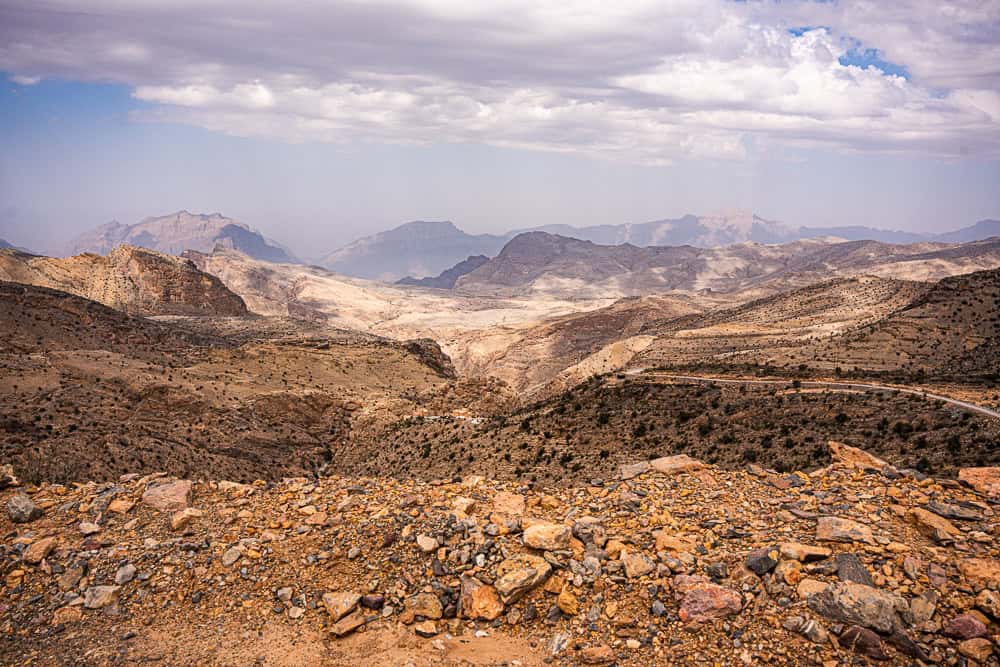
The Suwgra is located in the heart of Jabal Akhdar, Oman’s second-highest mountain, in the Al Hajar range. The village takes its name from a local tree once abundant, whose wood was used to build homes and ceilings. For five centuries, residents carved their dwellings into the limestone terraces, using olive, walnut, and juniper for building elements.
In the 1970s, Oman began modernizing. A road arrived in 2004, electricity in 2007. In 2014, the last family left the ancestral village to settle on the other side of the valley, in a modern village with running water and easy access. The Suwgra could have fallen into ruin, like so many other abandoned villages in Jabal Akhdar.
But the Al Sheriqi family, descendants of the original residents, refused to let this heritage disappear. In 2015, they began renovations. In 2016, the inn opened with two rooms. Today, it has eleven rooms, including several family suites, all restored with local materials and the utmost respect for traditional architecture.
The traditional architecture of The Suwgra, perfectly integrated into the Jabal Akhdar cliff face.
To access Jabal Akhdar, a 4×4 vehicle is mandatory. A Royal Oman Police checkpoint at the foot of the mountain systematically checks vehicles. Any car that is not a 4×4 is turned back. The last 4.5 km to reach the village are along a track carved into the rock, with impressive drop-offs. Use caution and be prepared to yield to oncoming vehicles.
When the village appears on the right, beneath the rocky overhangs, it is a visual shock. Alexandra and Arthur pressed their noses to the window. We parked in the designated lot on the cliff edge, on the other side of the canyon.
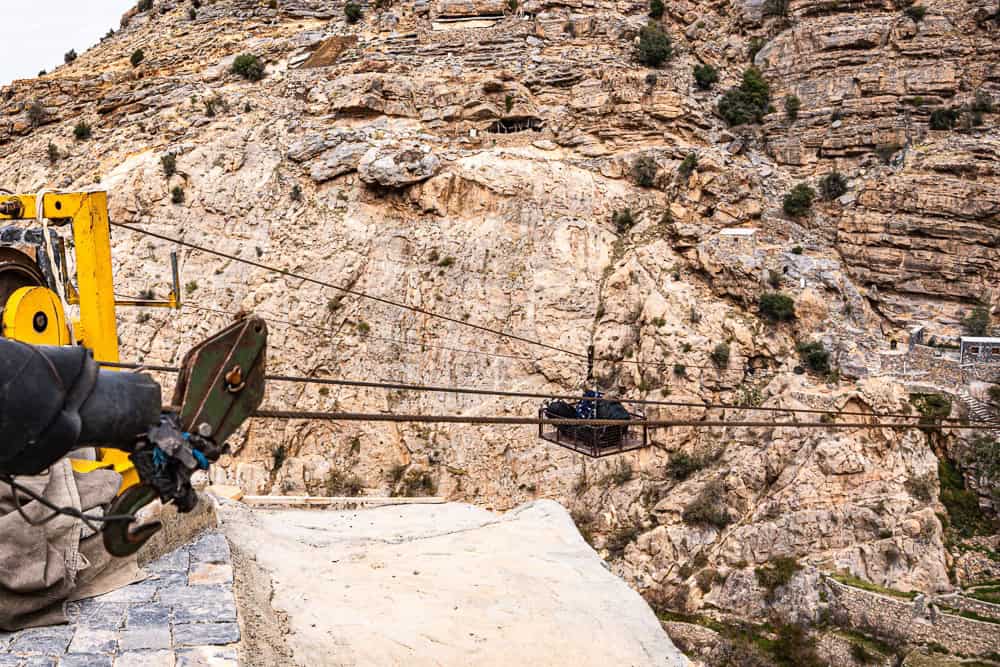
And then, the first surprise: luggage crosses the canyon by zip line. Not the travellers. Our suitcases flew over the void while we descended hundreds of stone-carved steps. Good to know: the descent is beautiful but demanding, and the climb back up to the start even more so.
Access to the village: marked road, steep path, suspension bridge, and a plunging view over the canyon.
At the bottom, a wooden bridge spans the riverbed. In winter, it is the only safe crossing when the water is flowing. We crossed, caught our breath, took a photo, then climbed the other side up to the village reception.
At reception, Hilal welcomed us with Omani cardamom coffee, fresh dates, and freshly pressed pomegranate juice. He told us that as a child, he was one of the students transported by helicopter from the village to the school in Nizwa, down below. He laughed, saying it was not as “VIP” as it looked.
The entire extended family runs the inn. They cook meals in the modern village, make the furniture, and guide hikes. Everything is handmade, with an attention to detail you can feel in every corner.
We had booked a family suite, perfect for four. Earthen architecture, a ceiling of woven branches, Arabic rugs on the floor, a hand-carved wooden door. In some rooms, the rock face serves as a wall. It is raw, authentic, and incredibly warm.
The various rooms and suites at The Suwgra, restored in keeping with traditional Omani architecture.
The bathroom is private and has hot water. For the shower, we discovered a space carved into volcanic stone: rustic, but very clean and functional. A carved stone sink, modern fixtures. Authenticity does not come at the expense of comfort.
The bathroom areas and kitchenette: volcanic-stone shower, carved sink, and a kitchen built into the rock.
It may seem contradictory, but it works. The rooms have electrical outlets, fans, an electric kettle, tea, and coffee. Wi-Fi arrived in 2017 and works in all rooms, which reassured our children.
Breakfast and dinner are included in the rate. Lunch can be added on request. All food is prepared fresh in the modern village on the other side of the valley, then transported by zip line. That says it all.
In the evening, we shared a traditional dinner: spiced grilled meats (mishkak cooked over a wood fire), fragrant rice, fresh Omani bread, seasonal vegetables, followed by a homemade sponge cake. It was peak pomegranate season, and the juice pressed from the garden alone was worth the trip.
Traditional Omani cuisine served at The Suwgra: spice-filled dinner, local breakfast, and tea service.
In the morning, we discovered a generous buffet: Arabic-style scrambled eggs (shakshuka), Omani pancakes, foul medames (stewed fava beans), fresh bread, honey, local cheese. And of course, pomegranate juice pressed in front of us. Alexandra loved the pancakes; Arthur asked for more honey three times.
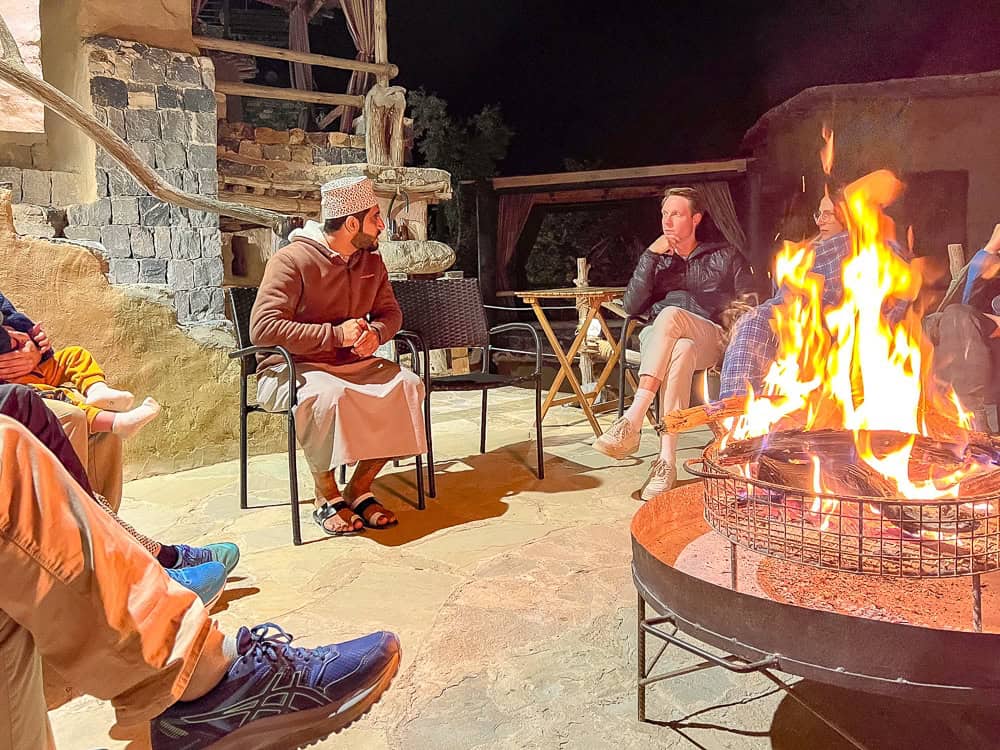
Meals are served on the restaurant’s panoramic terrace or around the fire, depending on the weather. Hosts encourage travellers to connect: before dinner, everyone gathers to hear the village’s story. Magic. We spoke with an Emirati couple and a British family. Alexandra and Arthur ended up playing cards with other children while we enjoyed our mint tea.
Dining areas at The Suwgra, indoors and on the terrace, with mountain views.
The heart of The Suwgra is Anat Café, perched just above the entrance. That is where we spent much of the afternoon, sipping espresso while watching Alexandra and Arthur explore the paved alleys (under our supervision, of course). The café is also open to day visitors, not only inn guests.
Common areas: traditional lounges, shaded terraces, an inner courtyard with a centuries-old olive tree.
The decorative elements tell a story all on their own. Mosaic lanterns, hanging pottery, finely carved old doors. The walls are sometimes raw rock, sometimes hand-smoothed earth. Everything reflects patient craftsmanship and a love of detail.
Omani craftsmanship in the spotlight: mosaic lanterns, carved doors, traditional pottery.
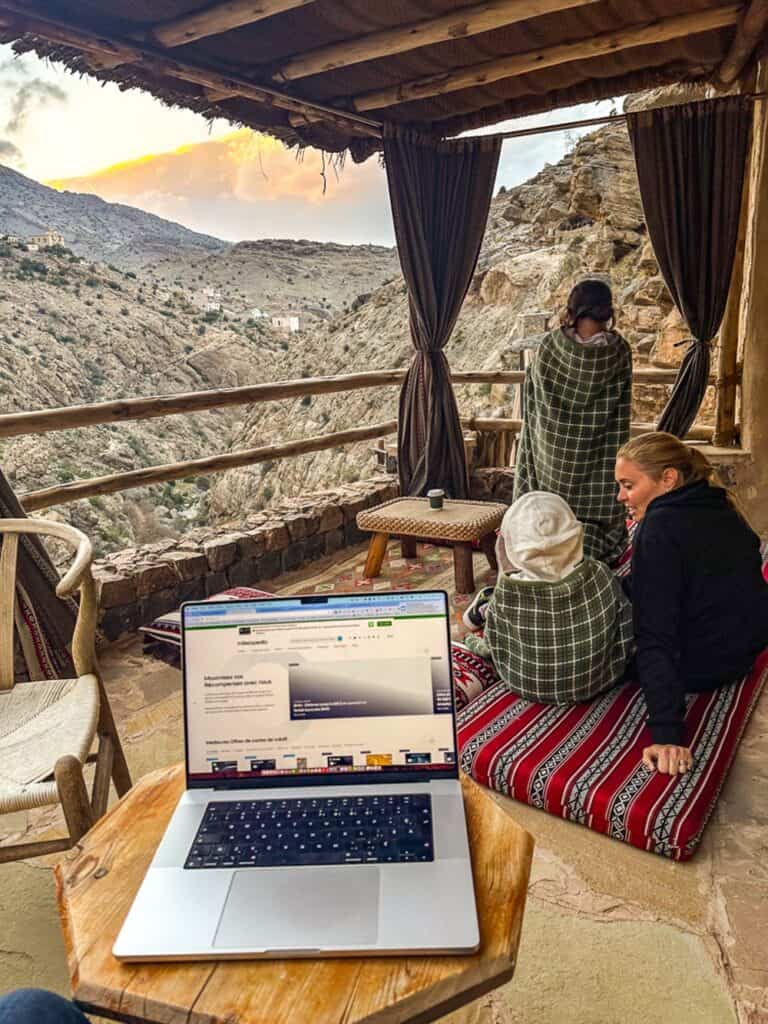
The Suwgra is built in successive terraces along the cliffside. Every corner of the village offers a different viewpoint over the valley, the canyon below, the modern village opposite, and the mountain ranges stretching to the horizon. Sunset is, without question, the magical moment of the day. Golden light slowly slides across the rock faces and everything turns orange.
Spectacular panoramas over Jabal Akhdar, from The Suwgra’s terraces and viewpoints.
In the morning, we watched swallows skim low over the rooftops, goats hop down the rocks, and daylight slowly climb up the valley. Jean-Maximilien had to pull me off my terrace by force for lunch.
The village offers many activities, arranged directly with the Al Sheriqi family. Here is what is available depending on the season:
With Alexandra and Arthur, we chose the hike to the summit. One hour of climbing, lots of breaks, goats that made them laugh, and a view worth every step. At the top, we sat under a tree and shared a pomegranate. It was one of the most beautiful moments of the trip.
Families are welcome, but with a few precautions. Hosts ask that children be closely supervised, both for the tranquillity of the place and for their safety. The village has many uneven steps, balconies without continuous guardrails, and nearby cliffs.
The village is about a 2.5-hour drive from Muscat. Once on the Saiq Plateau (2,000 m elevation), take Birkat al Mauz Road, then turn right after the dusitD2 Resort. After 5 km, follow the “The Suwgra” signs. The last 4.5 km are on a dirt track—caution required.
| Practical information | Detail |
|---|---|
| Location | Jabal Akhdar, Saiq Plateau, Oman |
| Distance from Muscat | About a 2.5-hour drive |
| Required vehicle | 4×4 required (police checkpoint at the foot of the mountain) |
| Number of rooms | 11 rooms and suites |
| Meals included | Breakfast and dinner (lunch on request) |
| Wifi | Available in rooms |
| Day visit | 9 AM to 4 PM, 1 OMR per person or 5 OMR for a family (up to 10 people) |
| Booking | Official website, phone, email, or Booking.com |
I will be honest: before this stay, I had a few concerns. Travelling with two children to a cliffside village, with no cable car for passengers, no alcohol, and strict rules could have been challenging. And in the end, it became one of our most beautiful family memories.
What moved me was the authenticity. Nothing is staged. The Al Sheriqi family truly lives this place and truly carries it in their hearts. Hilal told us about his childhood the way you tell a story to your own grandchildren. Dinner under the stars with other travellers, pomegranate juice pressed in the morning, the total silence of the night in the mountains—these are moments you cannot order; you can only receive them.
As we were leaving, Alexandra said: “Mom, can we come back?” Arthur held the little stone he picked up at the summit tight against him the whole way back. I think that sums it up.
The Suwgra is not a hotel; it is an encounter. With a place, with a family, with another way of living. Tomorrow, everything could stop—and that is why you should go now.
– Audrey Voisine
Yes, without hesitation—but only if you enjoy simplicity and a genuine change of scenery. The Suwgra is not a palace, does not offer a spa, and does not serve cocktails by the pool. What it offers is elsewhere: an immersion in authentic Oman, spectacular nature, and hospitality that comes from the heart.
If you are planning a stay in Oman, I strongly recommend dedicating at least one night to it. For a family with children old enough to walk (from about age 5–6), it is a formative experience. And if you are travelling as a couple or solo, you will find a rare sense of calm and authenticity.
To plan this type of trip, feel free to consult our Best credit cards page and our travel credit cards category to optimize your points and save on flights and hotels. For us, that is what allowed us to extend our stay in Oman.
on Scotiabank's website
The Suwgra is located on the Saiq Plateau, in Jabal Akhdar, Oman. It is a 500-year-old village carved into a cliffside in the Al Hajar range, about a 2.5-hour drive from Muscat. The elevation reaches nearly 2,000 meters.
Yes, it is mandatory. A Royal Oman Police checkpoint at the foot of the mountain denies access to vehicles that are not 4x4s. The road is paved up to the plateau, but the last 4.5 km are a narrow dirt track with steep drop-offs.
Yes. The village is open to day visitors between 9 AM and 4 PM. Admission costs 1 OMR per person or 5 OMR for a family group of up to 10 people. You can also have a coffee at Anat Café and enjoy the view without a reservation.
Yes, but with children old enough to walk independently (from about age 5–6). There are many uneven steps, and some balconies open directly onto the void. Several family suites comfortably accommodate two to six people. With babies or toddlers, I do not recommend it.
Breakfast and dinner are included in the room rate. Lunch can be added on request. All food is cooked fresh in the modern village across the way, then transported by zip line to the historic village.
Yes to both. Wi-Fi arrived in 2017 and works throughout the inn. Each room has electrical outlets, fans, an electric kettle, and tea/coffee. Private bathrooms have hot water.
Two seasons stand out. From March to mid-April is the Damask rose bloom: villages turn pink and fragrant. From July to late September is pomegranate season, with festivals and harvests. Winter (December–February) is cooler but offers spectacular sunsets.
You can book directly on The Suwgra’s official website, by phone, or by email. The property is also available on Booking.com, which may interest travellers who are members of the Genius program. To learn more, see our guide How does Genius, Booking.com’s loyalty program, work.
The Al Sheriqi family offers several guided hikes, including the Three Villages Walk, the summit climb (1 hour), the hike to Al Wakan (10 hours), and the Hidden Lakes Trail. Depending on the season, you can also take part in rose picking, pomegranate harvesting, or watch the traditional preparation of Shuwa.
on American Express's website
Apply with confidenceCheck whether your application will be approved before you submit it, with no impact on your credit score*When you apply for a personal American Express Credit Card, we will tell you whether you are eligible without affecting your credit score. So you can apply with confidence.*Instant decisions are only available for consumer Card applications (also called “personal Cards”).
Our reviews and rankings are based on an objective assessment. Advertisers do not influence our content. We may receive compensation through some links; our analysis and opinions remain independent.