Airbus A321XLR: Air Canada Receives Its First Aircraft

Loading article…
On April 24, 2026, Air Canada took delivery in Hamburg of its very first Airbus A321XLR, registered as C-GXLR. It is the first of an order for 30 aircraft—and, above all, the first narrow-body in the carrier’s history to offer fully lie-flat seats in Signature Class. For Canadian travellers, this makes direct transatlantic flights possible to European cities that were previously too costly to serve, with a premium product that until now was reserved for wide-body aircraft.
To ensure you don’t miss any news about the national carrier and Aeroplan updates, sign up for our newsletter. To compare the best Aeroplan credit cards, click here.
| Credit card | Annual fee | Welcome offer | |
|---|---|---|---|
| $599 | |||
| $599 | |||
| $599 |
The delivered aircraft, registered as C-GXLR and leased from SMBC Aviation Capital, is the first of a total order of 30 A321XLRs. Fifteen aircraft are being leased, and fifteen others are being acquired directly from Airbus S.A.S. Air Canada thus becomes the only Canadian carrier to operate this next-generation narrow-body aircraft.
Mark Galardo, Executive Vice President and Revenue and Network Planning Officer at Air Canada, presents the arrival of the aircraft as a decisive turning point. The A321XLR aims to significantly strengthen the carrier’s ability to launch new international routes and improve its offering in existing markets.
Equipped with Pratt & Whitney GTF engines, the A321XLR (Extra Long Range) is the extended-range version of the A320neo family. It combines the efficiency of a narrow-body aircraft with a range that allows it to operate transatlantic flights, a segment historically reserved for wide-body aircraft. This versatility makes it a pivotal aircraft in Air Canada’s strategy.
The arrival of the A321XLR coincides with the launch of Air Canada’s new cabin standard, named « Warm Welcome. » The finish of the materials was designed to be inspired by Canadian landscapes. Note: this same next-generation cabin will be gradually equipped on other aircraft in the fleet.
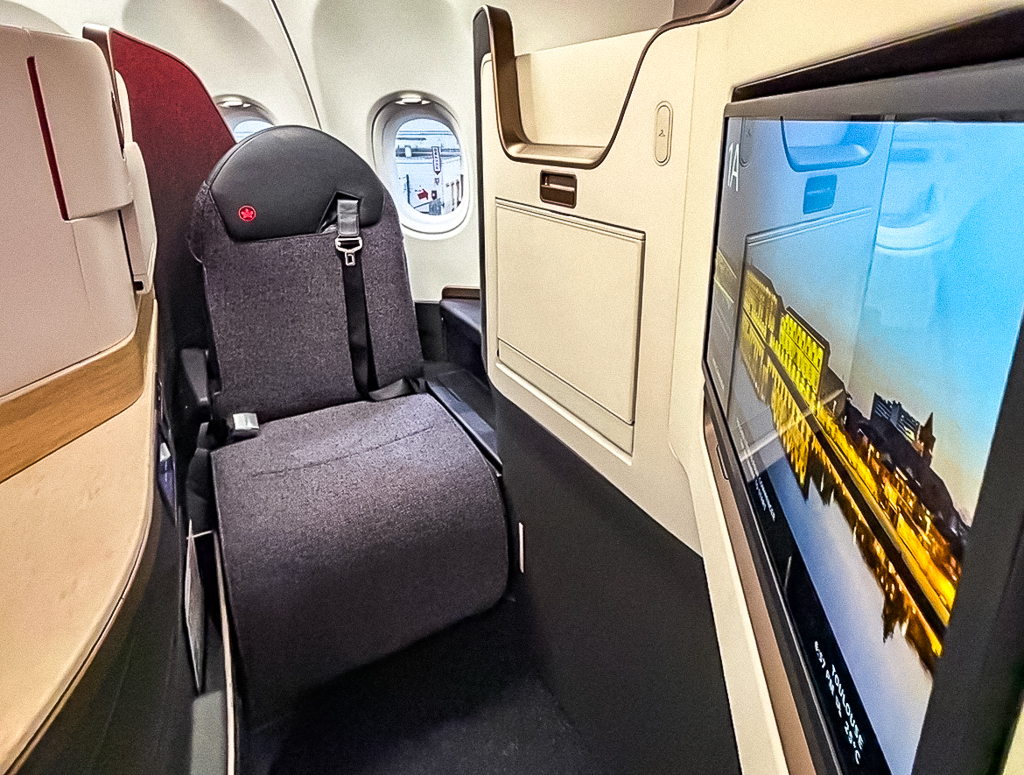
The full configuration totals 182 seats, including 14 lie-flat Signature seats in a 1-1 layout (direct aisle access for every seat) and 168 economy-class seats.
To learn more about this new cabin approach, you can consult our article on Air Canada’s new next-generation cabins.
This is a first for Air Canada: 14 fully reclining (lie-flat) seats in Signature Class on board a narrow-body aircraft. No other Canadian carrier offers this product on this type of aircraft. For travelers accustomed to wide-body aircraft, this means being able to enjoy a lie-flat seat on transatlantic or transcontinental flights, regardless of the size of the plane.
The A321XLR’s economy cabin features 168 seats, and this is where Air Canada has focused the bulk of its redesign, as it’s the class most travelers will occupy. The seats have been completely redesigned to offer a bit more personal space, with an integrated tablet holder and larger overhead bins. The idea behind the Warm Welcome standard: bringing the economy experience closer to the comfort usually associated with wide-body aircraft, even on a narrow-body.
A small detail that sets the tone right from boarding: a backlit maple leaf canopy greets passengers at the cabin entrance. This is the visual signature of Air Canada’s new Warm Welcome approach, designed to set a distinctly Canadian tone even before takeoff.
Beyond the cabin itself, Air Canada has revamped all the onboard technology. These amenities are available at every seat, in both Economy and Signature Class:
Air Canada’s fleet includes several types of aircraft. To fully understand the contribution of the A321XLR, it must be situated in relation to the carrier’s other planes, particularly on transatlantic and transcontinental routes.
| Aircraft | Type | Primary Use | Class with Lie-Flat Seat |
|---|---|---|---|
| A321XLR | Narrow-body | Transatlantic and Transcontinental | Yes (14 Signature seats) |
| A220 | Narrow-body | Regional and Transcontinental | No |
| 737 MAX | Narrow-body | Domestic and U.S. (transfer to Air Canada Rouge in 2026) | No |
| 787 Dreamliner | Wide-body | International Long-Haul | Yes |
| 777-200LR | Wide-body | International Long-Haul (Flagship) | Yes |
| A330 | Wide-body | Transatlantic | Yes |
The A321XLR fills a very specific niche. On transatlantic routes with moderate demand, deploying a wide-body aircraft like the 787 or A330 can be costly and risky for load factors. Conversely, older narrow-body aircraft did not have sufficient range. With the A321XLR, Air Canada can now open seasonal or secondary routes to Europe without mobilizing a wide-body aircraft.
Unlike the April delivery, when destinations still had to be confirmed, Air Canada has since clarified its deployment plan. The aircraft will find its footing on the domestic network before taking on transatlantic service this summer.
European destinations announced: Toulouse, Berlin, Nantes, and Edinburgh, departing from Montreal and Toronto for summer 2026.
For winter sun, the A321XLR also inaugurates the first direct link between North America and the Canary Islands: flights to Tenerife from Montreal and Toronto, from late October 2026 to late April 2027.
These routes confirm the aircraft’s logic: connecting Montreal and Toronto to European cities that wide-body aircraft could not serve profitably.
For Aeroplan members aiming for Elite status in 2026, the arrival of the A321XLR opens up new eligible flight options. Consult our guide to reaching Aeroplan Elite status with Air Canada flights.
The A321XLR is just one piece of the puzzle. Air Canada is pursuing a multi-year modernization program for its aircraft fleet. Several orders are currently being delivered or planned for the short and medium term.
This modernization is also accompanied by new features on the ground. Air Canada notably announced the opening of new Air Canada Cafés in Montreal and Vancouver, which enhance the experience for travelers connecting or waiting for a flight.
The arrival of the Airbus A321XLR in Air Canada’s fleet is an important milestone. This next-generation narrow-body aircraft will allow the carrier to expand its transatlantic and transcontinental network while improving the onboard experience. For travelers, this potentially means new direct destinations from Montreal and Toronto, as well as an unprecedented Signature product on a narrow-body aircraft.
We will closely follow the official announcement of the first commercial routes operated with the A321XLR. I strongly recommend keeping an eye on Aeroplan searches in the coming months to identify the new routes accessible with this aircraft.
| Credit card | Annual fee | Welcome offer | |
|---|---|---|---|
| $599 | |||
| $599 | |||
| $599 |
Air Canada took delivery of its first Airbus A321XLR in Hamburg on April 24, 2026. The aircraft, registered as C-GXLR, is leased from SMBC Aviation Capital.
Air Canada plans to integrate 30 A321XLR aircraft into its fleet over the coming years: 15 leased and 15 acquired directly from Airbus S.A.S.
The aircraft offers 14 fully reclining seats in Air Canada Signature Class. This is a first for the carrier on a narrow-body aircraft, and it is the only one in Canada to offer this product on this type of aircraft.
According to Air Canada’s press release, the A321XLR will soon be put into service on transatlantic routes departing from Montreal and Toronto, and will become a pillar of the main North American transcontinental markets. The full list of destinations has not yet been revealed.
Yes. Fast Wi-Fi is free for Aeroplan members on board the A321XLR. The cabin also offers a power outlet at every seat, larger screens, and Bluetooth connectivity.
In addition to the A321XLR, Air Canada is awaiting 8 A350-1000s (deliveries starting in 2030), 14 Boeing 787-10 Dreamliners, and 23 remaining Airbus A220s from an order of 65. Five additional leased Boeing 737 MAX aircraft entered service in 2026.
The A321XLR is designed for long-haul routes. Its extended range allows it to provide direct transatlantic flights, which distinguishes it from other narrow-body aircraft in Air Canada’s fleet, such as the A220 and the 737 MAX, which are more confined to regional and continental routes.
on TD's website
Our reviews and rankings are based on an objective assessment. Advertisers do not influence our content. We may receive compensation through some links; our analysis and opinions remain independent.