eSIM vs Roaming: Which is Really Cheaper in 2026?

Loading article…
If you’re starting to plan your next trip abroad, you’ve likely got a list of things you want to see, activities you want to try, food you want to eat, and a whole bunch of things you need to do before you can actually depart.
It’s also likely that one of the to-do items on your list is figuring out the best way to access data and use your mobile device while you’re away.
Luckily for you and other travellers, there are many different ways to stay connected while abroad, from roaming to mobile travel plans to eSIMs from providers like Saily, Airalo, and Holafly, connecting a compatible device to networks around the world now takes just a few minutes.
That said, with all these options, you may be left wondering about which one is actually best for you and which one is really cheaper in 2026?
To help you answer this question, in this article, we’ll settle the eSIM vs roaming debate by comparing the costs of roaming/travel plans against eSIMs, and we’ll weigh the pros and cons of each option to see which is better for your budget and your travel style. While you’re sorting out your trip, it’s also worth a look at our roundup of the best credit cards in Canada to cover your travel spending.

Before we really dig into our comparison of whether eSIMs or roaming/travel plans are the better choice for your next trip abroad, let’s make sure that we understand what each of these options entails.
On one side of our comparison, we have eSIMs. These entirely digital SIM cards can be easily purchased from reputable online vendors like Saily, Airalo, and Holafly, providing you with stable internet access in most countries around the world.
eSIMs use software that comes preinstalled on your compatible device, and they’re easily installed before you head out, letting you connect to local networks as soon as you arrive at your destination.
We’ve written a complete guide that explains everything there is to know about eSIMs, so we recommend you check that out if you’d like to better understand this technology. If you want to compare the main providers side by side, our guide to the best eSIM providers breaks down their plans and prices.
Compare available eSIM plans for your destination, trip length and data needs with our eSIM comparison tool.
On the other side of our comparison, we’re looking at the cost for using your home data plan while travelling, also known as “roaming.”
The term “roaming” comes from the way your mobile device searches for an available network when you turn it on while it’s away from your home network’s area of coverage. In essence your mobile device is roaming through the airwaves looking for a signal.
In the past, before travel plans became more common, roaming fees were always pay-per-use and incredibly expensive, and this, unfortunately, caused many travellers to receive shockingly large phone bills when they returned home.
Thankfully, with mobile device usage now a more constant part of our lives than it was in the past, mobile service providers (e.g., Bell, Rogers, Telus, Vidéotron) have expanded their travel offerings, letting you pay a much more reasonable fee to use your regular service plan while visiting another part of the world. While these plans are still “roaming,” they are based on agreements between your home provider and the international networks that keep the costs lower.
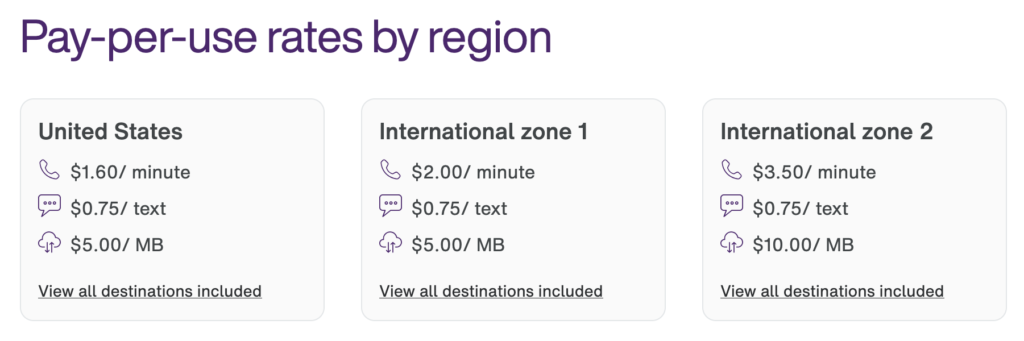
That said, it’s important to note that if you turn your device on when you don’t have an eSIM or travel plan in place, the very expensive pay-per-use roaming costs can still be charged. For example, the image below shows the fees that Telus charges for its pay-per-use roaming:
At this time, pretty much all mobile service providers offer some sort of roaming travel package to their customers, though the details and prices vary widely between the different companies.
For this article, we’ll focus our comparison on Canada’s 4 biggest mobile providers, Bell, Rogers, Telus, and Vidéotron, which each offer daily roaming plans and roaming packages for specific lengths of time. We’re also going to add in a comparison with Fizz Mobile, a budget-friendly carrier, to illustrate the range of options.
If you’d like to find out more about your provider’s travel connectivity options, you should be able to find this information easily by navigating to the “mobility” or “plans” section on their website.
To see how the prices compare between eSIMs and roaming/travel plans, we’ll look at 3 sample trips of different lengths in different parts of the world. For each example, we’ve aimed to select the cheapest plan that fits the trip’s length of time regardless of how much data is provided.
Within the trip examples, we’re comparing Saily’s eSIM options with the roaming/travel plans on offer from Bell, Rogers, Telus, Vidéotron, and Fizz Mobile.
As we mentioned earlier, each of these mobile providers offers different packages at varying prices. To give you some context around what’s available, here’s a brief overview of some of the options offered by our contenders:
It’s worth noting that some of the mobile service providers also offer monthly plans that let you use your phone in countries beyond Canada; however, for this comparison we’re focusing on the short-term, temporary travel plan options.
Now let’s dive into our trip examples to see which of these providers offers the cheapest option.
For our first trip example, let’s imagine you’re heading to Mexico for a 7 day trip. Regardless of whether you’re taking a family vacation to the Yucatan Peninsula or heading to Guadalajara, Mexico City, or Monterrey to explore and take in the World Cup energy, let’s see how much it could cost to stay connected with your mobile device:
From this comparison, we can see that the cost to stay connected for 7 days in Mexico ranges from about $4 with Fizz Mobile to roughly $100 with Vidéotron.
In this case, unless you’re a Fizz Mobile customer, the cheapest option is the Saily eSIM, offering 1 GB for around $7, with the option to add more data as needed.

Our next comparison looks at the cost to stay connected while you travel around the European continent, through multiple countries, over the course of one month:
Once again, we see that the Saily eSIM is the cheapest option, providing 3 GB for around $17. This is compared to the next cheapest option, which is Telus’ 30-day Europe travel pass for $60. Further up the pricing ladder, Bell charges $90 and Rogers $120 for a 30-day pass.

For our final trip comparison, we’re looking at the cost to stay connected over a 3-month adventure through Asia. In this example, we’re assuming that you’re travelling around multiple Asian regions, so you’ll need to have access to an international data plan:
For this longer trip, we once again see that the Saily eSIM is the most affordable way to go, giving you international data for over 3 months for only around $80.
Comparatively, unless you sign up for an international monthly plan with your at-home mobile service provider, the next cheapest option is around $270 with Bell’s 30-day Asia travel pass.

As you can see in the comparisons above, getting an eSIM from a reputable vendor like Saily is notably cheaper than even the most affordable travel plans from Canada’s top mobile service providers.
Here’s how the three sample trips stack up, comparing the cheapest Saily eSIM against the cheapest carrier travel plan:
| Trip | Cheapest eSIM (Saily) | Cheapest roaming travel plan | Difference |
|---|---|---|---|
| 7 days in Mexico | ~$7 (1 GB) | $60 (Telus 7-day pass) | ~$53 |
| 1 month in Europe | ~$17 (3 GB) | $60 (Telus 30-day pass) | ~$43 |
| 3 months across Asia | ~$80 (10 GB) | $270 (Bell Asia pass) | ~$190 |
That said, there are other factors beyond price that are worth considering when you’re planning how to stay connected on your trip. While eSIMs offer the most accessible pricing, are simple to install, activate, and maintain, and connect automatically once you arrive, there are a couple of reasons why it may be worth paying more and choosing a travel plan/roaming instead.
First, travel plans/roaming let you keep your home number for calls and text, so while travelling you can use your device the same way you do at home. Comparatively, Saily eSIMs only provide data access, so you’re not able to make/receive calls or use non-data texting services.
Additionally, choosing a travel plan/roaming also makes it easier to maintain access to things like banking or any other system that wants to text you a code for two-factor authentication since you still have the usual access to your calling and texting abilities. Unfortunately, with most eSIMs, this type of task becomes considerably more difficult.
As you can see, depending on where you’re travelling to, how long you’re travelling for, and what services you want to be able to access while you’re away, the cheapest plan might not end up being the best plan for you.
Whether you’re heading across the border to the US or across the ocean to North Africa and the Maghreb region, you’ll want to consider your personal priorities when it comes to how you want to use your device while travelling and then see what makes sense in terms of balancing price and convenience. For more travel tips and the latest deals, you can also sign up for our newsletter.
Staying connected while travelling is a high priority for most of us these days, and conveniently this is now easier and more affordable than ever before.
If you’re looking for the cheapest option to keep your travel costs low, eSIMs from a provider like Saily, offer easy, steady connectivity around the world for the lowest available prices.
That said, depending on your priorities around having your home phone number and texting capabilities at your destination, roaming with a travel plan from your home service provider may be the best option for you, despite the higher cost.
Ultimately, it’s best to consider how you prefer to travel and stay in touch, and balance these desires with the potential costs. Additionally, before you head out on your trip, you may also want to consider a VPN to protect your data and to make it easy to keep up with your favourite TV show while you’re travelling.
An eSIM is a digital SIM card that uses your compatible device’s preinstalled software to provide you with access to data while you travel.
You can easily purchase an eSIM online, install it onto your device, and activate it before you leave for your trip. This will give you access to the local network(s) in the destination you are visiting.
Signing up for a travel plan with your mobile service provider is usually pretty easy. While the process with each provider may be slightly different, you can expect the steps to be something like:
In most cases, yes. In our comparison, a Saily eSIM for 7 days in Mexico cost around $7, while the cheapest carrier travel plan ran $60. For a month in Europe, the gap was roughly $17 versus $60. The savings grow on longer trips, though a travel plan can still be worth the higher cost if you need to keep your home number.
Usually not. Most travel eSIMs, including Saily, are data-only, so you cannot make or receive calls and texts on your usual number. A few providers offer a local number in select countries, but it is not your home number. If keeping your number matters, a carrier travel plan or roaming is the better fit.
No. Your device needs to be eSIM-compatible and unlocked. Most recent iPhones, Google Pixels, and Samsung Galaxy models support eSIMs, but many older or budget phones do not. Before you buy a plan, check your phone’s settings or the manufacturer’s website to confirm that it supports eSIMs.
If you switch on your phone abroad without an eSIM or a travel plan in place, your device can connect to a local network and trigger pay-per-use roaming charges. These rates are much higher than any travel plan, so they can lead to a large bill. To avoid this, set up an eSIM or add a travel plan before you leave, or turn off data roaming until you do.
on BMO's website
Our reviews and rankings are based on an objective assessment. Advertisers do not influence our content. We may receive compensation through some links; our analysis and opinions remain independent.