

Insurance: The Best Credit Cards for Travel Insurance When Using Rewards Points
- Credit Card Insurance

Credit cards with travel insurance are a major advantage. If the coverage fits the traveller’s needs, it can even save you from buying separate insurance. On top of the rewards or points they earn, these cards offer complete protection: travel insurance, trip cancellation insurance, purchase protection, car rental coverage, and more.
Credit card travel insurance
When you received your credit card, you probably also got your insurance coverage booklet. If not, it’s easy to find on your financial institution’s website.
Ideally, you should refer to your insurance booklet before deciding to use this card to book your trip. Every credit card has different coverage tied to:
- The cardholder’s age
- The people covered and the destinations visited
- The length of coverage and time spent outside your province
- The type and cost of the rental car
- The number of hours of flight and baggage delay
One of the most important sections covers the eligibility of the trip, if you decide to pay for your trip with points.
That’s where you’ll find the conditions that apply to most of your card’s insurance coverages.
Different conditions for applying travel insurance coverage
Some cards will require that:
- 75% or 100% of the trip be paid with the credit card
If the entire trip must be charged to the credit card, you won’t be able to use reward points to be covered.
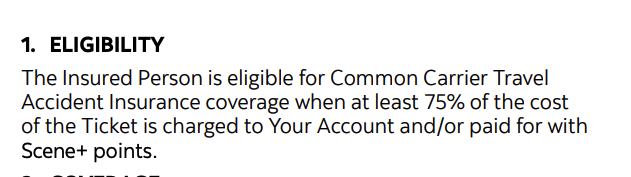
The minimum amount required can also be 75%, as with the Scotiabank Passport™ Visa Infinite +* Card. To be covered by its public transportation accident insurance, you must have paid at least 75% of your ticket price with:
- Your credit card;
- Or your Scene+ points;
- Or a combination of both.
So if your ticket costs $100, you must have paid at least $75 with your card or your points for the insurance to apply.

- Annual fee
- $150
- Our valuation
- $350Milesopedia first-year estimate First-year valueWelcome bonus$350Total$350Rewards on your spending are not included. The calculator that adds them from your own profile is on the card's page.
- Milesopedia first-year estimateFirst-year valueWelcome bonus$350Total$350Rewards on your spending are not included. The calculator that adds them from your own profile is on the card's page.
- Welcome offer
- Up to 35,000 points
- Ends Nov 1, 2026
on Scotiabank's website
A credit card’s travel insurance may allow points from the card’s linked rewards program to be used to pay for the trip. That’s the case, for example, with the American Express Gold Rewards Card: the insurance is valid if:
- Membership Rewards points were used to pay for the trip;
- The trip was paid in cash with the credit card;
- The trip was paid with a combination of cash + Membership Rewards points.
But you won’t have insurance if you used a program other than Membership Rewards, such as Aeroplan, Scene+ or AIR MILES. American Express clearly encourages cardholders to use its own program.

- Annual fee
- $250
- Our valuation
- $1,020Milesopedia first-year estimate First-year valueWelcome bonus$1,020Total$1,020Rewards on your spending are not included. The calculator that adds them from your own profile is on the card's page.
- Milesopedia first-year estimateFirst-year valueWelcome bonus$1,020Total$1,020Rewards on your spending are not included. The calculator that adds them from your own profile is on the card's page.
- Welcome offer
- Up to 60,000 points
on American Express's website
Apply with confidence — no impact on your credit scoreApply with confidenceCheck whether your application will be approved before you submit it, with no impact on your credit score*When you apply for a personal American Express Credit Card, we will tell you whether you are eligible without affecting your credit score. So you can apply with confidence.*Instant decisions are only available for consumer Card applications (also called “personal Cards”).
Other cards will only require that part of the trip be paid with the credit card. The « partial » cost of a ticket can be paid with another type of points or miles.
For example, here is the insurance certificate for the National Bank World Elite Mastercard, for trip cancellation and interruption insurance:
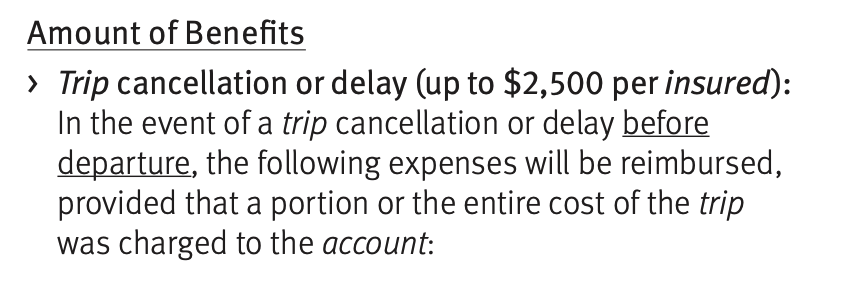
It is very important to read and understand your credit card’s insurance certificate. If you’re unsure, contact your card’s customer service.
A single card can have different eligibility criteria for different coverages. These are nuances that can have major consequences if something goes wrong.

- Annual fee
- $0 $150No annual fee the first year
- No annual fee the first year
- Our valuation
- $150Milesopedia first-year estimate First-year valueAnnual fee rebated$150Total$150Rewards on your spending are not included. The calculator that adds them from your own profile is on the card's page.
- Milesopedia first-year estimateFirst-year valueAnnual fee rebated$150Total$150Rewards on your spending are not included. The calculator that adds them from your own profile is on the card's page.
- Welcome offer
- First Year Annual Fee Rebate
- $150 annual fee rebated
- Ends Nov 4, 2026
on National Bank's website
General rule: using a card linked to a program
As a general rule, we recommend paying for your trip with:
- An AIR MILES credit card to cover a trip for which you used AIR MILES miles
- An AEROPLAN credit card to cover a trip for which you used AEROPLAN points
- A Membership Rewards credit card to cover a trip for which you used American Express Membership Rewards points
- and so on for each program
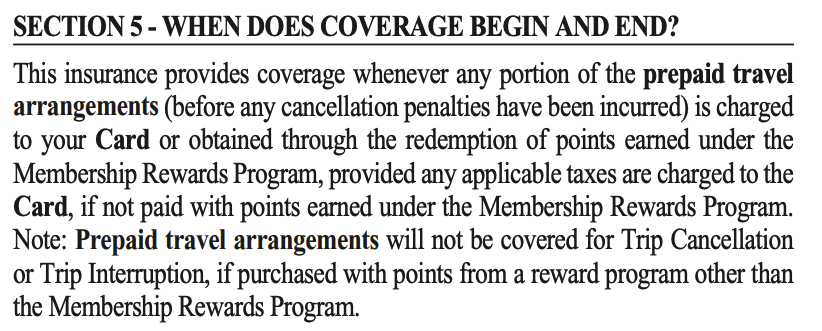
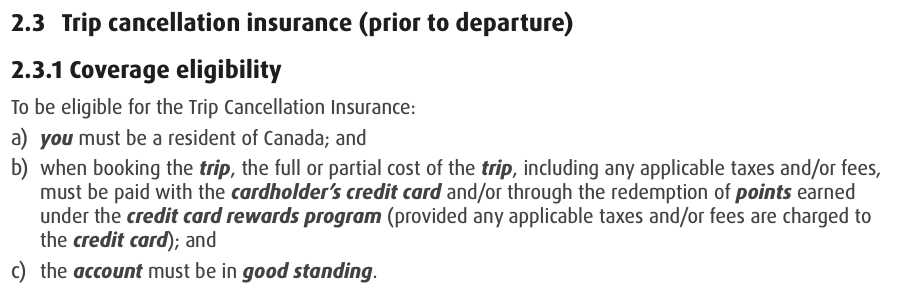
So if you use the BMO AIR MILES World Elite Mastercard, you’ll be covered if a problem arises on a trip paid for with AIR MILES miles. Here is this card’s insurance certificate for buying plane tickets with points from the linked program (here, AIR MILES):
- Annual fee
- $0 $150No annual fee the first year
- No annual fee the first year
- Our valuation
- $820Milesopedia first-year estimate First-year valueWelcome bonus$670Annual fee rebated$150Total$820Rewards on your spending are not included. The calculator that adds them from your own profile is on the card's page.
- Milesopedia first-year estimateFirst-year valueWelcome bonus$670Annual fee rebated$150Total$820Rewards on your spending are not included. The calculator that adds them from your own profile is on the card's page.
- Welcome offer
- Up to 100,000 points
- + First Year Annual Fee Rebate
on BMO's website
Special rule: the cards that cover every situation
Only two credit cards let you be covered even when you pay only part of the trip with them!
That means you can use Aeroplan miles, pay the taxes and surcharges with this type of credit card, and still be covered by your credit card’s insurance!
Two credit cards stand out in Canada:
Both credit cards provide coverage in most circumstances, whether you paid part or all of your trip cost with the card. However, baggage delay insurance requires that the full cost of the plane ticket was purchased with the card. The same applies to car rental insurance.
One major advantage for people aged 65 to 75: emergency medical care insurance outside your province of residence is included, for up to 15 days.
Note that the credit card whose insurance most closely matches the National Bank World Elite Mastercard is the Desjardins Odyssey® World Elite Mastercard. The difference, though, is that the Desjardins card requires the full payment to be charged to the card.
| Credit card | Annual fee | Welcome offer | |
|---|---|---|---|
| $0 | |||
| $115 |
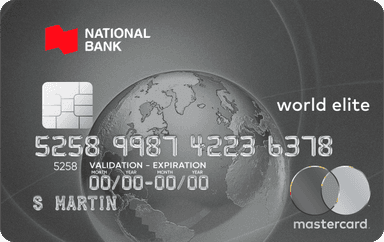
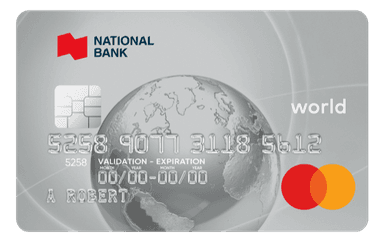
National Bank credit card travel insurance
For most included coverages, the National Bank World Elite Mastercard and the National Bank World Mastercard are among the few credit cards in Canada that cover you even if you charge only part of the trip cost to them.
For travel, only baggage delay and car rental insurance require the full cost to have been charged to the card.
| Insurance | Amounts |
| Emergency medical insurance outside your province of residence | Up to $5,000,000 per person (see details below on age and duration) |
| Trip cancellation (before departure) | Up to $2,500 per insured person |
| Trip interruption (after departure) | Up to $5,000 per insured person |
| Flight delay (more than 4 h) | $500 per insured person |
| Baggage delay (more than 6 h) | Up to $500 per insured person |
| Lost or stolen baggage | Up to $1,000 per insured person |
| Car rental | Vehicle worth up to $65,000 |
| Against theft or damage (180 days) | Up to $60,000 |
| Extended warranty | Up to 2 additional years |
| Medical, general, and legal assistance | Included |
| Insurance booklet |
The National Bank World Elite Mastercard and the National Bank World Mastercard offer emergency medical travel coverage that varies based on:
- The person’s age
- The length of their trip
| Age | Maximum trip length |
| 54 or under | 60 days |
| 55-64 | 31 days |
| 65-75 | 15 days |
| 76 or older | no coverage |
| Credit card | Annual fee | Welcome offer | |
|---|---|---|---|
| $0 | |||
| $115 |
Conclusion
As always, we recommend carefully reading each credit card insurance booklet before making a decision. It is your responsibility to contact your credit card issuer for clarification if you have any doubts.
To go further, check out our guide on what your credit card’s travel insurance really covers. You can also compare all the options in our ranking of the best credit cards and in our selection of the best credit cards for insurance.
Here are the various articles you can read about credit card travel insurance:
| Credit card | Annual fee | Welcome offer | |
|---|---|---|---|
| $0 | |||
| $115 |
Going further with American Express Membership Rewards points
To maximize your Membership Rewards balance, check out our complete guide to the American Express Membership Rewards program and our ranking of the best American Express Membership Rewards credit cards, updated every month by the Milesopedia team.
Finally, to never miss our analyses, sign up for our newsletter.
Credit card travel insurance – Frequently asked questions
Can you be covered by travel insurance when paying with points?
Yes, but it depends on the card. Some require 100% of the trip to be charged to the card, others accept 75%, and a few cover you even if you pay only part with the card. Always check the insurance certificate before booking with your points.
Which credit card covers trips paid for with Aeroplan points?
The National Bank World Elite Mastercard and the National Bank World Mastercard are among the few cards in Canada that cover you even if you charged only part of the trip cost to the card. So you can use Aeroplan points, pay the taxes with the card, and stay covered.
Does emergency medical insurance cover people aged 65 and over?
Often yes, but the duration decreases with age. For example, the National Bank World Elite and World cards cover up to 15 days for those aged 65 to 75, versus 60 days for those 54 and under. At 76 and over, these cards offer no coverage.
What happens if I close my card after booking?
If you close the card you used to book the trip, you lose access to its insurance. No more card, no more insurance. So keep the card at least until the end of your trip.
Do you need travel insurance in addition to your credit card’s?
It depends on your profile. If you travel for a long time, have a pre-existing condition, or are over 76, separate insurance is often necessary. In those cases, compare quotes from SoNomad, which specializes in these situations.
Our featured card
- Annual fee
- $0 $150No annual fee the first year
- No annual fee the first year
- Our valuation
- $150Milesopedia first-year estimate First-year valueAnnual fee rebated$150Total$150Rewards on your spending are not included. The calculator that adds them from your own profile is on the card's page.
- Milesopedia first-year estimateFirst-year valueAnnual fee rebated$150Total$150Rewards on your spending are not included. The calculator that adds them from your own profile is on the card's page.
- Welcome offer
- First Year Annual Fee Rebate
- $150 annual fee rebated
- Ends Nov 4, 2026
on National Bank's website
Our editorial integrity
Our reviews and rankings are based on an objective assessment. Advertisers do not influence our content. We may receive compensation through some links; our analysis and opinions remain independent.