* The potential value of savings and rewards during the first 12 months includes the value of the welcome offer, the potential value of points earned in the first year, the value of savings on foreign currency transaction fees and the cost of airport lounge access as of May 22, 2026:
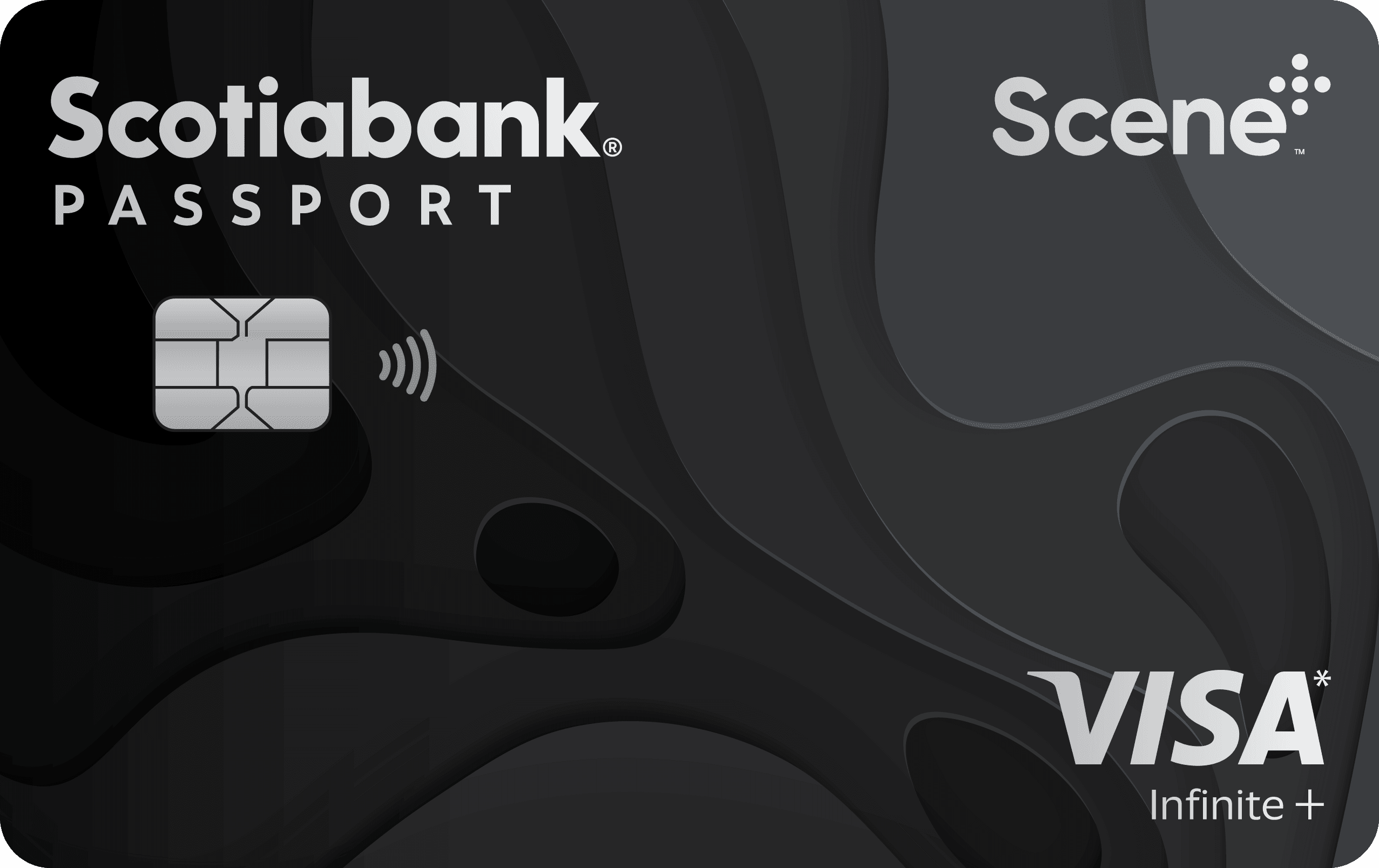
$250 in travel rewards (25,000 bonus Scene+ points) for new Scotiabank Passport® Visa Infinite +* Cardholders who charge $2,000 in purchases to their account within the first three (3) months;
$100 in travel rewards (10,000 bonus Scene+ points) for cardholders who charge $40,000 in purchases to their account;
$50 in savings from the annual fee waiver on the first additional card for new Scotiabank Passport Visa Infinite +* Card credit card account holders;
$132 in savings on foreign currency transaction fees based on the average amount of foreign currency purchases made per active account over the past 24 months (by saving on the 2.5% foreign currency transaction fees typically charged by other credit card issuers);
$364 representing the potential value of points earned in the first year (36,400 Scene+ points) based on the average amount of purchases made per active account over the past 24 months, assuming an average spend of 21% of purchases in categories eligible for accelerated earn rates of 2X and 3X points;
$358 representing the value of complimentary membership in the Visa Airport Companion program which includes 6 airport lounge passes (based on « Preferred » membership valued at approximately $357 CAD/$259 USD). Based on the exchange rate in effect on May 22, 2026.
Maximum potential value after the first year = $1,254 (rounded to $1,250)
The actual value of offers, savings realized and points earned will vary depending on card usage and eligibility for applicable offers. Conditions apply.
1 Offer description and conditions: The 25,000 Scene+ points offer (the « offer ») applies only to new Scotiabank Passport Visa Infinite +* Card credit card accounts (the « accounts ») opened between August 4, 2026 and November 1, 2026 (regardless of the date you apply for the account) subject to the conditions below. The offer may be modified, cancelled or extended at any time without notice, and it cannot be combined with any other offer.
In addition, as a Scotiabank Passport Visa Infinite +* Cardholder, you are eligible for an annual bonus of 10,000 Scene+ points if you charge at least $40,000 in eligible everyday purchases to your Scotiabank Passport Visa Infinite +* Card account over the course of one year. Conditions apply; see below for more details.
Description and conditions of the 25,000 bonus Scene+ points offer: To be eligible for the 25,000 bonus Scene+ points offer (« 25,000 bonus points »), you must charge at least $2,000 in total eligible purchases to your account within the first three months following the account opening date.
Conditions for the annual 10,000 Scene+ points bonus:
As a Scotiabank Passport Visa Infinite +* Card credit cardholder, you can earn an annual bonus of at least 10,000 Scene+ points (the « annual points bonus ») if you charge at least $40,000 in eligible purchases to your account over the course of one year (12-month period). The annual period begins on the account opening date; a new period starts again every twelve months thereafter. If you replace another Scene+-eligible credit card with the Scotiabank Passport Visa Infinite +* Card (i.e., it is not a new card or an additional card), the opening date of your original account will be carried over to your new Scotiabank Passport Visa Infinite +* Card account and your annual period under this offer will begin on the next anniversary date of your original account opening. For example, if you originally opened a Scotiabank Gold American Express® Card account on January 15, 2022 and you switch to the Scotiabank Passport Visa Infinite +* Card on July 15, 2025, your annual period under the 10,000 Scene+ points annual bonus offer will begin on January 15, 2026 (your next anniversary date) and a new period will start again on January 15 each year thereafter. You will earn 2,000 bonus Scene+ points for each additional $10,000 in purchases made during the same year once you have reached the $40,000 annual purchase threshold.
Eligible purchases means purchases, less refunds, returns and any other similar credits, and excludes payments, cash advances (including balance transfers and quasi-cash transactions), interest charges, as well as card fees and other fees.
Fulfillment of the annual points bonus: Bonus points will be credited within approximately eight weeks after you become eligible for a bonus, provided the account is open and in good standing. In the case of a joint account with a primary borrower and a co-borrower, bonus points will be credited as follows: (i) the 25,000 bonus points and the annual points bonus will be credited to the Scene+ account linked to the account of the borrower who made the transaction that reached the eligible purchase threshold ($2,000, or $40,000) within the appropriate timeframe (the first three months, or the first 12 months). If an additional cardholder makes the transaction that reaches the eligible purchase threshold for the 25,000 bonus points, or the annual points bonus, the bonus points will be credited to the Scene+ account linked to the primary borrower’s account. It is possible to transfer points between the Scene+ accounts of a primary borrower, a co-borrower or an additional cardholder by contacting Scene+. An account is in good standing if it is not past due, there is no over-limit, and the cardholder(s) have complied with the terms of the Revolving Credit Agreement that applies to the account. All other program conditions continue to apply during the offer period.
Offer eligibility and exclusions: You cannot take advantage of the offer if you are currently a primary or secondary cardholder of a Scotiabank personal credit card or have been one in the past two years, including if you transfer your balance from an existing Scotiabank personal credit card account, and if you are a Scotiabank employee. Subject to the exclusions mentioned above, small business credit cardholders are eligible for this offer.
Rates and fees: The annual fees are $150 for the primary card, $0 for the first additional card and $50 for each additional card thereafter (including those issued to joint account holders and additional cardholders). The preferred annual interest rates applicable to the account are as follows: 20.99% on purchases and 22.99% on cash advances (including balance transfers and quasi-cash transactions). The rates, fees, and features and benefits, which are described in the disclosure statement accompanying the application, may be changed.
Savings at Shell
Get up to 7 cents per litre in instant fuel discounts for a limited time and earn up to 3 cents per litre in Scene+ points value with an eligible Scotiabank Passport Visa Infinite + card linked to a Shell Go+ Account:
- Instant 3 cents per Litre Discount on Fuel Purchases (All Grades): Receive an instant 3 cents per litre discount on purchases of fuel (all grades) (“Fuel Purchases (All Grades)”) at participating Shell locations in Canada when you use any eligible Scotiabank debit card or credit card linked to a Shell Go+ Account, up to a maximum of 1,000 litres per month per Scotiabank debit card and per Scotiabank credit card account. This total limit resets at the start of each new month per payment card account. This discount is subject to the Scotiabank Fuel Benefit Terms and Conditions.
- Instant 4 cents per Litre Discount on Premium Fuel: Between May 26, 2026 and June 1, 2027 (“Promotional Period”), receive an instant 4 cents per litre discount on purchases of V-Power® gasoline, or V-Power® diesel (“Premium Fuel Purchases”) at participating Shell locations in Canada when you use any eligible Scotiabank credit card that earns Scene+ points linked to a Shell Go+ Account, up to a maximum of 1,000 litres per month per credit card account. This total limit resets at the start of each new month per credit card account. This promotional offer, including the Promotional Period, may be changed, extended, or withdrawn at any time without notice. These promotional offer terms are in addition to the Scotiabank Fuel Benefit Terms and Conditions.
- Earn up to 3 cents per Litre in Scene+ points Value (Equivalent) on Fuel Purchases: Each time you use your linked Scotiabank credit card that earns Scene+ points on Fuel Purchases (All Grades) at participating Shell locations in Canada, you will earn at least 1 Scene+ point per $1 spent. Plus, as a Scene+ Member you will also automatically earn 1 Scene+ point for each litre in Fuel Purchases (All Grades), and as a Shell Go+ member, automatically earn 1 additional Scene+ point for each litre in Premium Fuel Purchases, made with your linked Scotiabank credit card. This means that for every litre in fuel purchased with your linked credit card, you can earn the equivalent of up to 3 cents of redeemable Scene+ points value based on a redemption value of $10 for every 1,000 Scene+ points redeemed for fuel purchases at participating Shell locations. Actual value may be lower depending on how you choose to redeem your Scene+ points. Earn and redemption limits may apply. See the Scene+ Program Terms and Conditions available at sceneplus.ca/terms-and-conditions for full details including redemption options and additional terms.
Note: Highest value of 10 cents per litre assumes a Premium Fuel Purchase made with a Scotiabank Passport Visa Infinite + Card linked to a Shell Go+ Account. Actual value will vary depending on payment card used and whether or not the card is linked, fuel grade purchased, and how you choose to redeem your Scene+ points.
Additional 3¢/L at Shell (limited time)
Additional 3¢/L Fuel Discount Offer: Offer valid from October 5, 2026 to December 31, 2026 (“Promotional Period”), eligible Scotiabank credit and debit cardholders enrolled in the Shell Fuel Benefits Program who have linked an eligible Scotiabank payment card (an “Eligible Card”) to their Shell Go+ account will receive an additional instant fuel discount of 3 cents per litre on eligible fuel purchases at participating Shell-branded retail locations in Ontario, British Columbia, Alberta, Saskatchewan, Manitoba, and the Northwest Territories (the “Eligible Provinces”) excluding Shell Flying J locations. Fuel purchases made outside the Eligible Provinces are not eligible for this offer.
To receive the additional fuel discount, customers must pay with their linked Eligible Card at the time of purchase.
The additional fuel discount is in addition to the fuel savings available through the Shell Fuel Benefits Program and may be combined with other eligible fuel discounts, rewards programs, and promotional fuel offers unless otherwise stated in the applicable offer terms and conditions.
The additional fuel discount is available on up to 1,000 litres of eligible fuel purchases per calendar month for each Eligible Card. The 1,000-litre limit resets at the beginning of each calendar month.
The additional fuel discount is non-transferable, is not redeemable for cash, and cannot be substituted or exchanged.
Participation in the Shell Fuel Benefits Program is subject to the applicable program terms and conditions available at Scotiabank Fuel Benefit Terms and Conditions.
Shell Canada reserves the right to make changes to this offer and to terminate the offer at any time, for any reason and without notice.
All other applicable terms and conditions of the Shell Fuel Benefits Program, Shell Go+ and Scotiabank continue to apply.