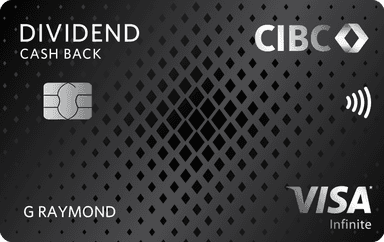
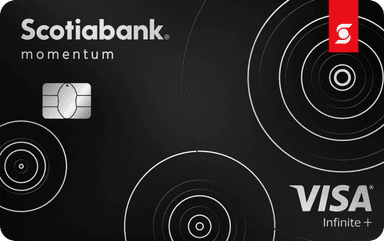
Comparison: CIBC Dividend Visa Infinite vs. Scotia Momentum Visa Infinite+
Loading article…
The CIBC and Scotiabank credit card lineups each include cash back cards offering up to 4% cash back:
In this comparison, we examine their welcome offers, income requirements, annual fees, cash back rates, insurance coverage, benefits and more.
Each card’s welcome offer changes with its promotions.
Here is how the current offers are structured:

For a limited time, when you apply for the CIBC Dividend® Visa Infinite* Card, you can receive:

For a limited time, when you apply for the Scotia Momentum Visa Infinite+* Card, you can receive:
The CIBC Dividend® Visa Infinite* Card requires an annual personal income of $60,000 or annual household income of $100,000.
The Scotia Momentum Visa Infinite+* Card is available with annual personal income of at least $60,000 to $80,000, household income of at least $100,000 to $150,000, or assets under management of at least $250,000 to $300,000.
The CIBC Dividend® Visa Infinite* Card has a $120 annual fee.
The Scotia Momentum Visa Infinite+* Card has a $120 annual fee.
The two cards offer different cash back rates.
With the CIBC Dividend® Visa Infinite* Card, you earn:
With the Scotia Momentum Visa Infinite+* Card, you earn:
Both cards have annual spending limits, after which the cash back rate drops to 1% instead of 2% or 4%.
With the CIBC Dividend® Visa Infinite* Card, once you exceed either of these annual limits, subsequent purchases earn 1% cash back:
This annual limit resets on the day after your December statement is issued.
With the Scotia Momentum Visa Infinite+* Card, once you exceed the annual limit for a category group, subsequent purchases earn 1% cash back:
This annual limit resets on the day after your November statement is issued.
With the CIBC Dividend® Visa Infinite* Card, you can redeem your cash back whenever you want, provided you have a balance of at least $25 when you submit your request.
With the Scotia Momentum Visa Infinite+* Card, you can redeem your cash back at any time, with a minimum balance of $25, through the Scotia mobile app or online banking.
With the CIBC Dividend® Visa Infinite* Card, you receive the following benefits:
With the Scotia Momentum Visa Infinite+* Card, you receive the following benefits:
| Coverage |  | |
|---|---|---|
| Trip cancellation insurance | None | Up to $1,500 |
| Trip interruption insurance | None | Up to $2,000 |
| Out-of-province or out-of-country emergency medical insurance | Up to $5,000,000 10 days | Up to $1,000,000 15 days |
| Flight delay insurance | None | Up to $500 after 4 hours |
| Delayed baggage insurance | None | Up to $500 after 4 hours |
| Lost or stolen baggage insurance | None | Up to $500 after 4 hours |
| Hotel burglary insurance | None | None |
| Rental car theft and damage insurance | Up to $65,000 | Up to $65,000 |
| Travel accident insurance | $500,000 | $500,000 |
| Mobile device insurance | $1,000 | $1,000 |
| Extended warranty | 1 additional year | 1 additional year |
| Purchase protection | 90 days | 90 days |
Which credit card comes out ahead?
Based on its overall features and flexible cash back redemptions, the CIBC Dividend® Visa Infinite* Card wins this comparison. However, if you plan to use your credit card to book travel, the Scotia Momentum Visa Infinite+* Card may be a better fit.
The CIBC Dividend® Visa Infinite* Card stands out for:
The Scotia Momentum Visa Infinite+* Card stands out for:
Here are some questions frequently asked in the Milesopedia community about these cards.
The Scotia Momentum Visa Infinite+* Card offers up to $300 in welcome cash back: 15% on the first $2,000 spent in the first three months. The CIBC Dividend Visa Infinite Card offers up to $200 in cash back (10% on up to $2,000 in net purchases during four statement periods), plus another $50 for setting up a pre-authorized payment. Both cards rebate the $120 annual fee for the first year. Even with the CIBC payment bonus, the Scotia offer pays more cash: up to $300 against $250.
Both cards offer 4% cash back in their main categories, but the categories differ. CIBC Dividend earns 4% on groceries and gas, 2% on transportation and dining, and 1% on everything else, with a combined $20,000 annual limit on its bonus categories. Scotia Momentum earns 4% on groceries and recurring payments and 2% on gas and transportation, with a higher $25,000 limit for each category group. CIBC may suit drivers with high gas spending, while Scotia may suit households with substantial recurring bills.
Yes. The Journie Rewards partnership can save you up to 10 cents per litre at participating Pioneer, Fas Gas, Ultramar and Chevron stations, in addition to the card’s 4% cash back on gas purchases. For a driver buying 50 litres each week, savings at that maximum rate would be about $5 per fill-up or $260 a year, before cash back. Scotia does not currently offer an equivalent gas partnership.
Scotia Momentum Visa Infinite offers broader travel protection, including trip cancellation and interruption, flight delays, lost or delayed baggage, and 15 days of out-of-province emergency medical coverage for travellers under 65. CIBC Dividend Visa Infinite has more limited coverage and does not include trip cancellation or interruption insurance. For families or frequent travellers who would otherwise buy separate coverage, Scotia’s travel protection may justify its $120 annual fee despite CIBC’s advantages in certain cash back categories.
Our reviews and rankings are based on an objective assessment. Advertisers do not influence our content. We may receive compensation through some links; our analysis and opinions remain independent.