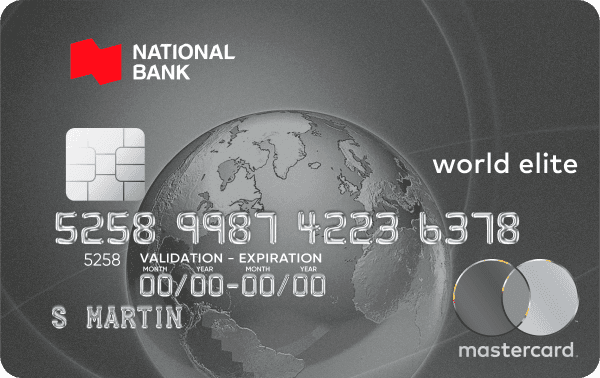
® Mastercard and World Elite are registered trademarks, and the circles design is a trademark of Mastercard International Incorporated. National Bank is an authorized user.
® The À LA CARTE REWARDS logo is a registered trademark of National Bank of Canada.
® NATIONAL BANK OF CANADA LOUNGE is a registered trademark of National Bank of Canada.
® À LA CARTE REWARDS PLAN is a registered trademark of National Bank of Canada.
® Apple Pay is a registered trademark of Apple Inc., registered in the U.S. and other countries. Apple Inc. is not a sponsor of or participant in National Bank Mobile Banking Solutions.
® Google Pay is a registered trademark of Google LLC. Use of this trademark is subject to Google Inc. Permissions.
TM À LA CARTE TRAVEL is a trademark of National Bank of Canada. The À la carte Travel agency is owned by Transat Distribution Canada Inc. and holds a Quebec permit (No. 753141).
TM À LA CARTE REWARDS is a trademark of National Bank of Canada.
® THE TOTAL, THE CONNECTED and NATIONAL BANK are registered trademarks of National Bank of Canada.
* Mastercard® World Elite®
The National Bank® World Elite® Mastercard® credit card was voted best Mastercard credit card by Milesopedia in 2026, 2025 and 2024.
The National Bank® World Elite® Mastercard® credit card was voted best travel credit card by Milesopedia in 2026, 2025 and 2024.
Every year, Milesopedia reviews credit card offers from major financial institutions and establishes its Ranking based on over 150 criteria such as fees, welcome offer, minimum income required, number of points per category, account credits, insurance, airport lounge access, etc.
- Certain restrictions apply. For more information, see the Rewards Plan section or the Plan Rules applicable to point accumulation.
- Grace period:
No interest is charged on purchases made during the month if the cardholder pays the full balance of their account within twenty-one (21) days of the statement date. This grace period does not apply to cash advances and balance transfers. Minimum payment: if your account balance is less than $10, you must pay the balance in full. If you reside in the province of Quebec, your minimum payment is 5% of your account balance plus any overdue amount, or $10, whichever is greater. If you reside outside Quebec, your minimum payment is 2.5% of the credit card account balance plus any overdue amount, or $10, whichever is greater. Account statement: an account statement is sent monthly.
Table of examples of credit fees calculated over a 30-day period
*Variable interest rate in effect as of September 1, 2021.
- Balance transfers and cash advances are subject to National Bank credit approval. Each amount transferred cannot be less than $250.
- Exclusive to World Elite Mastercard cardholders. Presentation of the physical credit card and boarding pass is required to access the lounge.
The National Bank® Lounge is accessible to customers traveling on international flights only (excluding flights to Canada and the United States).
You benefit from free and unlimited access with one guest and two children aged 12 and under.
Until October 4, 2026 (date subject to change), customers can enter the National Bank Lounge three hours before their flight departure time. From October 5, 2026 (date subject to change), access will be authorized for a maximum duration of 2 hours (3 hours for customers who hold a Private Banking 1859® World Elite® Mastercard® credit card).
National Bank customers who are not World Elite ® Mastercard ® cardholders can also access the current lounge based on current rates and benefit from a 25 % discount on these rates :
63,24 $ taxes included for adults (excluding discount)
$40.24 taxes included for children aged 2 to 12 (excluding discount)
free for children under 2 (excluding discount)
The entry fee is subject to change without notice and is the responsibility of the lounge operator.
- Subject to providing the required supporting documents in the manner and within the prescribed timeframe. Certain conditions may apply. Only the primary cardholder of a National Bank World Elite Mastercard (Cardholder) whose account is in good standing can request a « Travel Fee Reimbursement ». « Account in good standing » means an account linked to the credit card that does not violate the Credit Card Agreement in any way and on which no restrictions apply. For example, and without limitation, the associated annual fees must have been paid in full. The maximum reimbursement of $150 can be requested from January 1 to December 31 of each year.
Eligible expenses are:
airport parking
baggage fees
seat selection
airport lounge access worldwide
airline ticket upgrades
A reimbursement request must be made within 60 days of the purchase date. Travel expenses must be charged to the National Bank World Elite Mastercard credit card account. The maximum reimbursement of $150 is applicable per account. Please allow up to 7 business days for the reimbursement to be processed from the date your request is submitted. National Bank reserves the right to request additional supporting documents for validation purposes (e.g., invoices). You must keep all receipts and supporting documents for a period of 12 months from the date you made your reimbursement request. An unused reimbursement in one year cannot be carried over to the next year. You can make your request online at rewards.nbc.ca or by calling 1-800-341-8083 (toll-free) for an agent to assist you with your travel fee reimbursement request.
- Point accumulation on grocery and restaurant spending depends on the total gross monthly amount charged to the credit card account, across all categories. Earn 5 points per dollar spent on eligible grocery and restaurant purchases. The 5 points per dollar accumulation is valid for the first $2,500 of gross monthly purchases charged to the account. Beyond this amount, eligible grocery and restaurant spending will earn 2 points per dollar. The calculation of the gross monthly purchase amount is based on monthly billing. A grocery purchase means a purchase made at a merchant whose primary business is selling food, such as a grocery store, delicatessen, supermarket, fruit store, or specialty food store. Meal kit subscriptions and meal delivery services are eligible. Therefore, this definition excludes, among others, retail stores and big-box stores whose primary business is selling non-food items. Some merchants may sell products or services identical or similar to those of eligible merchants, or are separate merchants located on the same premises as eligible merchants, but are classified by Mastercard in different categories. Purchases made from other merchants only earn base reward points. A restaurant purchase means a purchase made at a restaurant, including quick-service restaurants, bars, discotheques, nightclubs, and taverns. To view the full list of Mastercard codes associated with eligible merchants, download the À la carte Rewards Plan® terms and conditions document.
- These protections apply if the purchases or rental are paid for in part with the card before departure, except, if applicable, for out-of-province medical-hospital insurance for which it is not necessary to charge the purchase of an à la carte trip and for baggage delay protection where the full cost of transport must have been charged to the card. All these protections apply to the primary cardholder, their spouse and/or their dependent children when they (spouse and dependent children) travel with the cardholder. Extended warranties apply to most new items purchased with the card, in Canada or abroad, provided the manufacturer’s warranty exists and is valid in Canada. Certain conditions, limitations and restrictions apply. For more information and details regarding your insurance coverage, please consult the insurance certificate linked to your card.
- Subject to credit approval by National Bank.
- Certain conditions apply. Visit mastercard.ca for more information. See all credit card terms and conditions.
- To earn 2 points per dollar spent, you must pay for your gas or electric charging purchases at a gas station or certain big-box stores. Some merchants may sell products or services identical or similar to those of eligible merchants, or are separate merchants located on the same premises as eligible merchants, but are classified by Mastercard in different categories. Purchases made from other merchants only earn base reward points. To view the full list of Mastercard codes associated with eligible merchants, download the À la carte Rewards Plan® terms and conditions document.
- Recurring bill payments are defined as payments made monthly or regularly that are automatically charged by the merchant to your National Bank World Elite Mastercard. Not all merchants offer recurring payments, and not all recurring payments are considered recurring bill payments. Therefore, some payments may not qualify for accelerated reward points.
- To earn 2 points per dollar spent, you must pay for your eligible purchases through the À la carte TravelTM agency section of our À la carte RewardsTM site.
- For example, if you spend $400 monthly on groceries, $200 on gas, $100 on recurring bills and $150 on other purchases, the $850 spent will generate 2,750 points, broken down as follows: 2,000 points for grocery spending (since the total gross monthly amount is $850, which is less than $2,500), 400 points for gas spending, 200 points for recurring bills and 150 points for other purchases.
- Insurance up to $1,000 in case of breakage, loss or theft of mobile devices for a maximum period of 2 years following the date of purchase. Subject to purchasing the device with the National Bank World Elite Mastercard or a phone service subscription paid by recurring payments from your National Bank Platinum Mastercard starting September 1, 2022. For all conditions, please consult the insurance certificate linked to your card.