Learn to manage your budget to save money and travel more

Loading article…
Learning how to manage your budget is a bit boring. Right? But what if I told you that managing your budget could help you save money and travel more? In this article, I share with you my best tips and tricks: budgeting, saving, strategy, and much more. At the same time, I’d like to share a little anecdote with you.
A friend of mine told me that she didn’t think it was possible to travel as much as I do, because she doesn’t make a lot of money. Yet she has a better income than mine! What I found ironic was that we were having this conversation while she was enjoying her Starbucks coffee and eating her chocolate bread.

So I made some calculations. This daily treat costs her about $8 “only”. She was very surprised when I told her that she spends $2,920 ($8 x 365 days) on lunch on the run, because she even goes there on her days off! At an average tax rate of 25% (marginal 36.12%), it takes about $3,900 in gross salary to afford this expense, which is equivalent to one month’s salary.
Is it worth working for a month to have the luxury of breakfast on the go every morning? The answer is personal to her, and I’ll never judge her; to each his own.
All this to say that it’s essential to draw up a budget to be aware of how much money we have coming in and going out! Then, manage your budget and make choices according to your priorities.
Here are my best tips and tricks to help you regain control of your finances, learn how to manage your budget and save!
Of course, the first step is to keep track of your expenses. Make a list of your weekly, monthly and annual expenses. But you don’t need to be up to the cent. However you do need to know how much you’re spending in each category or expense item. That’s the only way you’ll be able to analyze your habits and optimize all those hours spent at work!
It’s often the “phantom expenses” like the morning coffee that can surprise us, because they’re very small amounts. They accumulate and you don’t notice the financial haemorrhage. Once you’ve identified them, you can decide whether or not to keep them, but it will be a well-informed decision!
The large annual expenditures should not surprise us. After all, it’s the same thing every year: Christmas presents, license plates, dentist appointments, etc.

Do you know approximately how much money will be in your bank account at the end of the month? In 3 months? In 6 months?
This may be a personality thing, but I like to know what my expenses are going to be so I can readjust. I’m sharing the Excel file we use in our family. Check out our toolbox to download it.
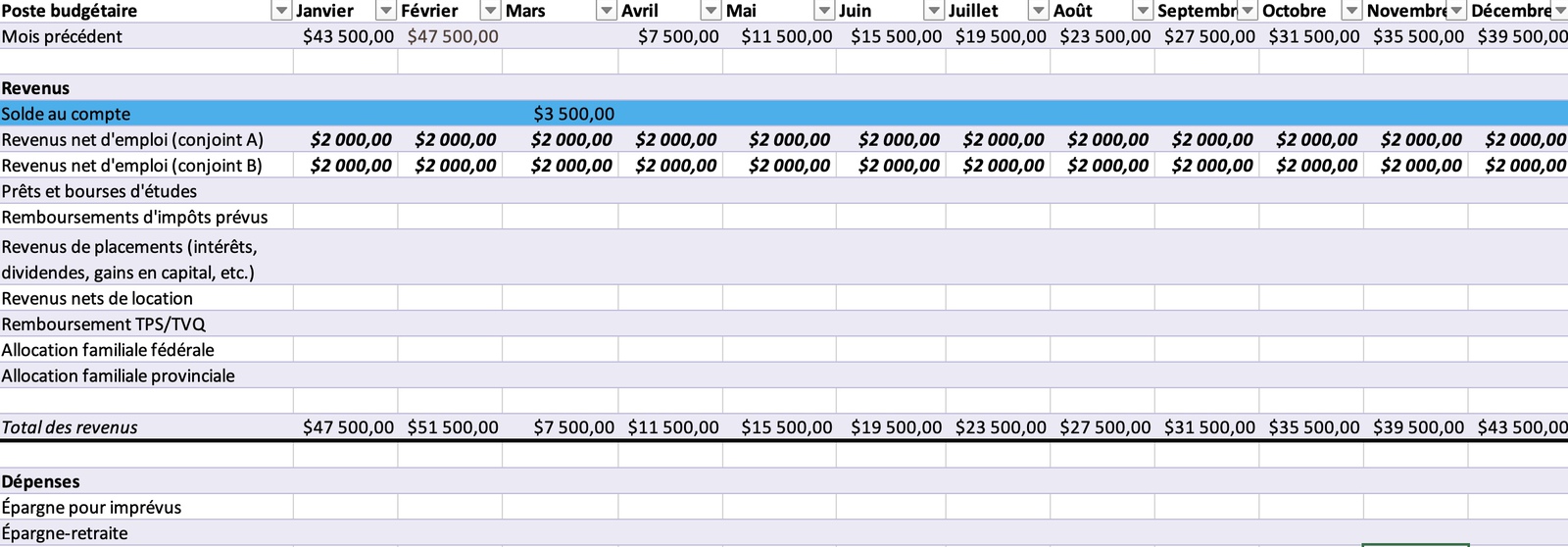
In short, this tool allows us to calculate all our cash inflows and outflows over the course of a year. To use it, simply fill it in with your figures. You can use it “as is”, or use it as a basis and adjust it according to your situation. Each month, simply :
Knowing whether I’ll run a deficit in my bank account motivates me to reduce my spending and/or increase my income. Also, having an emergency fund allows me to deal with the unexpected and reduce the associated stress.
To manage your budget more easily, you could instead use an online budgeting tool or mobile app. For some of you, this may be easier and more intuitive than an Excel file.
Free budget management applications are becoming increasingly rare. However, a few are still free. For example, EducFinance.
In my opinion, determining your ability to save is a very important step. In addition to points and travel, it’s important to plan for contingencies and retirement. I advocate a balance between carpe diem and retirement. Retirement is also my carpe diem… just later!
In my situation, I have several types of savings:
I consider my savings to be an “expense”. In other words, I force myself to put money aside as if I had no choice, just as I have to pay for my groceries because I have no choice. This behavior is called “paying yourself first”. Whether it’s $50 or $500 a paycheck, it’s important to create savings and not underestimate the power of compound interest.
In fact, you should invest your savings, according to your risk tolerance and objective, to make your money grow. For example, invest in exchange-traded funds (ETFs) using an online brokerage account.
For our family, our short-term savings for travel are in a high-interest savings account. Our retirement savings consist of investments in an online brokerage account and a real estate portfolio.
Like rewards points and credit cards, mastering investments is the key to getting maximum value from them.

I’m not judging anyone who decides to spend $3,900 of their gross salary on coffee and breakfast, if that’s what makes them happy. But, you have to be able to target expenses that you can reduce or cut if you can’t afford to do something else that’s also important to you.
The main excuse I hear is that people can’t afford _______. Eliminating phantom expenses and setting priorities are the first steps to doing this.
Good for you if you make enough income to pay for each budget item! For the others, we have to make choices and focus on our priorities.
With a clear, concise budget, it’s easier to target where you could cut.
The grocery budget is often the one we let go. But, in my opinion, it’s often the one where we lose the most money. On the contrary, I’m a foodie and I love to eat! In fact, it’s my second passion after travelling!
My main focus is on food waste. I find it absurd to throw food, and therefore money, in the garbage.
For optimal grocery shopping, you need to :
on American Express's website
Apply with confidenceCheck whether your application will be approved before you submit it, with no impact on your credit score*When you apply for a personal American Express Credit Card, we will tell you whether you are eligible without affecting your credit score. So you can apply with confidence.*Instant decisions are only available for consumer Card applications (also called “personal Cards”).
on National Bank's website
on Scotiabank's website
on BMO's website
Planning, execution, cross-check.
Think carefully. Are you aware of everything in your freezer? Is there a frozen lasagna you’ve forgotten about for 6 months? Did those bananas you bought 2 weeks ago end up in your tummy or in the garbage can?
These two statements are the real game-changers in my case:
This has enabled me to travel five to seven times a year over the past decade. In an article on credit card management, I had said that it’s best to concentrate on one or two programs when you’re a beginner, in order to master them well. Over time and depending on the number of programs mastered, you will build the points and rewards into your budget!
Thanks to AIR MILES, many everyday items as well as Christmas gifts for the kids end up being almost free every year. The same applies to the travel budget. I’ve been accumulating Aeroplan points for over 10 years, so I know my average annual accumulation rate.
Since I know how many plane tickets I can afford with my points, I can adjust my travel budget accordingly.
United we stand! I’m not telling you anything new when I say that many expenses are reduced when you’re a couple (or sharing with roommates). As far as points are concerned, accumulating them and using them in pairs is the most lucrative.
What’s more, I often share expenses with my parents, to get a better price (and bonus miles). For example, buying 5L of ketchup at Costco, or buying a large pack of paper towels.
These are savings that can go a long way as they accumulate and everyone’s budget shrinks. So think of your friends, your parents and your spouse to help each other save and collect points!
One thing I’ve often noticed is that people tend to make excuses for their financial problems. My philosophy is to find solutions and put them first. It’s also this kind of effort and mentality that will make life easier. If you’re convinced you’re going to run out of money, this will become your reality.
In short, good budget management and the integration of credit card rewards points are the two main factors that have enabled me to travel often in the last decade… and for those to come!
on American Express's website
Apply with confidenceCheck whether your application will be approved before you submit it, with no impact on your credit score*When you apply for a personal American Express Credit Card, we will tell you whether you are eligible without affecting your credit score. So you can apply with confidence.*Instant decisions are only available for consumer Card applications (also called “personal Cards”).
Create an Excel file with different sections for your cash inflows, fixed and variable expenses, savings, etc. Then use formulas to automatically calculate the totals for each section and the final balance. Finally, adjust the table to suit your needs. Consult our toolbox to download a dynamic Excel budget template.
Free budget management applications are becoming increasingly rare. Often, these tools require a paid subscription. However, a few are still free, such as Quebec’s EducFinance.
The 50/30/20 rule involves dividing your income into three categories: 50% for essential expenses, 30% for personal desires and 20% for savings. Divide your net income according to these percentages to get a clear picture of these 3 expense categories.
Keep a record of all your expenses to learn about and analyze your consumption habits. Then decide which ones you want to keep, reduce or eliminate. The money saved can be used to save and travel more.
on BMO's website
Our reviews and rankings are based on an objective assessment. Advertisers do not influence our content. We may receive compensation through some links; our analysis and opinions remain independent.