Float Financial: How Does It Work?

Loading article…
Float Financial is a Canadian spend management platform that gives your business corporate cards in CAD and USD, a business account paying 2.5% interest, free EFT and ACH bill payments and up to 1% cash back once card spending passes $25,000 a month, starting with a free plan.
Tracking your expenses is one of the most important aspects of running a successful business, but it can also be one of the most complicated.
Float Financial has designed its products and systems to improve and streamline the way Canadian businesses manage their expenses, striving to enable businesses and teams as a whole to spend effortlessly.
In this article, we examine what Float Financial offers and how you can use its products to save time and money.
Prefer to earn travel points on your business spending? Compare the best business credit cards in Canada.
Float Financial is a Canadian business financing platform that offers corporate credit cards and software to create a complete expense management system.
They allow you to pay your expenses, reimburse your employees, organize your finances and much more, all while earning 2.5% interest on the CAD and USD money you hold in your account and up to 1% cash back on your business cards.
To get started with Float Financial, you can visit the Float Financial website and create a free account.
From there, you can quickly access the business credit cards and key expense management features offered, including vendor payments, employee reimbursements, expense tracking, CAD and USD currency conversion, and earnings from a high-yield account.
Once you’ve created a Float account, you need to connect it to one of your business bank accounts to load funds and start spending.
From there, you can integrate your Float account with your business accounting software (such as QuickBooks Online, Xero, or NetSuite), and easily track business and employee expenses and reimbursements using the business credit cards and system integration.
Float’s systems also allow you to control spending, keep an eye on what’s happening through reports and data, and use features to automate tasks, saving you time and effort.

Good news for small businesses: you don’t need to be incorporated to use Float. Any business legally registered in Canada or the United States can apply, sole proprietors and new companies included, as long as it passes Float’s business verification.
The charge card is more selective. To qualify for Float Charge, your business must:
Float doesn’t ask for a personal guarantee on the charge card, and non-profits and cryptocurrency businesses are excluded. The platform displays in English or French depending on your browser settings, and customer support is offered in both languages.
As a Float Financial customer, you have a choice of three membership tiers:
With the Essentials and Professional tiers being the most popular, let’s take a closer look at what each offers.
At the Essentials tier, you will get the following:
The Professional tier includes everything in the Essentials tier, plus
Good news on payment fees: creating and approving bills or reimbursement reports is free, and EFT and ACH payments cost $0 at both levels above. Each wire transfer costs $20 CAD, and international payments carry a 1.5% markup on the exchange rate. You’ll find the full breakdown in Float’s help article on its payment fees.

Float Financial started by offering Canadian dollar business credit cards in 2021, and has now expanded to offer a suite of products, services, and platform integrations to support finance teams and expense management in general.
Float’s five key products and services that integrate into its platform are:
These five offerings can be used in tandem with the system’s other features and integration options to create an all-in-one expense management solution for your business.
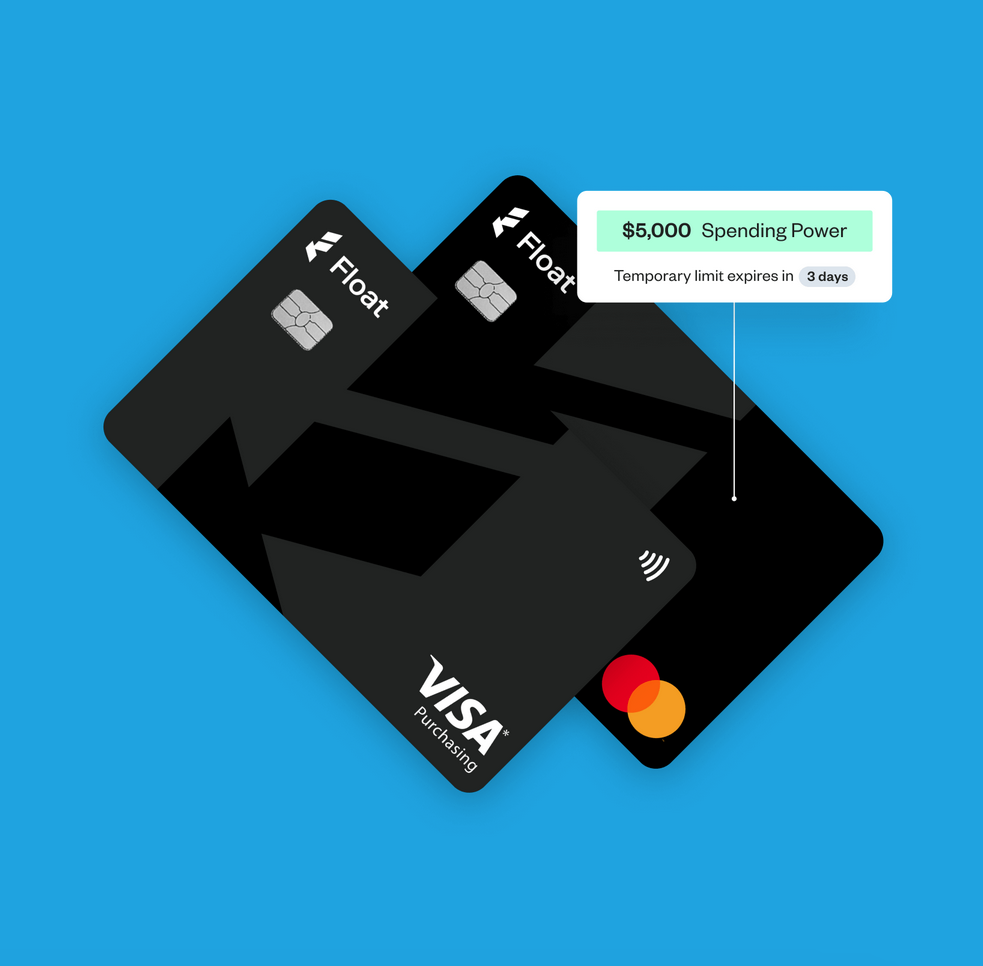
Float Financial’s best-known product is its business credit card, offered in CAD and USD as either a prefunded card or a charge card.
With Float’s CAD and USD prefunded cards, your card limit equals your bank account balance. Through their system, you can connect multiple business bank accounts (in CAD and USD) to fund your business expenses. You can also set up automatic reloads to ensure your funds are always available when you need them.
If you prefer, you can apply for the Float charge card, which offers up to $3,000,000 in unsecured credit on 30-day terms, subject to Float’s eligibility requirements. You can pay the balance down automatically throughout the month.
Both types of cards allow you to enjoy useful benefits, such as
Float Financial’s bill payment product offers you a new, more integrated way to manage your accounts payable process, including receiving invoices, payment, and reconciliation.
Through their system, your invoices are automatically tracked and categorized, and you can add additional automations to simplify the approval process, payments, and more.
You can then pay your vendors directly from Float, with payments typically processed in one business day.
Float has also launched Float Payments, which lets you pay suppliers abroad in 21 currencies from the same platform. International payments are converted at Float’s exchange rate plus a 1.5% markup, while EFT and ACH payments stay free and each wire costs $20 CAD.
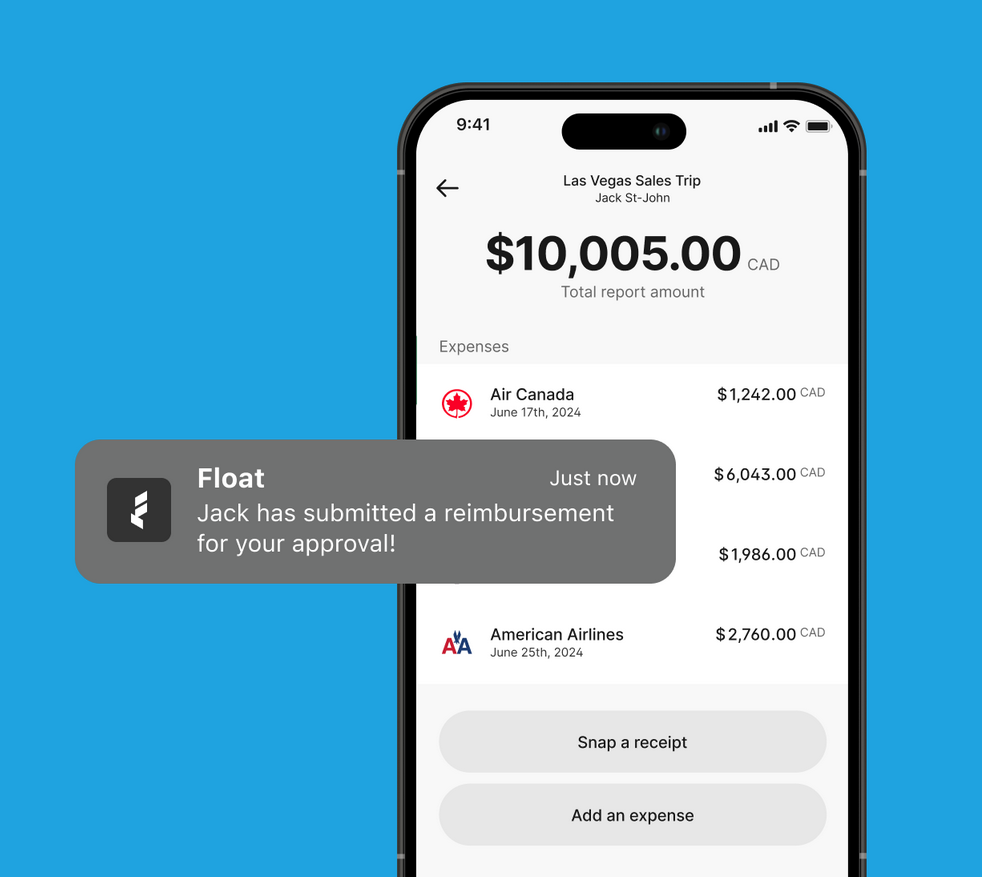
With Float’s employee reimbursement system, you can quickly and easily reimburse personal expenses without employees having to enter every data point, and without having to collect a pile of paper receipts.
Employees can simply submit a photo of the receipt for the requested reimbursement, and Float’s system (with your input) will direct the request through the appropriate approval process. Once expenses are approved, your finance team can review the information and send payments directly from your Float balance to the employee concerned.
If you bank with a traditional bank, chances are your money is sitting in a low-yield chequing account. If you’d prefer your money to work a little harder for you, you can earn 2.5% interest on the CAD and USD funds you keep in your Float account, whatever your balance. Float states that it may change this rate at any time without notice.
It’s nice to note that this rate applies to funds in both CAD and USD, and there’s no need to lock up your money for a specific period: you can move it as you want, when you want. On a $100,000 balance held for a full year, 2.5% works out to about $2,500 in interest, before tax and assuming the rate does not change.
For businesses that operate in both Canadian and US dollars, the ability to convert funds between the two currencies without spending a fortune on fees is extremely valuable.
By using Float Financial to convert your Canadian and US dollars, you’ll pay a 0.25% FX rate, lower than the conversion rates charged by most traditional banks, and you won’t need to maintain a USD bank account.
Additionally, this service allows you to pay in USD, issue USD credit cards, and send automated clearing house payments and USD wire transfers to vendors and reimburse US-based employees, all without having a USD account.

Loop is the other Canadian platform businesses most often compare with Float. Here is how the two stack up on the features that cost you money or earn you some, according to each company’s published pricing.
| Feature | Float | Loop |
|---|---|---|
| Monthly plans | $0 (Essentials); from $100 (Professional, first 10 active users included) | $0 (Basic); $79 (Plus); $299 (Power) |
| Currency conversion rate | 0.25% | 0.47% (Basic); 0.27% (Plus); 0.12% (Power) |
| Card currencies | CAD and USD | CAD, USD, EUR and GBP |
| Card rewards | 1% cash back once monthly spend passes $25,000 per card program | 1x to 2x points, depending on the plan and the currency |
| Interest on balances | 2.5% on CAD and USD | Not advertised on Loop’s pricing page |
| Wire transfers | $20 CAD each | Free |
| EFT and ACH payments | Free | Free |
| Who can apply | Businesses registered in Canada or the US, sole proprietors included | Businesses registered in Canada with a CRA business number |
In short, Float suits you better if you hold large CAD and USD balances and want them to earn interest. Loop is the stronger choice if you pay many suppliers by wire or spend in euros and pounds.
Float Financial’s business credit cards and expense management system can help you organize and streamline your finances, saving you time and money.
If you run a business in Canada and are looking for an alternative to traditional bank business credit cards, it’s worth exploring Float’s products and services. Float pays off most when you spend more than $25,000 a month on cards, hold large CAD and USD balances, or pay many suppliers by EFT.
If Float’s products aren’t right for you, consider discovering other ways to earn rewards on your business spending through our recommendations on the best business credit cards, which offer a wide range of benefits for business owners.
| Credit card | Annual fee | Welcome offer | |
|---|---|---|---|
| $199 | |||
| $0 | |||
| $199 |
Also be sure to read our complete review of Loop Financial, which offers similar products and services for businesses.
on Scotiabank's website
Our reviews and rankings are based on an objective assessment. Advertisers do not influence our content. We may receive compensation through some links; our analysis and opinions remain independent.