Supplementary Card Fees: Amex, Blue Rewards, CIBC and RBC Compared

Loading article…
The supplementary card is the blind spot of pricing grids: nobody thinks about it when choosing a card, yet it’s the line that climbs fastest. The CIBC fee increase in August 2026 pushed us to go back through the cards our readers ask about most, one by one, on each issuer’s official pages. The result is more scattered than expected.
A supplementary card costs between $0 and $250 a year in Canada. Most big banks charge $50 per additional card. TD asks $75 on its Aeroplan Visa Infinite, American Express climbs to $250 for a supplementary Platinum Card, while Tangerine, Rogers and the Cobalt Card charge nothing at all.
First trap before you even start comparing: each issuer uses its own vocabulary. American Express and CIBC talk about a supplementary card, BMO and National Bank about an additional card, TD about an additional cardholder, Tangerine and Rogers about an authorized user. It’s the same product: a second physical card tied to your account, for which you remain solely responsible.
The amount charged isn’t arbitrary: it almost always tracks the level of benefits the card extends to the supplementary holder, not just to you. A card with no travel insurance or costly lounge access to duplicate, like the Cobalt or a Tangerine card, has nothing to charge for a second card. A Visa Infinite or a World Elite, whose travel insurance also covers the supplementary holder, generally sits around $50. On the most premium cards, where the supplementary holder also gets airport lounge access and concierge service, the fee climbs accordingly, up to $250 at American Express.
Here are the amounts found on each issuer’s official pages as of August 19, 2026.
American Express shows the widest spread on the Canadian market. The American Express Cobalt® Card, at $191.88 a year ($15.99 a month), gives supplementary cards at no charge, up to nine per account. For a couple earning Membership Rewards points in the same place, that’s $0 more a year.
The top of the range works the other way around. On the American Express Platinum Card®, at $699 a year, each supplementary Platinum Card costs $250. There’s an official workaround: two supplementary Gold Cards come free on the same account, then $50 for each additional Gold. A spouse who doesn’t use the lounges has little reason to pay $250.
on American Express's website
Apply with confidenceCheck whether your application will be approved before you submit it, with no impact on your credit score*When you apply for a personal American Express Credit Card, we will tell you whether you are eligible without affecting your credit score. So you can apply with confidence.*Instant decisions are only available for consumer Card applications (also called “personal Cards”).
This is the most frequent request we get on this topic, still often phrased with the program’s former name: the BMO Blue Rewards World Elite®* Mastercard®* (formerly BMO AIR MILES®* World Elite Mastercard) charges $50 per additional card, on top of the primary cardholder’s $120. BMO refunds that $50 the first year when the additional card is added at the time of the initial application, with both the fee and the credit showing on the first statement.
The same $50 fee applies to the BMO eclipse Visa Infinite* Card. Add an additional card on an eclipse and BMO boosts your accelerated category’s earn rate by 10%, the only direct trade-off any Canadian issuer offers in exchange for a supplementary card fee.
The CIBC Dividend® Visa Infinite* Card went from $30 to $50 per supplementary card on August 1, 2026, a 66% increase that brings it in line with the market’s reference rate rather than setting it apart. The cap stays at three supplementary cards, and the primary cardholder’s annual fee remains at $120.
CIBC refunds the first year for both the primary cardholder’s $120 and each of the three supplementary cards’ $50. A family of four opening the account today therefore pays $0 the first year, then $270 starting in year two.
Our detailed analysis of CIBC’s supplementary card fee increase
on CIBC's website
RBC is the only major Canadian issuer to publish a complete comparison table of its additional card fees, product by product. The RBC Avion Visa Infinite Card charges $50 per additional card on a $120 annual fee. The Privilege version climbs to $99 on a $399 fee.
The rest of the lineup is more generous than the market average. The RBC Rewards+ World Elite Mastercard, at $99 a year, charges nothing for its additional cards. Neither does the RBC ION+ Visa Card, at $48. The WestJet co-branded cards are the exception, at $59 on the World Elite version and $19 on the entry-level version.
on RBC's website
The TD® Aeroplan® Visa Infinite* Card charges $75 per additional cardholder, against $50 at its direct competitors. The card remains one of the best sellers in our portfolio nonetheless: its welcome offer and its Aeroplan point value largely absorb the $25 gap per supplementary card, especially since the additional cardholder also enjoys the included travel insurance.
TD offsets this with a first-year rebate that covers the primary cardholder and up to three additional cardholders, provided you activate the card and make a first purchase within three months of opening the account, and add the additional cardholders within that same window.
In the same lineup, the TD First Class Travel® Visa Infinite* Card applies a declining-rate logic rarely seen in Canada: $50 for the first additional cardholder, then $0 for every one after that. A family of five pays $189 in total there, against $439 on the Aeroplan Visa Infinite.
on TD's website
The Scotia Momentum® Visa Infinite +* Card charges $50 per supplementary card on a $120 annual fee, and the current offer waives the first year on both the primary and supplementary cards. The Scotiabank Passport Visa Infinite +* Card, at $150, gives the first supplementary card free before charging $50 for the next ones.
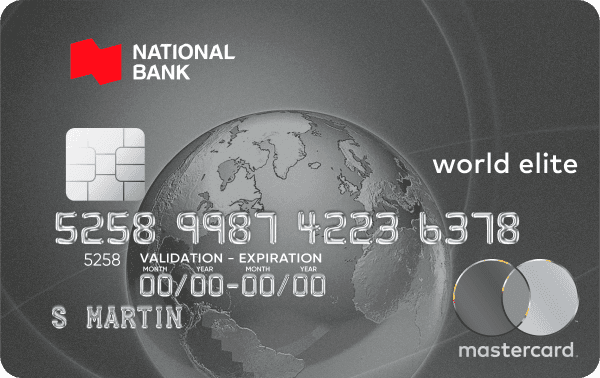
The National Bank World Elite® Mastercard® caps out at three authorized users, at $50 each on a $150 annual fee. The National Bank Platinum Mastercard® from the same bank drops to $35 per additional card on a $70 fee, one of the market’s few proportional pricing grids: the Platinum, with lighter insurance coverage than the World Elite, also costs less to duplicate for a supplementary holder.
Three issuers step completely outside the $50-per-card logic.
Asking the question backwards often changes the answer: instead of adding a $50 or $75 supplementary card, would the partner be better off applying for their own primary card?
Take a couple on the TD® Aeroplan® Visa Infinite* Card. A primary card plus one additional cardholder costs $214 a year. Two separate primary cards cost $278, or $64 more, but earn two welcome bonuses instead of one. On a bonus worth several hundred dollars in Aeroplan points, the $64 gap pays for itself in year one.
The logic flips after that first year. Once both bonuses are banked, the supplementary card becomes the cheaper option again, and it concentrates points in a single account, which avoids minimum transfer thresholds and scattered point balances. Our guide on managing points and credit cards as a couple details this approach.
Three situations where the supplementary card keeps the edge:
Four issuers refund supplementary card fees the first year, but none of them do it automatically under the same conditions.
On the business side, five cards refund the employee card in the first year: see the employee card fees on business credit cards.
Paying $50 or $75 makes sense when the second card generates spending in the bonused categories. On the CIBC Dividend® Visa Infinite* Card, at 4% on groceries and gas, just $1,250 in eligible annual spending on the supplementary card covers its $50 fee.
Below that threshold, the supplementary card costs more than it earns. That’s the typical case of a card handed to a child for small purchases, or to a partner who mostly uses their own card. A card with no annual fee and no supplementary card fee, like the Tangerine® Money-Back World Mastercard®*, does the same job for $0.
Also check what supplementary holder status doesn’t give you. At most Canadian issuers, the person who receives the card isn’t liable for the balance, so it doesn’t necessarily build their own credit history. Confirm this with your issuer before adding a card for a young adult for that reason alone.
Fifty dollars per card, per year, is the reference rate at CIBC, RBC, BMO and Scotiabank on their Visa Infinite and World Elite cards. The gaps sit at the extremes: $0 on no-annual-fee cards and up to $250 on the American Express Platinum Card®.
Fifty dollars a year per additional card on the BMO Blue Rewards World Elite®* Mastercard®* (formerly AIR MILES World Elite), on top of the primary cardholder’s $120 annual fee. BMO refunds that $50 the first year if the additional card is added at the time of the initial application.
It depends on the card. The American Express Cobalt® Card offers its supplementary cards at no charge, up to nine per account. The Gold Card gives one free before charging $50 for the next ones, while a supplementary Platinum Card® costs $250 a year.
Among the big banks’ Visa Infinite cards, TD Aeroplan sits slightly above the reference rate at $75, and its Privilege version at $199. American Express’s premium cards go further, up to $250 per supplementary Platinum Card, a figure that reflects benefits that are also more extensive (lounge access, concierge) extended to the supplementary holder.
Yes, by choosing a card that doesn’t charge them. The Tangerine® Money-Back World Mastercard®* accepts five authorized users at no charge, Rogers Red cards carry no annual fee, and the Cobalt® Card as well as several RBC cards offer their supplementary cards free despite an annual fee on the primary card.
The cap ranges from three to nine depending on the issuer. CIBC and National Bank stop at three, Tangerine at five, American Express and Rogers go up to nine. Several issuers don’t publish any maximum on their product pages.
Not necessarily. At most Canadian issuers, the supplementary holder isn’t liable for the balance, which limits the effect on their own credit history. Confirm your issuer’s practice before adding a card for a young adult for that reason alone.
No. Wealthsimple currently offers neither a supplementary card nor a co-holder option on its credit card. A couple who wants two cards has to open two separate accounts, each with its own credit application.
on National Bank's website
Our reviews and rankings are based on an objective assessment. Advertisers do not influence our content. We may receive compensation through some links; our analysis and opinions remain independent.