
Neo or Rogers: Which World Elite Card Should You Choose?
Neo World Elite or Rogers Red World Elite: on our reference profile, the Neo pays you $113 more a year, after the fee. Real rates, caps and insurance compared across three profiles.
Key Takeaways
- Neo World Elite and Rogers World Elite target cash back users through different reward structures.
- The Rogers card’s value depends partly on eligible Rogers services and how cash back is used.
- When comparing Neo and Rogers, check spending categories, fees, and announced insurance changes.
The Neo World Elite Mastercard pays you more if groceries, gas and recurring bills take up a big share of your budget. The Rogers Red World Elite Mastercard wins for a Rogers customer whose spending is spread everywhere. Starting November 18, 2026, Rogers pays 5% on your Rogers bill, but drops its trip cancellation insurance.
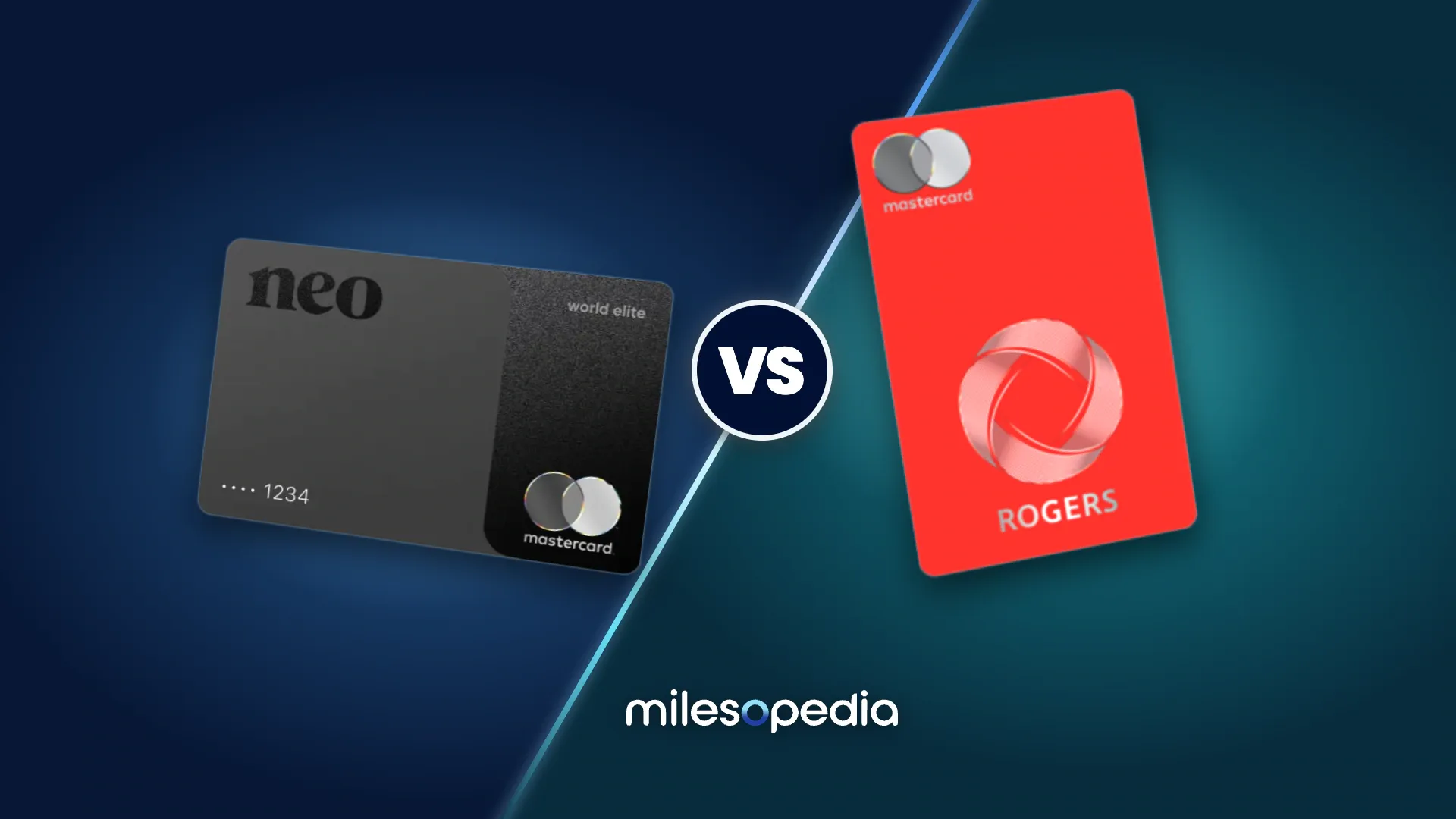
The Neo World Elite® Mastercard - Gas & Grocery and the Rogers Red World Elite® Mastercard target the same reader: someone who wants cash back on everyday spending without managing a points program. They get there by opposite routes.
Rogers bets on a single rate applied everywhere. Neo bets on high rates in three categories, with monthly caps. The math below settles it based on your actual spending profile.

Click a card name to open its full profile and current terms.
Rogers changes its rules on November 18
Today, a Rogers, Fido, Shaw or Comwave customer earns 2% on all eligible purchases with the World Elite.
Starting November 18, 2026, you earn 5% on eligible Rogers purchases, such as your Rogers, Fido or Shaw bill paid with the card, and still 2% on everything else. Your purchases in US dollars earn 3%. In-store purchases at Rogers do not count, so the value depends mostly on how much of your spending goes to your bill.
A second change has been in force since August 4, 2026: an annual cap of $61,000 in spending on the World Elite, beyond which the accelerated rate falls back to 1.5%. That threshold protects the vast majority of cardholders.
The real rates, caps included
At Neo, every bonus category has its own monthly cap: beyond it, your cash back drops back to 1%. At Rogers, the cap is annual and global.
| Criterion | Neo World Elite - Gas & Grocery | Rogers Red World Elite |
|---|---|---|
| Annual fee | $149 | $0 |
| Welcome offer | Varies with the period | None |
| Groceries | 5% up to $1,000 a month, then 1% | 2% (Rogers customer) |
| Gas | 3% up to $1,000 a month, then 1% | 2% (Rogers customer) |
| Recurring payments | 4% up to $500 a month, then 1% | 2% (Rogers customer) |
| Rogers, Fido or Shaw bill | 4% if it is set up as an automatic payment | 5% starting November 18, 2026 |
| Purchases in US dollars | 1% | 3% |
| All other spending | 1%, no cap | 2% (Rogers customer), 1.5% otherwise |
| Overall annual cap | None | $61,000, then 1.5% |
| Airport lounges | Membership in a Mastercard lounge program | Mastercard Travel Pass membership, US$32 per visit |
| Emergency medical travel insurance | 14 days, outside Quebec | 15 days up to age 64 starting November 18, 2026, 3 days from 65 to 74 |
| Trip cancellation insurance | Included, outside Quebec | Removed on November 18, 2026 |
| Income required | $80,000 personal or $150,000 household | $80,000 personal or $150,000 household |
| Foreign transaction fee | 2.5% | 2.5% |
The $1,000 monthly cap at Neo is the figure people forget most often. A household spending $1,400 a month on groceries does not earn 5% on the whole amount: it earns 5% on $1,000 and 1% on the next $400, an effective rate of 3.86%.

- Annual feeNo annual fee the first year
- $0 $149
- First year free
- Our valuationMilesopedia first-year estimate First-year valueAnnual fee rebated$149Total$149Rewards on your spending are not included. The calculator that adds them from your own profile is on the card's page.
- $149
- Welcome offer$149 annual fee rebated
- First Year Annual Fee Rebate
on Neo Financial's website
Neo's 7% costs $10,000 up front
Neo advertises "up to 7%" on groceries on its rates page. That figure is real, but you do not get it by spending: you get it by tying up money. The rates climb in tiers based on the balance kept in a Neo chequing account.
- $0 balance: 5% on groceries, 3% on gas, 4% on recurring payments
- $5,000 balance: 6% on groceries, 3.5% on gas, 4.5% on recurring payments
- $10,000 balance: 7% on groceries, 4% on gas, 5% on recurring payments
Here is the calculation the rates page does not run. A household spending $800 a month on groceries earns $480 a year at 5%, and $672 at 7%. The gain is worth $192 a year, obtained by keeping $10,000 in a chequing account.
That $10,000 therefore returns 1.92% a year as extra cash back. That is less than the same amount earns in a good high interest savings account, and the money stays locked in place. The top tier only pays off if you max all three bonus categories at once, which means roughly $2,500 of targeted spending a month.
Three spending profiles compared
To find out which card pays you more, we calculated how much cash each one actually puts back in your pocket over a full year, after the annual fee, for three ways of spending. On the Rogers side, we count a $150 monthly cell phone or internet bill paid with the card, and the rates that apply from November 18, 2026.
Grocery heavy household, Rogers customer
Your monthly budget: $800 on groceries, $300 on gas, $300 in automatic bill payments (including $150 to Rogers) and about $667 on everything else. Over a year, that adds up to $24,800 on the card.
- With the Neo: $812 in cash back ($480 on groceries, $108 on gas, $144 on bills, $80 on the rest), minus the $149 annual fee = $663 in your pocket
- With the Rogers: $90 on the Rogers bill at 5%, plus $460 on everything else at 2%, with no annual fee = $550 in your pocket
- Difference: the Neo leaves you $113 more a year
What it means for you: if groceries, gas and fixed bills take up a big share of your budget, the Neo's cash back covers its $149 fee and still leaves you about $9 more a month than the Rogers.
High spender spread out, Rogers customer
Your monthly budget: about $3,333 on the card, of which only $500 on groceries, $200 on gas and $150 on the Rogers bill. The rest goes to travel, restaurants, renovations and online shopping, for $40,000 a year.
- With the Neo: $742 in cash back ($300 on groceries, $72 on gas, $72 on the Rogers bill, $298 on the rest at 1%), minus the $149 annual fee = $593 in your pocket
- With the Rogers: $90 on the Rogers bill at 5%, plus $764 on everything else at 2%, with no annual fee = $854 in your pocket
- Difference: the Rogers leaves you $261 more a year
What it means for you: when most of your purchases fall outside groceries, gas and bills, the Rogers 2% on everything beats the Neo's 1% on "everything else", and you have no annual fee to earn back. You keep about $22 more a month.
Household with no Rogers service
Take the first profile at $24,800 again, but in a household subscribed to Bell, Telus or Videotron. The Rogers accelerated rate does not apply.
- With the Neo: the same result as the first profile = $663 in your pocket
- With the Rogers: without a Rogers service, all your spending earns 1.5%, so $24,800 at 1.5% = $372 in your pocket
- Difference: the Neo leaves you $291 more a year
What it means for you: the Rogers card is only worth it if you are already a Rogers, Fido, Shaw or Comwave customer. Without that service, the Neo leaves you about $24 more a month, and the Rogers even pays you less than a solid no annual fee cash back card.
| Your profile | Neo World Elite | Rogers Red World Elite | Best choice |
|---|---|---|---|
| Grocery heavy, Rogers customer ($24,800 a year) | $663 | $550 | Neo, $113 more |
| Spread-out spending, Rogers customer ($40,000 a year) | $593 | $854 | Rogers, $261 more |
| Grocery heavy, no Rogers service ($24,800 a year) | $663 | $372 | Neo, $291 more |

Insurance and lounges: the real gap
Both cards include emergency medical travel insurance, but not in the same proportions, and the gap widens with age.

- Neo World Elite: 14 days of emergency medical coverage, except in Quebec, where Neo does not offer its travel insurance
- Rogers Red World Elite, 64 and under: 10 days today, rising to 15 days on November 18, 2026
- Rogers Red World Elite, ages 65 to 74: 3 days only
Three days covers almost no real trip. If you are 65 or older, or if you live in Quebec and choose the Neo, plan on travel insurance bought separately.
On November 18, 2026, Rogers also removes trip cancellation, trip interruption and trip delay insurance from its World Elite. The Neo World Elite includes all three protections, except for Quebec residents. In Quebec, compare with a card that keeps them, such as the National Bank World Elite Mastercard.
On airport lounges, the two cards are even: each gives you a free membership in a lounge network, DragonPass at Neo and Mastercard Travel Pass at Rogers, but every visit is still paid. At Rogers, expect US$32 per person per visit. For an occasional traveller, this criterion carries little weight in the choice.
- Annual feeNo annual fee the first year
- $0 $150
- First year free
- Our valuationMilesopedia first-year estimate First-year valueWelcome offer$315Annual fee rebated$150Total$465Rewards on your spending are not included. The calculator that adds them from your own profile is on the card's page.
- $465
- Welcome offer+ First-year annual fee refundedUp to 15,000 points from net purchases, plus 10,000 with payment insurance for 90 days and 10,000 with a first eligible chequing account. Conditions apply.
- Up to 35,000 points
- Ends Mar 31, 2027
on National Bank's website
Neo or Rogers: our verdict
Over a normal year, the Neo World Elite® Mastercard - Gas & Grocery wins in two profiles out of three. It returns $663 a year on our reference profile, after the fee, against $550 for Rogers. For a household with no Rogers service, the gap grows to $291.
The Rogers Red World Elite® Mastercard remains one of the best cards on the market for someone already subscribed to Rogers, Fido, Shaw or Comwave whose spending is spread everywhere. On that profile, it pays you $261 more a year. Without that service, it loses its appeal.
If you are hesitating, look at your last statement and add up groceries, gas and automatic bill payments. If that total is roughly half of your spending or more, take the Neo. Below that, and if you are a Rogers customer, take the Rogers.
To go further:
Neo World Elite or Rogers: Frequently Asked Questions
Which of the two cards pays you more?
It depends on your profile. On a $24,800 budget concentrated on groceries and gas, the Neo World Elite pays you $663 a year after the fee, against $550 for the Rogers Red World Elite after November 18, 2026. On a $40,000 budget spread everywhere, Rogers takes the lead with $854 against $593.
Does Neo's travel insurance cover Quebec residents?
No. Neo states that its travel insurance is not available to Quebec residents, so the 14 days of medical coverage and the trip cancellation insurance do not apply. In Quebec, you keep purchase protection, extended warranty and rental car insurance.
Is the 7% cash back Neo advertises real?
Yes, but it requires keeping $10,000 in a Neo chequing account. Without that balance, the grocery rate is 5%. The top tier adds roughly $192 a year for a household spending $800 a month on groceries, a 1.92% return on the money tied up.
Do you need to be a Rogers customer to get the card?
No, the card is open to everyone. But the accelerated 2% rate on all purchases is reserved for cardholders with at least one active Rogers, Fido, Shaw or Comwave service. Without that service, the card earns 1.5% on Canadian dollar purchases.
What happens when I hit a cap at Neo?
The rate drops to 1% for the rest of the month in that category, then returns to the bonus rate the following month. The caps are $1,000 a month on groceries, $1,000 on gas and $500 on recurring payments.
Is the $149 Neo annual fee worth it?
Yes, if you spend enough on groceries. The fee pays for itself once your grocery spending runs about $5,000 a year ahead of the no fee version: the Neo World Mastercard offers 2% in the same categories with the same caps, and the 3-point gap covers the fee from that threshold.
Which card should you choose after 65?
Neither one for travel coverage. The Rogers Red World Elite drops to 3 days of emergency medical coverage from 65 to 74, and the Neo World Elite offers 14, outside Quebec. In both cases, travel insurance bought separately remains necessary for a trip longer than two weeks.
What changes on the Rogers card on November 18, 2026?
You earn 5% on eligible Rogers purchases, such as your bill paid with the card, and still 2% on your other purchases if you are a Rogers customer. Rogers also removes trip cancellation, interruption and delay insurance from the World Elite, and raises emergency medical coverage under 65 from 10 to 15 days.
Can you hold both cards at the same time?
Yes, and it is often the best strategy. The Neo World Elite covers groceries, gas and recurring bills up to the monthly caps, and the Rogers Red World Elite takes over on everything else at 2%. Both require a personal income of $80,000 or a household income of $150,000, and each application leaves a mark on your credit file.