RBC Cash Back: The Revamp Quantified Across 6 Profiles

Loading article…
RBC revamped its two cash back cards on October 1, 2026. The RBC Cash Back Preferred World Elite Mastercardਠhas moved from a flat 1.5% to unlimited 3% on nine everyday categories. Its annual fee has risen from $99 to $120.
Meanwhile, the no-annual-fee RBC Cash Back Mastercardਠhas removed the cap on its 2% grocery rate but cut the rate on all other purchases in half.
On December 2, 2026, a second set of changes arrives: cash back becomes available on demand, starting at $1. We have quantified the real impact using six spending profiles. The result: some cardholders gain $250 per year, while others lose $146. You can then compare it with our selection of the best credit cards in Canada.
| Credit card | Annual fee | Welcome offer | |
|---|---|---|---|
| $120 | |||
| $0 |
RBC is spreading its revamp over two months. Rates and fees changed first; the redemption mechanics follow on December 2.
| Date | What’s changing | Targeted cards |
|---|---|---|
| October 1, 2026 | New earn rates; purchase rate from 20.99% to 21.99% | Both cards |
| October 1, 2026 | Annual fee from $99 to $120; additional cards from $0 to $50 | Preferred World Elite |
| October 1, 2026 | Three new insurances added | Preferred World Elite |
| December 2, 2026 | Cash back on demand, minimum redemption lowered to $1 | Both cards |
The card is abandoning its single-rate model. Until September 30, it paid 1.5% on all purchases up to $25,000 per year, then 1% thereafter. Since October 1, it applies a category-based grid with no caps.
| Category | Previous rate | Since October 1, 2026 |
|---|---|---|
| Grocery | 1.5% ($25,000/year) | Unlimited 3% |
| Dining, bars and food delivery | 1.5% ($25,000/year) | Unlimited 3% |
| Gas and EV charging | 1.5% ($25,000/year) | Unlimited 3% |
| Public transit and rideshare | 1.5% ($25,000/year) | Unlimited 3% |
| Streaming and digital gaming | 1.5% ($25,000/year) | Unlimited 3% |
| All other purchases | 1.5% then 1% after $25,000 | Unlimited 1% |
| Purchase rate | 20.99% | 21.99% |
| Annual fee | $99 | $120 |
| Additional card | $0 | $50 each |
These nine categories exactly mirror those of the RBC ION+ Visa Card, with one difference: you earn cash instead of Avion points. We will return to this later.

The RBC Cash Back Mastercardਠfollows an opposite logic. Its 2% on groceries has become unlimited, which is a real gain. However, the rate on all other purchases has dropped to 0.5% permanently.
| Category | Previous rate | Since October 1, 2026 |
|---|---|---|
| Grocery | 2% ($6,000/year), then 1% | Unlimited 2% |
| Gas, EV charging | 0.5%, then 1% after $6,000 | Unlimited 1% |
| Public transit and rideshare | 0.5%, then 1% after $6,000 | Unlimited 1% |
| All other purchases | 0.5%, then 1% after $6,000 | 0.5% |
| Purchase rate | 20.99% | 21.99% |
| Annual fee | $0 | $0 |
The crux of the problem lies in the last line. Until September 30, as soon as your annual purchases crossed $6,000, all your remaining spending earned 1%. Since the revamp, this 1% is gone: your non-category purchases are capped at 0.5%, regardless of volume.

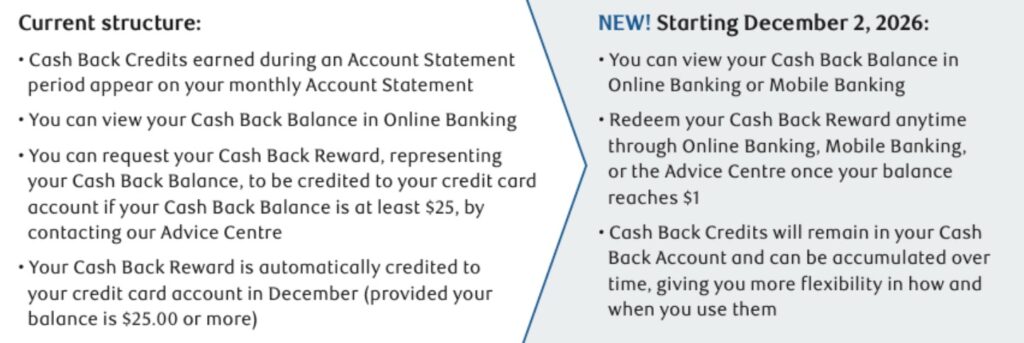
On December 2, 2026, RBC is modernizing redemptions. Today, cash back accumulates with each statement and redemption requires a $25 balance. Two barriers are being removed.
This flexibility catches up to what Tangerine and Rogers already offer. In practical terms, it changes little regarding yield, but a lot regarding the experience. You no longer have $25 sitting idle.
The $21 increase in annual fees is accompanied by an enrichment of the insurance component on the Preferred World Elite. Three coverages were added on October 1.
This trio brings the card up to the level of competing World Elite cards. To compare coverages item by item, see our ranking of the best credit cards with insurance.
To measure the real effect, we built six annual spending profiles. Each reflects a common Canadian reality. Note that Costco warehouse purchases appear in a separate column: warehouse clubs do not code as groceries with payment networks.
| Profile | Grocery | Dining | Gas | Transit | Streaming | Costco | Other | Total |
|---|---|---|---|---|---|---|---|---|
| A. Suburban family | $12,000 | $3,600 | $3,600 | $0 | $600 | $0 | $10,200 | $30,000 |
| B. Road representative | $4,800 | $4,800 | $9,600 | $0 | $600 | $0 | $5,200 | $25,000 |
| C. Costco loyalist | $2,400 | $1,800 | $2,400 | $0 | $0 | $9,000 | $4,400 | $20,000 |
| D. Urban youth without a car | $3,600 | $4,800 | $0 | $1,800 | $900 | $0 | $3,900 | $15,000 |
| E. Renovator and varied shopper | $0 | $0 | $0 | $0 | $0 | $8,000 | $17,000 | $25,000 |
| F. Everything on one card | $6,000 | $3,000 | $3,000 | $0 | $0 | $0 | $33,000 | $45,000 |
Here is the net annual cash back, annual fees deducted, before and after October 1, 2026. The amounts take into account the $25,000 cap that applied to the 1.5% rate until September 30.
| Profile | Previous net ($99) | New net ($120) | Annual difference | Verdict |
|---|---|---|---|---|
| A. Suburban family | $326 | $576 | +$250 | Winner |
| B. Road representative | $276 | $526 | +$250 | Big winner |
| C. Costco loyalist | $201 | $212 | +$11 | Neutral |
| D. Urban youth without a car | $126 | $252 | +$126 | Winner |
| E. Renovator and varied shopper | $276 | $130 | -$146 | Loser |
| F. Everything on one card | $476 | $570 | +$94 | Winner |
Profile B clearly illustrates the logic of the change. With $9,600 in gas per year, their cash back on this item alone goes from $144 to $288. The representative who drives for a living doubles their harvest. Profile E, however, pays the price. Their $25,000 in spending does not touch any accelerated categories. Their rate has therefore dropped from 1.5% to 1% while their fees went up.
A single figure decides your fate: the share of your spending in the nine 3% categories. Below the threshold, you lose. Above it, you win.
| Annual spending | Share required in 3% categories | In dollars |
|---|---|---|
| $15,000 | 32% | $4,800/year |
| $20,000 | 30% | $6,060/year |
| $25,000 | 29% | $7,300/year |
| $30,000 | 24% | $7,320/year |
| $40,000 | 18% | $7,320/year |
In other words, about $7,300 per year in groceries, dining, gas, transit, or streaming is enough to come out ahead. A household spending $600 per month on groceries already crosses this threshold. This is why the majority of cardholders will benefit.
The picture darkens for the no-annual-fee card. Five out of six profiles lose money. We added a seventh profile, the one who only uses the card for groceries.
| Profile | Previous cash back | New cash back | Annual difference | Verdict |
|---|---|---|---|---|
| A. Suburban family | $360 | $348 | -$12 | Nearly neutral |
| B. Road representative | $292 | $245 | -$47 | Loser |
| C. Costco loyalist | $206 | $148 | -$58 | Loser |
| D. Urban youth without a car | $174 | $138 | -$36 | Loser |
| E. Renovator and varied shopper | $220 | $125 | -$95 | Loser |
| F. Everything on one card | $510 | $330 | -$180 | Big loser |
| G. Groceries only ($12,000) | $180 | $210 | +$30 | Winner |
The loss for profile F is striking. Their $33,000 in varied purchases earned 1% thanks to the $6,000 threshold. They drop to 0.5%, meaning $165 vanished on this item alone. This card ceases to be an all-purpose card; it becomes a grocery card.
The calculation is clear. To lose nothing, your grocery spending must represent a significant portion of your spending on the card.
| Annual spending on the card | Grocery share required | In dollars |
|---|---|---|
| $10,000 | 73% | $7,340/year |
| $15,000 | 60% | $9,000/year |
| $20,000 | 53% | $10,680/year |
| $30,000 | 47% | $14,010/year |
Few households devote half of their card purchases to groceries. Consequently, the right strategy is to reserve this card for groceries and pay for everything else elsewhere. See our page on the best no-annual-fee credit cards for alternatives.
The new Preferred World Elite enters a crowded category. We applied the same six profiles to the main Canadian cash back cards, including category caps. All amounts are net of regular annual fees, without considering first-year waivers.
| Profile | RBC Pref. WE ($120) | Scotia Momentum VI ($120) | BMO CashBack WE ($139) | Desjardins CashBack WE ($100) | Amex SimplyCash Preferred ($119.88) | Rogers WE ($0) | Tangerine WMC ($0) |
|---|---|---|---|---|---|---|---|
| A. Suburban family | $576 | $582 | $479 | $572 | $792 | $450 | $438 |
| B. Road representative | $526 | $376 | $381 | $390 | $668 | $375 | $413 |
| C. Costco loyalist | $212 | $176 | $205 | $208 | n/a | $300 | $199 |
| D. Urban youth without a car | $252 | $165 | $218 | $290 | $252 | $225 | $228 |
| E. Renovator and varied shopper | $130 | $130 | $111 | $150 | n/a | $375 | $125 |
| F. Everything on one card | $570 | $540 | $611 | $590 | $960 | $675 | $855 |
Three findings stand out. First, the SimplyCash® Preferred Card from American Express dominates wherever it is accepted, with 4% on groceries and gas plus 2% elsewhere. However, American Express is not accepted at Costco or in many businesses, hence the “n/a” boxes.
Second, the Scotia Momentum® Visa Infinite +* Card holds its own against the RBC card for families with a large grocery bill: $582 versus $576 for profile A, thanks to its 4% on groceries. Third, the new RBC card wins its duel against Scotia and BMO among heavy gas consumers, as its 3% is never capped.
This is the clearest collateral damage of this revamp. The flat 1.5% made the Preferred World Elite one of the few interesting Mastercards for Costco warehouses, since Costco Canada refuses Visa and American Express. Warehouse purchases now drop to 1%.
We revisited profile C, which spends $20,000 per year, including $9,000 at Costco warehouses. Here is the ranking by net cash back.
| Card | Gross cash back | Annual fee | Net cash back |
|---|---|---|---|
| Rogers Red World Elite® Mastercard | $300 | $0 | $300 |
| CIBC Costco Mastercard | $284 | $0 | $284 |
| RBC Cash Back Preferred WE Mastercard (new rates) | $332 | $120 | $212 |
| Desjardins CashBack World Elite Mastercard | $308 | $100 | $208 |
| BMO® CashBack World Elite®* Mastercard®* | $344 | $139 | $205 |
| RBC Cash Back Preferred WE Mastercard (previous rates) | $300 | $99 | $201 |
| Tangerine® Money-Back World Mastercard®* | $199 | $0 | $199 |
The RBC card gains $11 regardless, because Costco gas continues to code as gas and benefits from the new 3%. That said, two no-annual-fee cards still outperform it. For a warehouse-oriented wallet, see our comparison of the best credit cards for Costco.
The new rates for the Preferred World Elite mirror those of the RBC ION+ Visa Card exactly: 3% on the same nine categories, 1% elsewhere. The difference comes down to two things: currency and price. The ION+ costs $48 and pays Avion points; the Preferred costs $120 and pays cash.
| Profile | Preferred WE, net | ION+ Avion Points | ION+ at 1.0 ¢/pt, net | ION+ at 1.5 ¢/pt, net |
|---|---|---|---|---|
| A. Suburban family | $576 | 69,600 | $648 | $996 |
| B. Road representative | $526 | 64,600 | $598 | $921 |
| D. Urban youth without a car | $252 | 37,200 | $324 | $510 |
| F. Everything on one card | $570 | 69,000 | $642 | $987 |
At a nominal value of 1¢ per point, the ION+ consistently leads by $72, which is exactly the difference in annual fees. At our valuation of 1.5¢ per Avion point, the gap explodes. However, one must extract this value, which requires a good understanding of the program.
The Preferred World Elite therefore maintains a specific audience: those who want cash without arbitrage, point transfers, or card pairing. It also adds DragonPass lounge access and World Elite benefits, which are absent from the ION+. To evaluate the other path, read how much RBC Avion points are worth.
RBC renewed the welcome offers on both cards with the revamp. They apply to applications received from October 1, 2026 to February 2, 2027.
| Card | Welcome offer | Maximum value | Year 1 fee | Year 1 net gain |
|---|---|---|---|---|
| Preferred World Elite | 15% extra cash back on the first $2,000 in purchases for 3 months | $300 | $120 | $180 |
| Mastercard Cash Back | 5% extra cash back on the first $2,000 in purchases for 6 months | $100 | $0 | $100 |
At a $120 annual fee, the card will need to generate more than $120 in cash back to justify its cost. According to our six profiles, this threshold is crossed starting at $12,000 in well-distributed annual spending.
The answer depends entirely on your spending structure. Here are the two scenarios.
In the second case, three options stand out. The Rogers Red World Elite® Mastercard pays a flat yield with no annual fee. The SimplyCash® Preferred Card from American Express dominates the grocery and gas duo, wherever American Express is accepted. Finally, the Desjardins Cash Back World Elite Mastercard targets outings and transit.
For the Preferred World Elite, the verdict is favourable. Four out of six profiles gain between $94 and $250 per year. The break-even point is reached with about $7,300 in annual spending in accelerated categories. The $21 in additional fees is further justified by the addition of three insurances, including out-of-country medical coverage.
For the no-annual-fee card, the finding is harsher. The cut from 1% to 0.5% on non-category purchases penalizes anyone who used it as their primary card. Only those with large grocery bills come out ahead. If you are in this situation, reserve it for groceries from now on.
Both cards gain at least one thing: redemption from $1 starting December 2. To follow upcoming changes to Canadian programs, subscribe to our newsletter.
on RBC's website
Here are frequently asked questions in the milesopedia community regarding RBC cash back cards.
The new earn rates have applied to both cards since October 1, 2026. On the same date, the annual fee for the RBC Cash Back Preferred World Elite Mastercardਠincreased from $99 to $120. Additional cards also became fee-based at $50 each. The second phase arrives on December 2, 2026: cash back becomes redeemable on demand from $1, and it is credited as soon as a transaction is posted. You will, however, need to request it yourself, as the automatic January payout ends.
Yes. RBC is announcing a 3% rate with no spending cap or cash back limit on the nine targeted categories. This is the central argument of the revamp, as most competitors have caps. BMO limits its 5% on groceries to $500 per statement. Scotia caps its tiers at $25,000 per year. In exchange, RBC’s base rate drops to 1%, compared to 1.5% until September 30 on the first $25,000.
No, it has lost its appeal for warehouse shopping. A Costco warehouse is coded as a warehouse club, never as a grocery store: your purchases there have dropped from 1.5% to 1%. Since Costco Canada only accepts Mastercard, this card was among the few valid options. Two no-annual-fee cards now outperform it: the Rogers Red World Elite® Mastercard at 1.5% and the CIBC Costco Mastercard. Good news regardless: Costco gas stations code as gas and benefit from the new 3%.
Because its base rate on other purchases dropped from 1% to 0.5% permanently. Until September 30, as soon as your annual purchases crossed $6,000, all your remaining spending earned 1%. This tier is gone. The 2% on groceries has become unlimited, which only compensates if groceries represent about half of your spending on the card. In our simulations, a profile spending $45,000 per year loses $180.
Both cards offer exactly the same rates since October: 3% on nine categories, 1% elsewhere. The RBC ION+ Visa Card costs $48 and pays Avion points; the Preferred World Elite costs $120 and pays cash. At a nominal value of 1¢ per point, the ION+ leads by $72 per year, which is the fee difference. Choose the Preferred if you want cash without arbitrage and World Elite benefits, including DragonPass lounge access.
Nine categories trigger the 3% rate on the Preferred World Elite: groceries, restaurants and bars, food delivery, gas and EV charging. Also included are public transit, rideshare, streaming and digital gaming. Everything else earns 1%, including purchases at provincial liquor stores such as the LCBO or SAQ. Watch the merchant code: a Costco warehouse is classified as a warehouse club and not a grocery store, so it only earns 1%. Costco gas stations, however, do code correctly as gas.
It takes about $7,300 per year in the 3% categories to not lose out compared to the old 1.5%. This threshold corresponds roughly to $600 per month in groceries, or a mix of groceries, dining, and gas. To cover the $120 annual fee alone, expect about $12,000 in well-distributed annual spending. Beyond $30,000 in spending, a 24% share in accelerated categories is already enough.
Yes, and this is the most costly change for households. On the Preferred World Elite, each additional card went from $0 to $50 per year on October 1, 2026. A couple sharing the card sees their bill jump from $99 to $170, an increase of $71. With two additional cards, the total reaches $220. Check if the additional cardholder generates enough spending in accelerated categories to absorb this cost.
No. Until now, RBC automatically credited your cash back balance in January, at the end of each annual period, provided it had reached $25. Starting December 2, 2026, this automatic crediting ends on both cards. Your cash back accumulates in your cash back account until you request it, from $1, through Online Banking, the RBC Mobile App or by phone. You can redeem all or part of your balance, as often as you like, and RBC credits your account within five business days. If you never had to request your cash back before, set a reminder: it will no longer arrive on its own. Details are on the RBC cash back updates page.
Yes. RBC raised the annual purchase interest rate on both cards from 20.99% to 21.99%. The new rate applies from the first day of your statement period beginning on or after October 1, 2026. If you pay your balance in full by the due date, this change costs you nothing. If you carry a balance, the extra percentage point adds about $10 in interest per year for every $1,000 carried.
on RBC's website
Our reviews and rankings are based on an objective assessment. Advertisers do not influence our content. We may receive compensation through some links; our analysis and opinions remain independent.