RBC Avion Points Value: How Much Are Avion Points Worth?

Loading article…
There is no single answer to the Avion points value question. Depending on the redemption you choose, one point is worth roughly 0.58 cents at the low end and up to 2.33 cents on the air travel redemption chart, and it can exceed 2.9 cents when you transfer to an airline partner during a bonus period. That fourfold gap comes from how you spend your RBC Avion points, not from which card sits in your wallet.
At Milesopedia, we value an Avion point at 1.5 cents. This benchmark lets us compare welcome offers across programs. However, it remains an average. Indeed, you can do considerably better with the fixed air travel redemption chart, and considerably worse inside the booking portal. Before you pick a card, compare your options on our best credit cards page.
The short answer: between 0.58 and 2.33 cents per point. The result depends only on the redemption type and on your membership level within Avion Rewards®. Three families of redemptions explain the entire spread.
The table below summarizes the value you get by use case. Afterwards, each section covers the conditions that apply.
| Avion points redemption | Rate | Value per point |
|---|---|---|
| Air travel redemption chart (Avion Elite members) | 15,000 to 100,000 points per round trip | 2.00 to 2.33 cents |
| Transfer to an airline partner, with a bonus | depends on the receiving program | 2.9 cents and up |
| Business class | 100 points = $1 | 1.00 cent |
| Booking portal, Avion Elite member | 100 points = $1 | 1.00 cent |
| Booking portal, Avion Distinction member | 172 points = $1 | 0.58 cent |
| Merchandise, gift cards, Ticketmaster, statement credit | Not disclosed | No published chart |
This is where Avion points deliver the most. RBC publishes a fixed grid: each travel category costs a set number of points and covers a base fare up to a specific cap. As a result, the closer your base fare sits to that cap, the higher your value per point climbs.
| Points (round trip) | Category | Zone covered | Max base fare | Max value per point |
|---|---|---|---|---|
| 15,000 | Quick Getaways | Adjacent province, territory or US state | $350 | 2.33 cents |
| 35,000 | Explore North America | Canada and the United States, excluding Hawaii and Alaska | $750 | 2.14 cents |
| 45,000 | Vacation Destinations | Western Canada and US to Mexico, Hawaii, Alaska; Eastern Canada to Bermuda, Central America, the Caribbean | $900 | 2.00 cents |
| 55,000 | Unforgettable Escapes | Eastern Canada and US to Mexico, Hawaii, Alaska; Western Canada to Bermuda, Central America, the Caribbean | $1,100 | 2.00 cents |
| 65,000 | Visit Europe | Major Canadian or US gateway to Europe | $1,300 | 2.00 cents |
| 100,000 | See the World | Major gateway to Asia, Australia, New Zealand, the South Pacific, the Middle East, Africa, South America | $2,000 | 2.00 cents |
A few rules frame this chart. First, the amounts shown are round trips; a one way costs half the points. Second, taxes, surcharges and fees remain payable in cash. Finally, if the base fare exceeds the category cap, you pay the difference yourself. For the full walkthrough, read our guide to the RBC air travel redemption chart.
Here is the single most useful number in this article. Inside the booking portal, your membership level changes everything. An Avion Elite member pays 100 points per $1 of travel, which works out to 1.00 cent per point. An Avion Distinction member pays 172 points per $1, or roughly 0.58 cent per point.
In other words, the same $500 trip costs 50,000 points at the Elite level but 86,000 points at the Distinction level. Your points balance does not change; only the applied rate does. That is why your membership level matters more than the size of your balance. We break down each tier in our guide to Avion membership levels.
Avion Rewards also lets you move points to four airline partners. The ratios vary widely, and each transfer carries a minimum. Moreover, once the points leave your account, the conversion cannot be reversed.
| Partner | Transfer ratio | Minimum |
|---|---|---|
| WestJet Rewards | 100 Avion points = 1 WestJet dollar | 1,000 points |
| The British Airways Club (Avios) | 1 point = 1 Avios | 10,000 points |
| American Airlines AAdvantage | 10 points = 7 miles | 5,000 points, in increments of 10 |
| Cathay Pacific Asia Miles | 1 point = 1 mile | 10,000 points |
| Hudson’s Bay Rewards | Transfer ended: Hudson’s Bay Rewards closed in 2025, with the liquidation of Hudson’s Bay | Not applicable |
British Airways and Asia Miles convert at parity, which preserves your balance. In contrast, AAdvantage applies a ratio of 10 points for 7 miles, so you give up 30 percent of your volume on conversion. Our Avion transfer guide walks through every step.
The air travel redemption chart caps out at 2.33 cents per point. That ceiling stops applying as soon as RBC bonuses a transfer. Once or twice a year the bank adds a premium on conversions to an airline program, and the lowest bonus we have recorded to British Airways Avios is 30 percent. On the American Airlines AAdvantage side the premium runs around 15 percent, and Cathay Pacific Asia Miles has been bonused in the past as well.
The effect is mechanical. A bonus cuts the number of Avion points you need, so it raises the value of every point. Here is the arithmetic on an ordinary redemption, without even hunting for an exceptional fare.
A one way Montreal to London in economy on British Airways costs 27,500 Avios plus $150 in taxes, against $768 paid in cash. You therefore save $618 net. At parity, that works out to 2.25 cents per Avion point. With a 30 percent bonus, the same 27,500 Avios only take 21,154 points, and the value climbs to 2.92 cents per point, past the best return on the chart. Our guide to booking British Airways award tickets covers the process.
This is the redemption our readers ask about most. A one way Montreal to Doha in business class, so in Qsuite, starts at 70,000 Avios off peak. With a 30 percent transfer bonus, that comes to 53,846 Avion points. The transfer then beats the chart’s 2.33 cents as soon as the cash fare on the same flight passes roughly $1,255, which is common on this route in business class. Our guide to flying Qsuite with points compares the available programs.
This is also where Avios crushes AAdvantage. Both programs ask 70,000 units for the flight, and the taxes are actually lower with AAdvantage. However, the 10 points for 7 miles ratio changes everything: going through AAdvantage takes 86,957 Avion points against 53,846 through Avios, which is 62 percent more. As for Asia Miles, taxes on this route approach $526, which wipes out the benefit.
Our own trips show how far a sweet spot can go. In 2020, a Taipei to Tokyo flight on Japan Airlines for four passengers took 44,000 Avios and $200.80 in taxes, against $2,059 in cash. That is 4.22 cents per Avios, and 5.49 cents per Avion point with a 30 percent bonus.
A 2023 Qsuite return from Southeast Asia for two passengers came in at 150,000 Avios against $7,068 in cash, so 4.71 cents per Avios, or 6.13 cents per Avion point with a bonus. Both cases are dated: they predate the British Airways award price increase of December 2025. They show the order of magnitude that is reachable, not a current fare.
These are the redemptions that push your value toward the top of the range.
Conversely, some redemptions melt the value of your balance. Avoid them whenever you can.
Let us be transparent: RBC publishes no chart for these redemptions. The point prices for merchandise, gift cards, Ticketmaster tickets and statement credits only appear once you log into the Avion Rewards portal. Consequently, we cannot quote a cents per point value for any of them.
In practice, take five minutes before you confirm. Open your account, note the point price on screen, then divide the dollar value of the item by that number of points. You will get the real value of your redemption without guessing. Our guide on how to use Avion points without travelling reviews these options.
Our 1.5 cent Avion points value does not come out of thin air. It reflects what an Avion Elite member gets on average across all redemptions, by combining the two main channels of the program.
The 1.5 cent average therefore sits between the chart and the portal. Indeed, nobody books only flights that hit the cap of every category. This conservative figure exists so you can compare a 70,000 point Avion welcome offer against an offer expressed in another currency. However, it never replaces the actual math on your own redemption.
| Avion points balance | Milesopedia benchmark (1.5 cents) | Portal, Avion Elite member (1.00 cent) | Portal, Avion Distinction member (0.58 cent) |
|---|---|---|---|
| 15,000 points | $225 | $150 | $87 |
| 35,000 points | $525 | $350 | $203 |
| 55,000 points | $825 | $550 | $320 |
| 70,000 points | $1,050 | $700 | $407 |
| 100,000 points | $1,500 | $1,000 | $581 |
An Avion point is worth what you make of it. The air travel redemption chart puts you between 2.00 and 2.33 cents per point; the portal pulls you back to 1.00 cent at the Elite level and 0.58 cent at the Distinction level. Therefore, the first question to ask is not how many points you hold, but which door you plan to redeem them through.
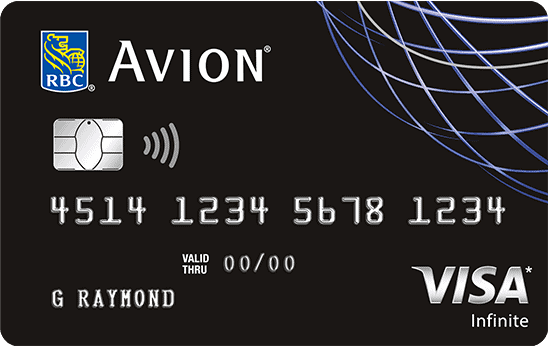
To earn Avion points, the RBC Avion Visa Infinite remains the entry point to the Elite level. Finally, subscribe to our newsletter to follow changes to the chart and the welcome offers worth watching.
For a limited time, the RBC Avion Visa Infinite Card offers a welcome bonus of up to 70,000 Avion points, worth up to $1,500 in travel.
You can redeem your Avion points for flights on more than 500 airlines, with no blackout periods or seat restrictions, or transfer them to partner programs such as American Airlines AAdvantage, The British Airways Club, Cathay Pacific Asia Miles and WestJet Rewards.
The card earns 1.25 points per dollar on eligible travel purchases and 1 point per dollar on all your other eligible purchases. It also includes extensive insurance coverage: emergency medical, trip cancellation and interruption, rental car collision and mobile devices.
The annual fee is $120.
on RBC's website
Here are the questions our readers ask most often about the value of RBC Avion points.
An Avion point is worth between 0.58 and 2.33 cents depending on the redemption. The published maximum comes from the Quick Getaways category of the air travel redemption chart, at 15,000 points for a base fare of up to $350. The minimum matches the booking portal at the Avion Distinction level, at 172 points per $1. Milesopedia uses a benchmark value of 1.5 cents per point to compare programs against each other.
The air travel redemption chart almost always delivers the best return. Each category costs a fixed number of points and covers a capped base fare, which puts you between 2.00 and 2.33 cents per point. Therefore, book when the base fare sits close to the category cap. The portal still helps when no eligible flight matches your dates, but it brings you back to 1.00 cent per point at the Elite level.
Because the portal applies a fixed rate tied to your membership level. An Avion Elite member pays 100 points per dollar of travel, or 1.00 cent per point. An Avion Distinction member pays 172 points per dollar, or roughly 0.58 cent per point. This rate depends on neither the ticket price nor the destination. Our guide to Avion membership levels explains which tier matches which card.
Four airline partners accept Avion points: WestJet Rewards, The British Airways Club, American Airlines AAdvantage and Cathay Pacific Asia Miles. British Airways and Asia Miles convert at parity, while AAdvantage applies 10 points for 7 miles. Note that Avion Distinction members can only transfer to WestJet. Our Avion transfer guide lists the minimum for each program.
The Visit Europe category requires 65,000 points for a round trip departing from a major Canadian or US gateway. It covers a base fare of up to $1,300, which gives a maximum value of 2.00 cents per point. A one way costs half the points. However, taxes, surcharges and fees still come out of your pocket.
No. The chart covers the base fare only, up to the maximum set by the category. You then pay taxes, surcharges and other fees in cash. In addition, if the base fare exceeds the category cap, the difference remains yours to cover. Calculate the value of your redemption on the base fare alone.
Yes. The Avion Rewards portal offers merchandise, gift cards, Ticketmaster tickets and statement credits. However, RBC publishes no chart for these redemptions: the point prices appear only once you log into your account. Check the price on screen, then run the math yourself before you confirm. Our guide on how to use Avion points without travelling covers these options.
At our 1.5 cent benchmark, 70,000 Avion points are worth about $1,050 in travel. In the booking portal, the same balance is worth $700 for an Avion Elite member (1.00 cent per point), but only about $407 for an Avion Distinction member (0.58 cent). With the air travel redemption chart you can aim higher, up to 2.00 cents per point in most categories.
on RBC's website
Our reviews and rankings are based on an objective assessment. Advertisers do not influence our content. We may receive compensation through some links; our analysis and opinions remain independent.