

Aeroplan Mixed Cabin: When to Accept It and How to Avoid Overpaying
- Business

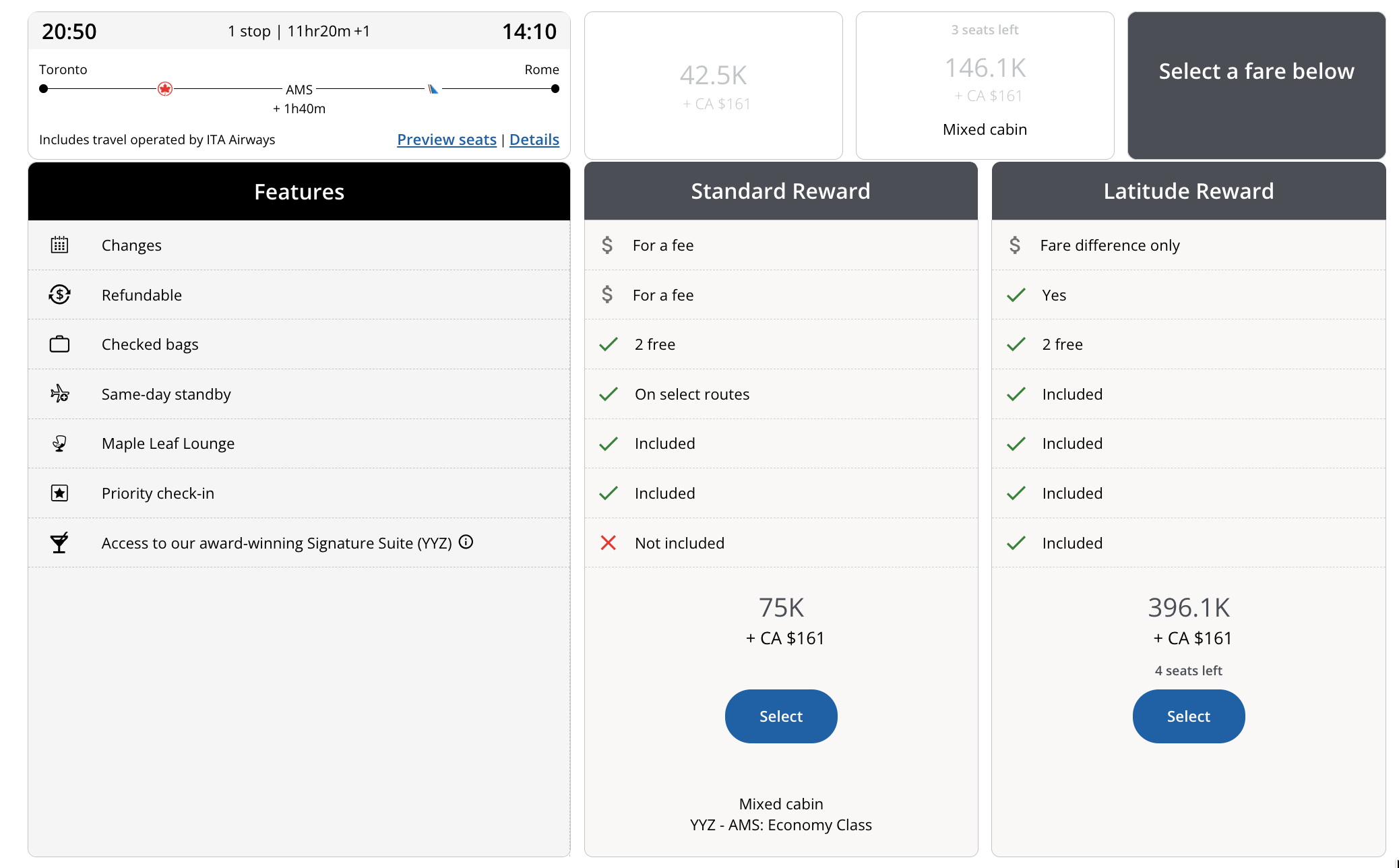
Aeroplan prices a mixed cabin itinerary at the highest class of service in the itinerary, per direction of travel. A single economy segment therefore does not lower your bill by one point. On a Toronto-Rome award at 75,000 points in business class, you pay the full price. The first two-hour flight may well put you at the back of the aircraft.
This rule explains the most common frustration among Aeroplan members flying to Europe. Before you book, it pays to know how to spot a mixed cabin and how to work around it. To fund these awards, our roundup of the best Aeroplan credit cards is the place to start.
Why an Aeroplan mixed cabin costs full price
Aeroplan’s flight reward policy is explicit. The price of a reward booked across different classes of service is based on the highest class of service, for each direction of travel. In other words, as soon as one segment goes out in business class, the entire direction bills at the business rate.
The gap is concrete. Between North America and the Atlantic, take the 4,001 to 6,000 mile band. The chart in effect since June 1, 2026 asks 42,500 points in economy and 75,000 points in business, per direction. A mixed cabin therefore costs you 32,500 points more than the economy rate, no matter how much of the trip you actually spend up front.
These fixed numbers only apply to a flight operated by a Star Alliance partner. A flight operated by Air Canada itself follows a different logic entirely: the number of points moves with demand, much like a cash price. On the same city pair, the same day, an Air Canada flight can cost two or three times more than a partner’s, or less. Check who operates the flight before comparing two prices against each other.
Spotting a mixed cabin before you book
The display on aircanada.com gives a useful clue to watch for. A business class search there returns itineraries the engine still labels as business, even when one or more segments go out in economy. Opening the detail of each itinerary and checking the advertised cabin segment by segment catches it, rather than relying on the overall label alone.

Three habits speed up this sorting:
- Expand every itinerary: the actual cabin appears under each flight number, not in the price banner.
- Look at the short segment: a feeder flight to the hub (Montreal-Toronto, Toronto-Newark) is the first candidate for economy.
- Compare against the band rate: if the displayed price matches the full business rate, the mixed cabin saves you nothing.
Specialized award search engines also flag mixed cabin itineraries directly, which Air Canada’s own tool does not do obviously. They save a lot of time on flexible dates.
Four ways to avoid a mixed cabin
All of these methods can be built directly from the online search, with no call to the contact centre, as long as you know the room the routing policy leaves you.
Change connections within the 24-hour window
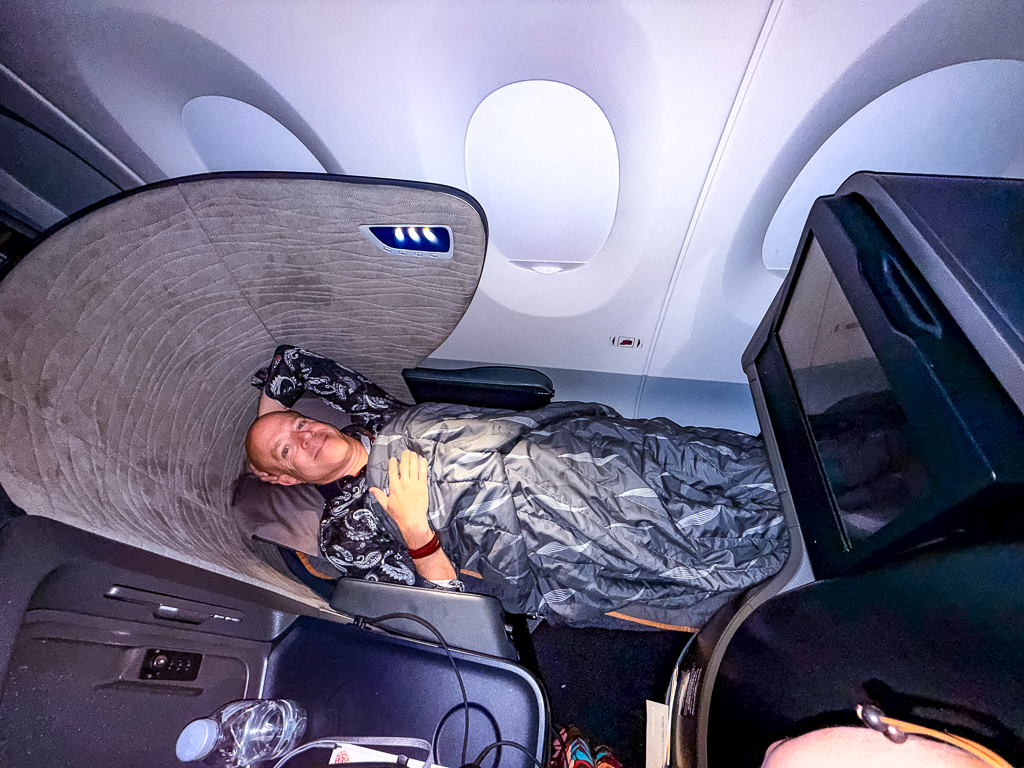
Aeroplan tolerates a long connection before treating it as a stopover. Between Canada or the United States and an international destination, the 24-hour connection window applies to each connection taken individually. Between two points in Canada and the United States, the limit drops to 4 hours, unless otherwise permitted.
That room changes everything. If the morning feeder flight only has economy, try a late-day departure instead. That flight stays within the same award and sometimes shows business class. Beyond the limit, the award breaks into two separate directions of travel, or triggers a stopover, and the price changes.
Split the outbound and return into two awards
Pricing applies per direction, so the outbound and return stay independent of each other. Booking two one-way awards rather than a round trip changes the bill. You pay 75,000 points for the direction entirely in business, and 42,500 points for the one where only economy opens up.
In the 4,001 to 6,000 mile band, that split brings the trip down from 150,000 to 117,500 points. However, two separate bookings also mean two files to change, so potentially double the fees.
Change your connecting airport
A different connecting airport can turn up an all-Premium-Economy or all-Business fare on the same route, simply because a partner flies a different aircraft type out of that hub. Check, via the Aeroplan multi-city search, whether a nearby hub (Montreal instead of Toronto, Munich instead of Frankfurt) removes the segment that was forcing the full fare.
Target a non-stop flight to Europe
The simplest fix is the non-stop flight: with no connection, a mixed cabin becomes impossible. From Montreal and Toronto, several Star Alliance partners serve Europe non-stop, which removes the problematic feeder segment in one move.

Note one zone constraint as well: travel between North America and Europe must cross the Atlantic Ocean. A detour through Asia is therefore not an option for chasing availability.
The calculation to run
Knowing which segment is in economy changes everything. A mixed cabin costs very differently depending on whether it hits the two-hour flight or the seven-hour crossing.
| Scenario | Segment in economy | Price paid | Verdict |
|---|---|---|---|
| Mixed feeder | Montreal-Toronto, 1 h | 75,000 points | Acceptable: the crossing is in business |
| Mixed crossing | Toronto-Rome, 8 h | 75,000 points | Turn it down: you pay business for economy |
| Economy on purpose | Whole itinerary | 42,500 points | Saves 32,500 points |
The action rule fits in one sentence: accept a mixed cabin when the economy segment runs under two hours, turn it down as soon as it hits the transatlantic flight. In that second case, the distance band makes you pay 32,500 points for comfort you will not get.
These amounts come from the chart that took effect on June 1, 2026, which raised transatlantic business class from 70,000 to 75,000 points.
The routing limits to know
Rebuilding an itinerary to find business availability is allowed, but within a precise frame. Aeroplan accepts a circuitous trip as long as the cumulative flown distance between origin and destination does not exceed twice the non-stop distance, for a given direction of travel.
- No backtracking: within a single direction, you cannot pass again through the same airport, city or country.
- Six segments per direction maximum: a reservation accepts 12 segments in total and 1 to 6 directions of travel.
- One stopover per direction: up to 45 days, for additional points, but never within Canada, the United States or China.
- Final validation: Aeroplan and the operating airlines approve the routing, so a compliant build can still be refused.
In practice, stretching a trip to chase a business seat remains possible. Do check the displayed price after every change, though, since the number of points depends on the distance band of the itinerary you settle on.
Which card earns these 75,000 points
A one-way transatlantic award in business asks 75,000 points. A single welcome bonus therefore covers a good part of the ticket, which makes the choice of card decisive.
The CIBC Aeroplan® Visa Infinite* Card offers up to 50,000 Aeroplan points for $12,000 in spending over 12 months. CIBC rebates the $139 annual fee in the first year. At 2 cents per point, you gain roughly $1,000 in year one, with no fee.

- Annual fee
- $0 $139No annual fee the first year
- No annual fee the first year
- Our valuation
- $1,139Milesopedia first-year estimate First-year valueWelcome bonus$1,000Annual fee rebated$139Total$1,139Rewards on your spending are not included. The calculator that adds them from your own profile is on the card's page.
- Milesopedia first-year estimateFirst-year valueWelcome bonus$1,000Annual fee rebated$139Total$1,139Rewards on your spending are not included. The calculator that adds them from your own profile is on the card's page.
- Welcome offer
- Up to 50,000 points
- + First Year Annual Fee Rebate
on CIBC's website
The TD® Aeroplan® Visa Infinite* Card follows a similar logic: up to 50,000 points for $12,000 over 12 months, and the same $139 fee rebated in the first year. The value lands near $1,000.
- Annual fee
- $0 $139No annual fee the first year
- No annual fee the first year
- Our valuation
- $1,139Milesopedia first-year estimate First-year valueWelcome bonus$1,000Annual fee rebated$139Total$1,139Rewards on your spending are not included. The calculator that adds them from your own profile is on the card's page.
- Milesopedia first-year estimateFirst-year valueWelcome bonus$1,000Annual fee rebated$139Total$1,139Rewards on your spending are not included. The calculator that adds them from your own profile is on the card's page.
- Welcome offer
- Up to 50,000 points
- + First Year Annual Fee Rebate
on TD's website
To earn faster, the American Express® Aeroplan®* Reserve Card offers up to 85,000 points for $7,500 over 3 months, against a $599 annual fee. The net gain lands around $1,100 in year one.
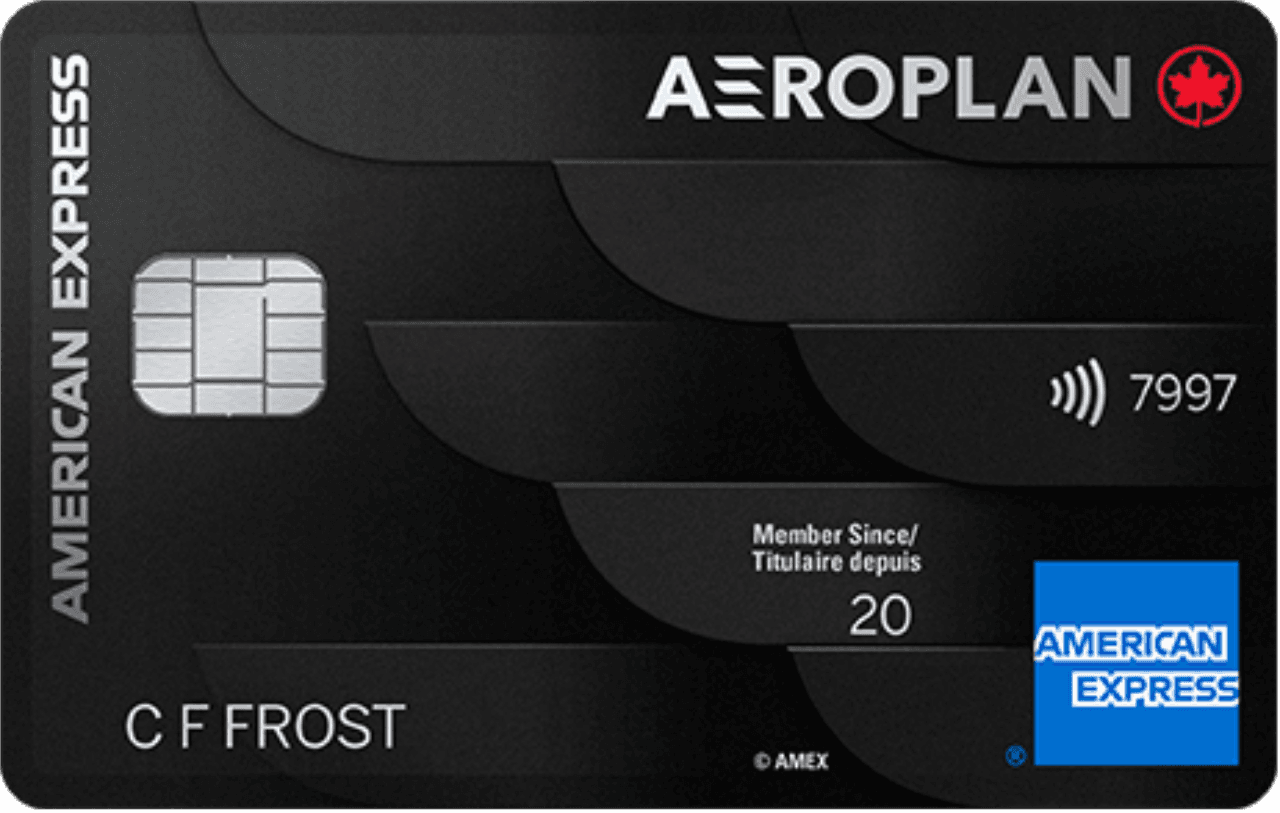

- Annual fee
- $599
- Our valuation
- $1,700Milesopedia first-year estimate First-year valueWelcome bonus$1,700Total$1,700Rewards on your spending are not included. The calculator that adds them from your own profile is on the card's page.
- Milesopedia first-year estimateFirst-year valueWelcome bonus$1,700Total$1,700Rewards on your spending are not included. The calculator that adds them from your own profile is on the card's page.
- Welcome offer
- Up to 85,000 points
on American Express's website
Apply with confidence — no impact on your credit scoreApply with confidenceCheck whether your application will be approved before you submit it, with no impact on your credit score*When you apply for a personal American Express Credit Card, we will tell you whether you are eligible without affecting your credit score. So you can apply with confidence.*Instant decisions are only available for consumer Card applications (also called “personal Cards”).
These estimates assume a value of 2 cents per Aeroplan point, the middle of the 1.8 to 2.3 cent range we observe depending on the type of booking. To compare every option on the market, see our page of best credit cards.
What to remember before booking
A mixed cabin comes down to how the price is distributed. Since the bill is calculated on the highest cabin of each direction, your only room to manoeuvre lies in deciding which segment deserves those points.
- Short segment in economy: book it, the crossing in business justifies the 75,000 points.
- Crossing in economy: turn it down and pay 42,500 points in deliberate economy instead.
- Only one problematic direction: split into two one-ways and save 32,500 points.
- Disappointing connection: shift it within the 24-hour window before giving up on your dates.
To follow the next changes to the Aeroplan chart and transfer bonuses, subscribe to our newsletter.
Aeroplan mixed cabin – Frequently asked questions
Here are the questions that come up most often in the milesopedia community about mixed cabin itineraries with Aeroplan.
What is a mixed cabin with Aeroplan?
A mixed cabin is an award itinerary whose segments are not all in the same class of service. For example, a Montreal-Rome trip via Toronto where the first flight goes out in economy and the crossing in business. Aeroplan then bills the whole direction at the rate of the highest cabin, which is the business rate.
Do I pay less if one segment is in economy?
No. Aeroplan’s policy calculates the price on the highest class of service in the itinerary, per direction of travel. An economy segment gives no discount. In the 4,001 to 6,000 mile band to Europe, you pay 75,000 points in business whether all or only part of the trip happens in that cabin.
How many points for a Toronto-Rome flight in business class?
Toronto-Rome sits in the 4,001 to 6,000 mile band of the North America to Atlantic zone. Business class costs 75,000 points per direction under the June 1, 2026 chart, and economy 42,500 points. The rate is fixed with Star Alliance partners, while it varies on flights operated by Air Canada.
Can I upgrade my economy segment after booking?
It is possible, but never guaranteed. Aeroplan states that changes to rewards booked with mixed classes of service are subject to availability and may require additional points, on their own or combined with cash. Courtesy upgrade requests are refused, including on the day of travel at the airport.
How long can a connection last without triggering a stopover?
Between Canada or the United States and an international destination, a connection can reach 24 hours. Between two points in Canada and the United States, the limit drops to 4 hours unless otherwise permitted. Beyond that, the award breaks into two directions of travel or triggers a stopover, which changes the number of points required.
Is it better to book two one-ways than a round trip?
Yes, as soon as a single direction is a problem. Since pricing applies per direction of travel, two separate awards change the total. You pay 75,000 points for the outbound in business and 42,500 points for the return in economy, so 117,500 points instead of 150,000. The trade-off lies in change fees, which then apply to two files.
How far can an itinerary be stretched to find availability?
Aeroplan allows a circuitous trip as long as the cumulative flown distance does not exceed twice the non-stop distance, for a given direction of travel. Backtracking through the same airport, city or country stays prohibited within a single direction. A reservation accepts at most 6 segments per direction and 12 segments in total.
Can you route through Asia to reach Europe with Aeroplan?
No. The routing policy requires travel between North America and Europe to cross the Atlantic Ocean. The same constraint applies to the Middle East. For South America, travel must stay wholly within the Western Hemisphere. These rules close the door on creative detours through another pricing zone.
This discount stacks on top of another recent perk: the 15% cardholder discount.
Learn more
Our featured card
- Annual fee
- $0 $139No annual fee the first year
- No annual fee the first year
- Our valuation
- $1,139Milesopedia first-year estimate First-year valueWelcome bonus$1,000Annual fee rebated$139Total$1,139Rewards on your spending are not included. The calculator that adds them from your own profile is on the card's page.
- Milesopedia first-year estimateFirst-year valueWelcome bonus$1,000Annual fee rebated$139Total$1,139Rewards on your spending are not included. The calculator that adds them from your own profile is on the card's page.
- Welcome offer
- Up to 50,000 points
- + First Year Annual Fee Rebate
on TD's website
Our editorial integrity
Our reviews and rankings are based on an objective assessment. Advertisers do not influence our content. We may receive compensation through some links; our analysis and opinions remain independent.