

Apply with Confidence: Check Your Amex Eligibility Without Impacting Your Credit

Did you know that with American Express, you have the option to use Apply with Confidence to find out if American Express would approve your personal card application before you submit a card application?
This preliminary check is based on a soft credit inquiry and therefore does not affect your score. This step addresses the main hesitation we often hear on social media about American Express, provided you understand what it does not do—and it would be a shame to miss out!
The fear constantly returns for a new cardholder: apply for a card, get rejected, and leave a mark on your credit file for NOTHING.
American Express addresses this fear with an intermediate step, offering its Apply with Confidence « tool. » Its operation is simple, but its protection stops at a specific moment in the application process.
What Does Apply with Confidence Do Exactly?
American Express refers to this step or tool by its English name, Apply with Confidence. On its educational page dedicated to credit checks, the issuer states it plainly:
For your personal cards, you can check if you will be approved without your credit score being affected.
The mechanism relies on a distinction that Canadian credit bureaus have used for a long time. Equifax Canada speaks of « hard credit inquiry » and « soft credit inquiry. » In industry jargon, the two English terms remain the most common: hard check and soft check.
A soft inquiry leaves a note visible on your own copy of your file, but it does not change your score and lenders do not take it into account. A hard inquiry, on the other hand, is visible and calculated.
However, note that in the case of an application for business cards or made by phone, you will not have access to this verification step.
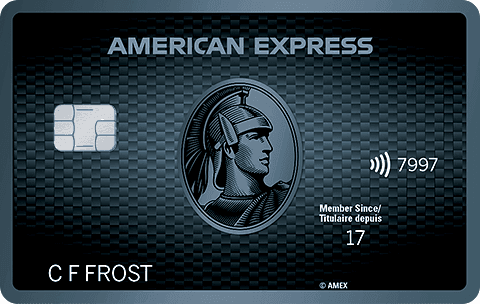

- Annual fee
- $191.88
- Our valuation
- $255Milesopedia first-year estimate First-year valueWelcome bonus$255Total$255Rewards on your spending are not included. The calculator that adds them from your own profile is on the card's page.
- Milesopedia first-year estimateFirst-year valueWelcome bonus$255Total$255Rewards on your spending are not included. The calculator that adds them from your own profile is on the card's page.
- Welcome offer
- Up to 15,000 points
on American Express's website
Apply with confidence — no impact on your credit scoreApply with confidenceCheck whether your application will be approved before you submit it, with no impact on your credit score*When you apply for a personal American Express Credit Card, we will tell you whether you are eligible without affecting your credit score. So you can apply with confidence.*Instant decisions are only available for consumer Card applications (also called “personal Cards”).
The Two Stages of an Amex Application
The process is divided into two distinct moments when applying for an American Express credit card.
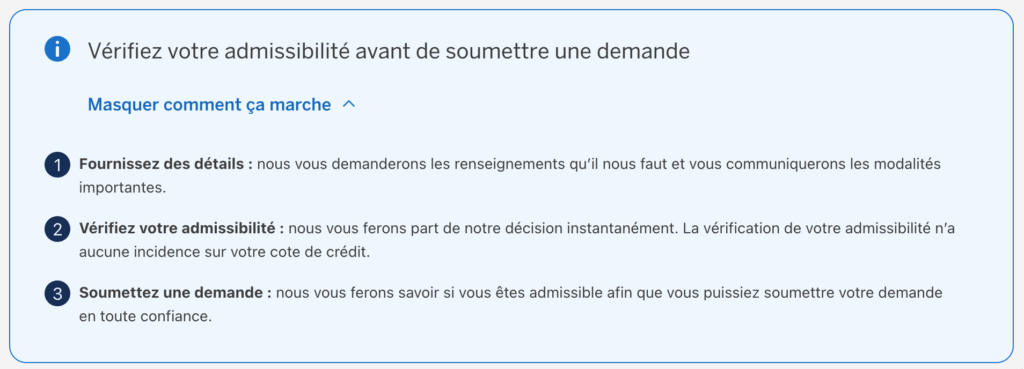
1. The Soft Inquiry
You open the page for the targeted American Express card and click the application button. American Express then collects basic information, without going further:
- Your contact information
- Your annual income
With this information, the issuer conducts a soft credit inquiry and evaluates your eligibility. American Express is categorical on its page: a soft inquiry has no impact on your credit score.
2. The Official Application, with Impact
You then receive the eligibility verdict. At this stage, nothing has been officially submitted yet: you decide whether to continue or stop there.
If you choose to accept the card, American Express proceeds to the standard check, the one that counts.
The issuer specifies that hard inquiries can remain on your credit file for up to 36 months. This duration matches Equifax Canada’s, which keeps credit inquiries for 3 years. TransUnion keeps them longer, up to 6 years. The mark therefore lives longer at one bureau than at the other, which matters all the more here: American Express applications are recorded with TransUnion.
| Criterion | Soft Inquiry (soft check) | Hard Inquiry (hard check) |
|---|---|---|
| Timing | Before the official application | Upon application submission |
| Effect on Score | None | Minor and temporary effect |
| Visibility to Lenders | Visible to you only | Visible to lenders |
| Duration on File | No impact | 3 years (Equifax), up to 6 years (TransUnion) |
| What You Get | An eligibility indication | A decision and, if approved, the card |
Which Amex Cards Are Eligible?
You can obtain this decision-making tool only for personal cards. We count nine personal American Express cards in Canada, versus four Business cards. It is the first nine that are of interest here.
- Personal cards, including the American Express Cobalt® Card, the American Express® Gold Rewards Card, and the American Express Platinum Card®
- Applications made online
- Business cards: American Express indicates that the soft inquiry is not yet offered for this type of product
- Applications taken by phone: the soft inquiry process is not offered there
Here are the cards that have this step:
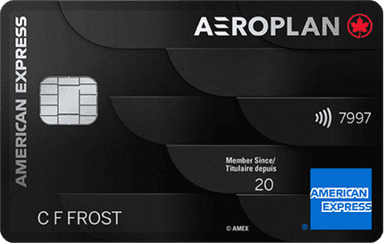
| Credit card | Annual fee | Welcome offer | |
|---|---|---|---|
| $191.88 | |||
| $799 | |||
| $120 | |||
| $250 | |||
| $0 | |||
| $0 | |||
| $119.88 | |||
| $120 | |||
| $599 |






The Calculation Few Readers Make
This is where the preliminary check takes on its full value, and no one makes this calculation out loud. Take a common scenario: you are hesitating between two American Express personal cards, and you do not know which one would approve you.
The American Express Cobalt® Card costs $191.88 per year. The American Express® Gold Rewards Card costs $250. Two different products, two different approval profiles.
Without a preliminary check, testing both means two official applications, therefore two hard inquiries. At 3 years of retention each at Equifax, and up to 6 years at TransUnion, your file carries two marks for one card obtained. With the preliminary check, you test both and submit only one official application: one mark instead of two.
Push the reasoning to the scale of an active shopper. Three personal cards evaluated out of curiosity over three years means three hard inquiries in the old world, versus only one today. Over a period when each new credit application weighs in the calculation of your score, the difference is not symbolic.

- Annual fee
- $250
- Our valuation
- $1,020Milesopedia first-year estimate First-year valueWelcome bonus$1,020Total$1,020Rewards on your spending are not included. The calculator that adds them from your own profile is on the card's page.
- Milesopedia first-year estimateFirst-year valueWelcome bonus$1,020Total$1,020Rewards on your spending are not included. The calculator that adds them from your own profile is on the card's page.
- Welcome offer
- Up to 60,000 points
on American Express's website
Apply with confidence — no impact on your credit scoreApply with confidenceCheck whether your application will be approved before you submit it, with no impact on your credit score*When you apply for a personal American Express Credit Card, we will tell you whether you are eligible without affecting your credit score. So you can apply with confidence.*Instant decisions are only available for consumer Card applications (also called “personal Cards”).
What Limits Does This Check Have?
An eligibility indication is not a contract. Three areas remain beyond the reach of the preliminary check, and these are precisely the ones that surprise new cardholders.
- The financial review. American Express may request financial documents after approval, sometimes months later. The preliminary check does not change this.
- Your credit limit. The preliminary step tells you if you pass, never with what limit or under what conditions.
- Overall debt ratio. A healthy score does not cancel out a total credit limit already too high across all your accounts.
To go deeper into these last two points, two of our guides go further than this article.
Read our article on American Express card rejection and its real causes, which also details the waiting period before trying again.
Also consult our explanation of the American Express financial review and how to avoid it.
How to Prepare Before Clicking
The preliminary check does not exempt you from preparation. It evaluates your file as it is today, not as it could be in two months. Three reflexes before starting the process:
- Review your credit file. An error on your file distorts the result of the preliminary check as well as the official application. Our guide to improve your credit score in Canada covers the most profitable fixes.
- Know what income to declare. The amount you enter weighs heavily in the evaluation. Our article on income taken into account for a credit card application specifies what counts.
- Go through the complete list. Our guide to read before applying for a credit card and our tutorial on credit card application in Canada review each step.
Our Verdict on Apply with Confidence
This step has its merit: it transfers the risk of rejection from you to the issuer. You know, before committing, whether you will be accepted or not; thus, your file does not pay the price of your curiosity.
That said, it does not replace the selection work. A card you obtain without making it profitable remains a bad purchase, regardless of the number of checks avoided. Start by choosing the right card, then use the preliminary check to confirm your eligibility.
Finally, American Express specifies in its privacy statement that these decisions are based on automated processes. You have the right to request a review of this decision if you believe it does not accurately reflect your situation. So in case of rejection, do not hesitate to file a complaint if you are convinced of your choice.
| Credit card | Annual fee | Welcome offer | |
|---|---|---|---|
| $191.88 | |||
| $250 | |||
| $799 |
To broaden the comparison beyond American Express, use our credit card comparator in Canada.
Do you prefer to start from an already sorted selection? Consult our ranking of the best American Express credit cards.
Apply with Confidence – Frequently Asked Questions
Does Apply with Confidence affect your credit score?
No. The preliminary check step is based on a soft credit inquiry, and American Express clearly indicates that an inquiry of this type has no impact on your score. It is the official application that follows, if you decide to complete it, that triggers a hard inquiry.
Does Apply with Confidence guarantee approval?
The step indicates whether American Express would approve you based on the information provided. It does not replace the official application, which remains subject to the issuer’s usual checks. A positive result is a strong signal, not a contractual guarantee.
Which American Express cards accept the preliminary check?
Personal cards, including the American Express Cobalt® Card, the American Express® Gold Rewards Card, and the American Express Platinum Card®. American Express specifies that the soft inquiry is not yet offered for its business cards.
How long does a hard inquiry remain on file?
It depends on the bureau. Equifax Canada keeps credit inquiries for 3 years, the 36 months American Express refers to. TransUnion keeps them for up to 6 years. Their weight decreases progressively over time, well before they are removed from the file.
Is the preliminary check offered by phone?
No. American Express specifies that the soft inquiry process for personal cards is not offered when the application is taken by phone. If you want to take advantage of this step, go through the card page online.
Does Apply with Confidence avoid the American Express financial review?
No, these are two distinct mechanisms. The preliminary check occurs before approval, while the financial review can occur after, when the issuer requests financial documents. Our dedicated article on the financial review details the situations that trigger it.
What to Do If the Preliminary Check Indicates Rejection?
You stop there, without having left a mark on your credit file. Take advantage of this to correct what is blocking, often an overall debt ratio that is too high or a credit file that is still young. Our article on American Express card rejection specifies the most common causes and the waiting period to respect. You also have the right to request a review of this automated decision if you believe it does not accurately reflect your situation.
Our featured card
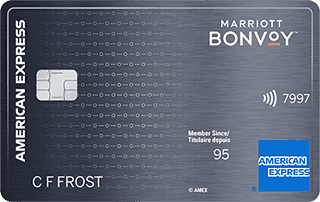
- Annual fee
- $120
- Our valuation
- $990Milesopedia first-year estimate First-year valueWelcome bonus$990Total$990Rewards on your spending are not included. The calculator that adds them from your own profile is on the card's page.
- Milesopedia first-year estimateFirst-year valueWelcome bonus$990Total$990Rewards on your spending are not included. The calculator that adds them from your own profile is on the card's page.
- Welcome offer
- Up to 110,000 points
- Ends Sep 22, 2026
on American Express's website
Apply with confidence — no impact on your credit scoreApply with confidenceCheck whether your application will be approved before you submit it, with no impact on your credit score*When you apply for a personal American Express Credit Card, we will tell you whether you are eligible without affecting your credit score. So you can apply with confidence.*Instant decisions are only available for consumer Card applications (also called “personal Cards”).
Our editorial integrity
Our reviews and rankings are based on an objective assessment. Advertisers do not influence our content. We may receive compensation through some links; our analysis and opinions remain independent.