The acronym FIRE stands for « Financial Independence, Retire Early ». It’s a movement that has exploded in popularity in recent years. More recently, we’ve seen the release of a trilogy on financial independence in Quebec ( Liberté. Un éveil à l’indépendance financière) and the launch of a Canada-wide documentary series on TV5-Unis TV(Jeunes et retraités). In this article, we look back at the definition of the FIRE movement, but above all, we explore the different variations of the FIRE movement.
The FIRE movement (Financial Independence, Retire Early)
Basically, the definition of the FIRE movement is very simple: increase your income, reduce your expenses, save and invest the difference in assets so that you can retire at a young age. It’s a challenge, but it’s possible. What’s more, this movement shares elements with frugalism and minimalism in some respects.
However, this formula does not apply to everyone. Some people prefer to tighten their belts and leave their jobs as quickly as possible. Or, at least, the traditional world of work. On the other hand, there are people who love their jobs and want to continue working, but who are still interested in financial independence, because they want to be free of financial stress. They also want the freedom to choose! For example, to say « no » to a job they don’t like or a project that doesn’t interest them.
And so several variations on the FIRE movement were born…
The most frequent variations of the FIRE movement
The FIRE movement is all about freedom. But the precise definition differs from person to person. For some, it means financial security (financial independence). For others, it means « Bye Bye Boss » (early retirement). And in between, there are a multitude of meanings.
So there are many variations on the FIRE movement. But which one is right for you? Read on, as we explore the different types of FIRE. You’ll be able to determine which one you prefer, and then set a clear and concise goal.
Traditional FIRE
In the original version of the FIRE movement, people maximize savings and investment for retirement. They will sometimes adjust their lifestyles (cutting back on spending) or find ways to increase their income in order to accentuate their investments. Followers of the FIRE movement are generally people who are also interested in frugalism.
They aim to achieve an investment portfolio approaching 25X their annual expenses, in order to withdraw a retirement income similar to their current expenses. Theoretically, the assets amassed should suffice for the rest of their lives (4% rule).
The goal is traditional retirement, but above all, to achieve it as quickly as possible.
Lean FIRE
The first variation of the FIRE movement is: Lean FIRE. The person seeking to achieve Lean FIRE aims to accumulate enough assets to cover basic expenses. In fact, these individuals tend to live very frugal lifestyles and want to maintain these habits in retirement.
By being very minimalist, there is no need to set aside a large amount. In addition, since this individual has a lower than average cost of living, it is often easier to invest the money saved. Do these people deprive themselves to lower their annual expenses so much? Sometimes yes, but often no. Some people just don’t have a very high standard of living without having to restrict themselves.
Lean FIRE shares many of these principles with other movements, such as minimalism and frugalism.
Fat FIRE
The second variation of the FIRE movement is Fat FIRE. In contrast to Lean FIRE, the Fat FIRE individual usually plans for an above-average cost of living, both now and in retirement.
For example, most people are limited in the number of vacations they can take. Globetrotters at heart are likely to travel more and better in retirement! Therefore, in order to have this lifestyle, the amount accumulated needs to be higher, « fatter ».
These people may also simply want Fat FIRE to feel comfortable with their disbursement strategies (regardless of stock market fluctuations) and limit their risk of running out of money in retirement.
Barista FIRE
The third variation of the FIRE movement is Barista FIRE. This type of financial independence is based on an investment portfolio to partially support oneself, then working part-time to make up the missing income.
The origin of the term « Barista » comes from the fact that a job at Starbucks would be enough extra income. Plus, they offer medical insurance even if you work there part-time!
So the investment portfolio itself is not high enough to achieve traditional FIRE. On the other hand, it allows you to:
Working less, part-time
Change to a less stressful field
Have some freedom to choose your own schedule
Keep working, because we love it
Etc.
And most importantly, to enjoy life a little more since the wallet doesn’t need to be as big as for other types. It’s a pretty interesting lifestyle!
For example, a person with a cost of living of $40,000 would need to accumulate $1,000,000 to achieve traditional FIRE (25X annual expenses). By aiming for the Barista FIRE, this same person could decide to halve his target. Each year of « retirement », she could then withdraw $20,000 from her $500,000 investment portfolio and work part-time to cover the shortfall.
Coast FIRE
The fourth variation of the FIRE movement is Coast FIRE. This variation is based on the snowball effect. We work hard to shape a solid snowball, then put all our energy into bringing it to the top of the mountain. Then you watch it roll and grow exponentially with no further effort.
The idea behind Coast FIRE is to accumulate a large sum of money as quickly as possible, then let compound interest do its magic. At some point, you won’t need to keep saving, as the portfolio will grow and reach the FIRE Number on its own. In the meantime, it’s important not to disburse these investments in order to reach the projected amount, and to have confidence in our returns.

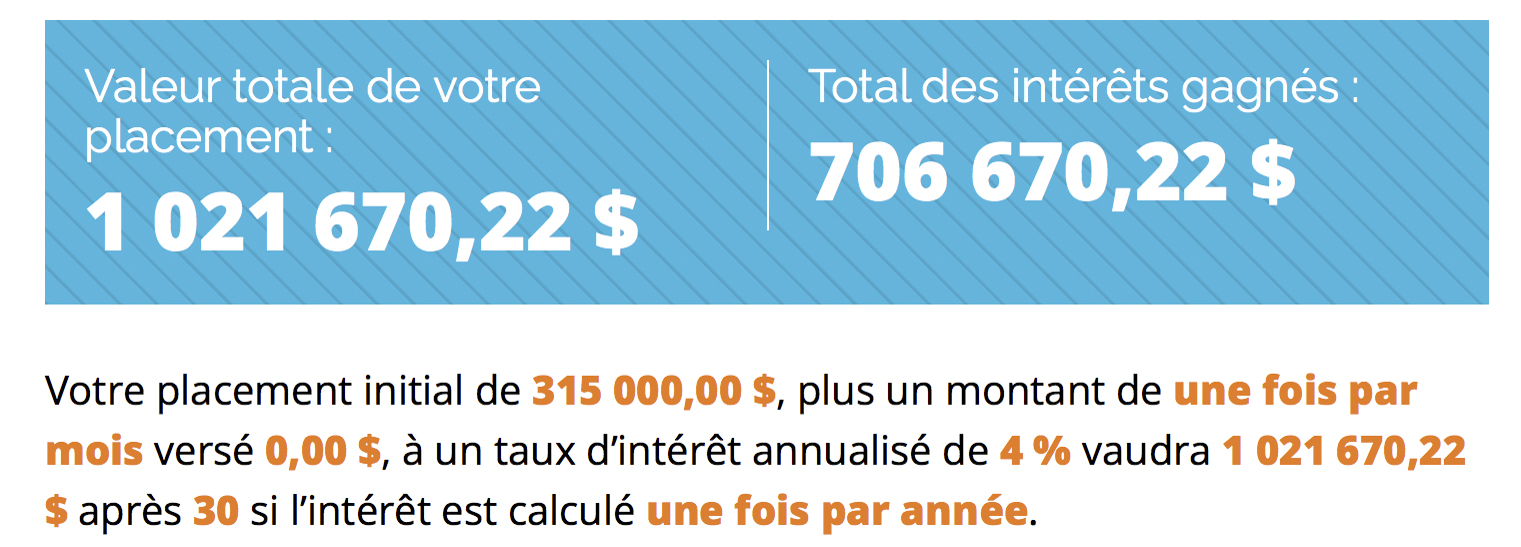
Let’s take the example of the person with a cost of living of $40,000 who needs to accumulate $1,000,000 (25 X $40,000) to reach the traditional FIRE. If she manages to accumulate $315,000 at age 35, she’ll have more than $1,000,000 by age 65. Their money will have grown with an ultra conservative 4% return for 30 years. During these 30 years, savings are no longer necessary and we simply have to work to meet our current cost of living.
Like the Barista FIRE, the Coast FIRE can make choices with a certain freedom and less stress.
Here’s an online calculator to work out how much you’ll need to save to reach Coast FIRE.
Savings and disbursement strategy
Savings strategy and vehicles
In Canada, there are many ways to save and invest to increase your wealth:
RRSP
With a Registered Retirement Savings Plan (RRSP), your money grows tax-free, and your withdrawals are taxed at your marginal tax rate.
TFSA
In a Tax-Free Savings Account(TFSA), your money also grows tax-free. But withdrawals are not taxed. Unlike an RRSP, the TFSA does not imply tax deductions.
FHSA
With the Tax-Free Savings Account for First-Time Home Buyers(FHSA), your money grows tax-free, and your withdrawals are tax-free for the purchase of a qualifying first home. Not to mention tax deductions for your contributions. With a FHSA, the money you’ve saved won’t be available (liquid) when you retire. However, this savings vehicle will have enabled you to obtain tax benefits during your journey to financial independence (FIRE), in addition to being used to purchase a real estate asset.
Non-registered account
In non-registered accounts (excluding RRSPs and TFSAs), your capital gains will be taxed only on the sale of your investment (when realized), while your interest income and dividend will be taxed from year to year. RRSPs and TFSAs should generally be maximized before turning to non-registered accounts.
When we talk about RRSPs and TFSAs, we must understand that they are investment vehicles, not investments. A vehicle is no better at one bank or on one platform than another. It all depends on what you choose to put in it:
Investment decisions are up to you. But to invest in these financial assets, you’ll need to open a brokerage account with an online broker, for example:
The importance of using the savings vehicles mentioned above lies in the disbursement strategy. In fact, when we talk about accumulating our FIRE figure, it will be made up of a combination of : RRSPs, TFSAs and non-registered investment accounts. In other cases, we could also be talking about rental property that generates positive cash flow. But to simplify our explanations and examples, we’ll limit ourselves to stock market investments.
For example, when disbursing our one-time income of $40,000, this amount will be virtually net of tax if :
$10,000 from RRSP (taxable at marginal rate)
$20,000 from TFSA (non-taxable)
$10,000 from non-registered accounts (taxable based on type of return: capital gain, ineligible and eligible dividends, interest income)
Bottom Line
When it comes to the FIRE movement, there’s no single solution. There is something for everyone! For some, financial independence (the « FI » in FIRE) is the most important thing. For others, early retirement (the « RE » in FIRE) is just as important.
We hope that one of the variations of the FIRE movement presented in this article matches your values and financial objectives. To each his own strategy and life plans!
Here’s some interesting reading, including several blogs from Quebec’s FIRE community:
$150ⓘMilesopedia first-year estimateFirst-year valueAnnual fee rebated$150Total$150Rewards on your spending are not included. The calculator that adds them from your own profile is on the card's page.
Milesopedia first-year estimateⓘFirst-year valueAnnual fee rebated$150Total$150Rewards on your spending are not included. The calculator that adds them from your own profile is on the card's page.
With Milesopedia, take advantage of an exclusive offer: your first-year annual fees are refunded with the National Bank World Elite Mastercard. This offer is exclusively available on the Milesopedia network, from June 30 to November 4, 2026.
Refund of the first-year annual fee (a $150 value) for the primary cardholder. This fee is charged to your new card account, then refunded as a credit on your statement within five months of opening your account, provided it remains open and in good standing.
The National Bank World Elite Mastercard is the best Mastercard credit card offered by NBC.
With this card, you earn up to 5 points per dollar on your purchases:
5 points per dollar for groceries and restaurants
2 points per dollar on gas and electric recharge purchases
2 points per dollar on recurring bills
2 points per dollar on À la carte Travel
1 point per dollar for all other purchases
And since it’s an NBC mycredit Mastercard, you can use it at Costco.
With this card, you have access to a $150 annual travel credit that you can use in any of these categories:
Airport parking
Baggage fees
Seat selection
Access to airport lounges
Airline ticket upgrades
What’s more, you can enjoy access to DragonPass airport lounges and unlimited access to the National Bank Lounge at Montreal-Trudeau.
Finally, Milesopedia has named the National Bank World Elite Mastercard as the Best Travel Credit Card in 2023, 2024, 2025, and 2026.
Legal
® Mastercard and World Elite are registered trademarks, and the circles design is a trademark of Mastercard International Incorporated. National Bank is an authorized user.
® The À LA CARTE REWARDS logo is a registered trademark of National Bank of Canada.
® NATIONAL BANK OF CANADA LOUNGE is a registered trademark of National Bank of Canada.
® À LA CARTE REWARDS PLAN is a registered trademark of National Bank of Canada.
® Apple Pay is a registered trademark of Apple Inc., registered in the U.S. and other countries. Apple Inc. is not a sponsor of or participant in National Bank Mobile Banking Solutions.
® Google Pay is a registered trademark of Google LLC. Use of this trademark is subject to Google Inc. Permissions.
TM À LA CARTE TRAVEL is a trademark of National Bank of Canada. The À la carte Travel agency is owned by Transat Distribution Canada Inc. and holds a Quebec permit (No. 753141).
TM À LA CARTE REWARDS is a trademark of National Bank of Canada.
® THE TOTAL, THE CONNECTED and NATIONAL BANK are registered trademarks of National Bank of Canada.
* Mastercard® World Elite®
The National Bank® World Elite® Mastercard® credit card was voted best Mastercard credit card by Milesopedia in 2026, 2025 and 2024.
The National Bank® World Elite® Mastercard® credit card was voted best travel credit card by Milesopedia in 2026, 2025 and 2024.
Every year, Milesopedia reviews credit card offers from major financial institutions and establishes its Ranking based on over 150 criteria such as fees, welcome offer, minimum income required, number of points per category, account credits, insurance, airport lounge access, etc.
Certain restrictions apply. For more information, see the Rewards Plan section or the Plan Rules applicable to point accumulation.
Grace period: No interest is charged on purchases made during the month if the cardholder pays the full balance of their account within twenty-one (21) days of the statement date. This grace period does not apply to cash advances and balance transfers. Minimum payment: if your account balance is less than $10, you must pay the balance in full. If you reside in the province of Quebec, your minimum payment is 5% of your account balance plus any overdue amount, or $10, whichever is greater. If you reside outside Quebec, your minimum payment is 2.5% of the credit card account balance plus any overdue amount, or $10, whichever is greater. Account statement: an account statement is sent monthly.
Table of examples of credit fees calculated over a 30-day period
Annual interest rate
$500
$3,000
22.49%
$9.24
$55.45
20.99%
$8.63
$51.76
13.2%
$5.53
$33.16
9.2%
$3.78
$22.68
*Variable interest rate in effect as of September 1, 2021.
Balance transfers and cash advances are subject to National Bank credit approval. Each amount transferred cannot be less than $250.
Exclusive to World Elite Mastercard cardholders. Presentation of the physical credit card and boarding pass is required to access the lounge. The National Bank® Lounge is accessible to customers traveling on international flights only (excluding flights to Canada and the United States). You benefit from free and unlimited access with one guest and two children aged 12 and under. Until October 4, 2026 (date subject to change), customers can enter the National Bank Lounge three hours before their flight departure time. From October 5, 2026 (date subject to change), access will be authorized for a maximum duration of 2 hours (3 hours for customers who hold a Private Banking 1859® World Elite® Mastercard® credit card). National Bank customers who are not World Elite ® Mastercard ® cardholders can also access the current lounge based on current rates and benefit from a 25 % discount on these rates : 63,24 $ taxes included for adults (excluding discount) $40.24 taxes included for children aged 2 to 12 (excluding discount) free for children under 2 (excluding discount) The entry fee is subject to change without notice and is the responsibility of the lounge operator.
Subject to providing the required supporting documents in the manner and within the prescribed timeframe. Certain conditions may apply. Only the primary cardholder of a National Bank World Elite Mastercard (Cardholder) whose account is in good standing can request a « Travel Fee Reimbursement ». « Account in good standing » means an account linked to the credit card that does not violate the Credit Card Agreement in any way and on which no restrictions apply. For example, and without limitation, the associated annual fees must have been paid in full. The maximum reimbursement of $150 can be requested from January 1 to December 31 of each year. Eligible expenses are: airport parking baggage fees seat selection airport lounge access worldwide airline ticket upgrades A reimbursement request must be made within 60 days of the purchase date. Travel expenses must be charged to the National Bank World Elite Mastercard credit card account. The maximum reimbursement of $150 is applicable per account. Please allow up to 7 business days for the reimbursement to be processed from the date your request is submitted. National Bank reserves the right to request additional supporting documents for validation purposes (e.g., invoices). You must keep all receipts and supporting documents for a period of 12 months from the date you made your reimbursement request. An unused reimbursement in one year cannot be carried over to the next year. You can make your request online at rewards.nbc.ca or by calling 1-800-341-8083 (toll-free) for an agent to assist you with your travel fee reimbursement request.
Point accumulation on grocery and restaurant spending depends on the total gross monthly amount charged to the credit card account, across all categories. Earn 5 points per dollar spent on eligible grocery and restaurant purchases. The 5 points per dollar accumulation is valid for the first $2,500 of gross monthly purchases charged to the account. Beyond this amount, eligible grocery and restaurant spending will earn 2 points per dollar. The calculation of the gross monthly purchase amount is based on monthly billing. A grocery purchase means a purchase made at a merchant whose primary business is selling food, such as a grocery store, delicatessen, supermarket, fruit store, or specialty food store. Meal kit subscriptions and meal delivery services are eligible. Therefore, this definition excludes, among others, retail stores and big-box stores whose primary business is selling non-food items. Some merchants may sell products or services identical or similar to those of eligible merchants, or are separate merchants located on the same premises as eligible merchants, but are classified by Mastercard in different categories. Purchases made from other merchants only earn base reward points. A restaurant purchase means a purchase made at a restaurant, including quick-service restaurants, bars, discotheques, nightclubs, and taverns. To view the full list of Mastercard codes associated with eligible merchants, download the À la carte Rewards Plan® terms and conditions document.
These protections apply if the purchases or rental are paid for in part with the card before departure, except, if applicable, for out-of-province medical-hospital insurance for which it is not necessary to charge the purchase of an à la carte trip and for baggage delay protection where the full cost of transport must have been charged to the card. All these protections apply to the primary cardholder, their spouse and/or their dependent children when they (spouse and dependent children) travel with the cardholder. Extended warranties apply to most new items purchased with the card, in Canada or abroad, provided the manufacturer’s warranty exists and is valid in Canada. Certain conditions, limitations and restrictions apply. For more information and details regarding your insurance coverage, please consult the insurance certificate linked to your card.
Subject to credit approval by National Bank.
Certain conditions apply. Visit mastercard.ca for more information. See all credit card terms and conditions.
To earn 2 points per dollar spent, you must pay for your gas or electric charging purchases at a gas station or certain big-box stores. Some merchants may sell products or services identical or similar to those of eligible merchants, or are separate merchants located on the same premises as eligible merchants, but are classified by Mastercard in different categories. Purchases made from other merchants only earn base reward points. To view the full list of Mastercard codes associated with eligible merchants, download the À la carte Rewards Plan® terms and conditions document.
Recurring bill payments are defined as payments made monthly or regularly that are automatically charged by the merchant to your National Bank World Elite Mastercard. Not all merchants offer recurring payments, and not all recurring payments are considered recurring bill payments. Therefore, some payments may not qualify for accelerated reward points.
To earn 2 points per dollar spent, you must pay for your eligible purchases through the À la carte TravelTM agency section of our À la carte RewardsTM site.
For example, if you spend $400 monthly on groceries, $200 on gas, $100 on recurring bills and $150 on other purchases, the $850 spent will generate 2,750 points, broken down as follows: 2,000 points for grocery spending (since the total gross monthly amount is $850, which is less than $2,500), 400 points for gas spending, 200 points for recurring bills and 150 points for other purchases.
Insurance up to $1,000 in case of breakage, loss or theft of mobile devices for a maximum period of 2 years following the date of purchase. Subject to purchasing the device with the National Bank World Elite Mastercard or a phone service subscription paid by recurring payments from your National Bank Platinum Mastercard starting September 1, 2022. For all conditions, please consult the insurance certificate linked to your card.
Annual fee
Primary card$150
Additional card$50
Annual income required
Individual$80,000
Household$150,000
Conversion fees
2.5%
Earning rate
5xRestaurants
5xGroceries
2xTravel
2xBills & recurring payments
2xGas & EV
1xAll spending
Value
1st Year Value$778
2nd Year Value$923
Card benefits
Airport lounge access$400
Travel creditsIncluded
Travel insurance
Travel medical (under 55)Up to $5,000,000 / 60 days
Travel medical (55-64)Up to $5,000,000 / 31 days
Travel medical (65+)Up to $5,000,000 / 15 days
Trip CancellationUp to $2,500
Trip InterruptionUp to $5,000
Delayed BaggageUp to $500
Lost BaggageUp to $1,000
Flight DelayUp to $500
Travel AccidentIncluded
Purchase protection
Purchase ProtectionIncluded
Extended Warranty+2 years
Mobile DeviceUp to $1,000 / 2 years
Auto Rental CollisionUp to $65,000 / 48 days
Frequently asked questions about the FIRE movement
What is the FIRE movement?
The acronym FIRE stands for « Financial Independence, Early Retirement ». The FIRE movement is based on the following principles: increase your income, reduce your expenses, save and invest the difference in assets (stock market or real estate) so that you can retire at an early age. It’s a challenge, but it’s possible.
How do you calculate the figure required to be FIRE?
The figure required to be FIRE (the FIRE Number) is the equivalent of 25X your annual expenses. For example, if your annual expenses are $40,000, you need to accumulate $1,000,000 in investments.
How much do you need to save to be FIRE?
According to the 4% Rule, you must accumulate an investment portfolio equivalent to 25X your annual expenses in order to maintain the same pace of life in retirement and not run out of money.
$990ⓘMilesopedia first-year estimateFirst-year valueWelcome bonus$990Total$990Rewards on your spending are not included. The calculator that adds them from your own profile is on the card's page.
Milesopedia first-year estimateⓘFirst-year valueWelcome bonus$990Total$990Rewards on your spending are not included. The calculator that adds them from your own profile is on the card's page.
Apply with confidence — no impact on your credit scoreⓘApply with confidenceCheck whether your application will be approved before you submit it, with no impact on your credit score*When you apply for a personal American Express Credit Card, we will tell you whether you are eligible without affecting your credit score. So you can apply with confidence.*Instant decisions are only available for consumer Card applications (also called “personal Cards”).
The Marriott Bonvoy® American Express®* Card is the best credit card in Canada for free hotel nights.
New Cardmembers can earn up to 110,000 Marriott Bonvoy® points with the current offer:
Earn 80,000 points after you spend $6,000 on your Card in your first 6 months of Cardmembership.
Plus, earn 30,000 points by making a purchase during your 15th month of Cardmembership.
This offer ends on September 22, 2026. The annual fee is $120, and there is no annual fee on Additional Cards, so you can add a partner or a family member at no extra cost.
Every year after your first Card anniversary, you receive an Annual Free Night Award good for a redemption of up to 35,000 points at eligible hotels and resorts worldwide. At a valuation of 0.9 cents per Marriott Bonvoy point, that certificate is worth roughly $315, which on its own more than covers the $120 annual fee. That is the main reason to keep this Card year after year instead of cancelling it.
To get the most out of the certificate, aim it at a night that would otherwise price close to the 35,000 point ceiling.
The Card also gives you 15 Elite Night Credits each calendar year and automatic Marriott Bonvoy Silver Elite status. Those credits count toward the next Elite tier, so you begin every year 15 nights ahead of where you would otherwise start.
You move up to Gold Elite status automatically when you reach $30,000 in purchases on the Card in a year, or when you combine 10 qualifying paid nights within one calendar year with the 15 Elite Night Credits from your Card.
Marriott Bonvoy points are generally valued at 0.9 cents each. On that basis, the 110,000 point welcome offer is worth about $990, and an Annual Free Night Award used at its full 35,000 point ceiling is worth about $315.
Marriott Bonvoy points pull their weight on free nights rather than on gift cards or merchandise, which is why this Card should be judged on the hotel stays it produces.
You earn 5 points per dollar on eligible purchases at participating Marriott Bonvoy hotels and 2 points per dollar on all other purchases. Points can be redeemed for free nights with no blackout dates at more than 7,000 hotels around the world.
The Card carries a solid package of coverages: $500,000 travel accident insurance, flight delay, baggage delay, lost or stolen baggage and hotel or motel burglary at $500 each, car rental theft and damage up to $85,000 for rentals of up to 48 days, Purchase Protection for 90 days and a one year Extended Warranty.
Two things to plan around: the 2.5% foreign transaction fee on purchases made in a foreign currency, and the 21.99% purchase interest rate, which makes this a Card to pay in full every month. Like all American Express Canada Cards, no minimum income is published for this Card, and you can see whether you would be approved before you apply, with no impact on your credit score.
Legal
American Express is not responsible for maintaining or monitoring the accuracy of information on this website. For full details and current product information, click the Apply Now link. If you apply and get approved for an American Express Card, we may receive compensation from American Express, which can be in the form of monetary payment.
Annual fee
Primary card$120
Additional card$0
Annual income required
Individual$0
Household$0
Conversion fees
2.5%
Earning rate
5xMarriott Bonvoy hotels
2xAll spending
Value
1st Year Value$1,437
2nd Year Value$312
Travel insurance
Delayed BaggageUp to $500
Lost BaggageUp to $500
Flight DelayUp to $500
Hotel BurglaryUp to $500
Travel AccidentUp to $500,000
Purchase protection
Purchase ProtectionIncluded
Extended Warranty+1 years
Auto Rental Collision (primary)Up to $85,000 / 48 days
Our editorial integrity
Our reviews and rankings are based on an objective assessment. Advertisers do not influence our content. We may receive compensation through some links; our analysis and opinions remain independent.