How to Get NHL Tickets at a Good Price
- 2026 FIFA World Cup

Loading article…
For fans of the NHL who want to attend a game or two this season, getting NHL tickets at a reasonable price is usually the hard part. There is good news for 2026-27, however: the league moves from 82 games to 84, so all 32 teams now play 42 home dates instead of 41. That means more chances to find the match-up you want.
Maybe you want your home team against its division rival. Maybe you want to catch a game while visiting another city. Either way, a bit of planning and a bit of luck should get you into the building.
In this article, we go through the strategies that actually work to get NHL tickets at a good price: timing your purchase, picking the right city, and watching for presales. We also cover how paying with the right credit card lets your points absorb part of the bill. For the wider picture, see our roundup of the best credit cards in Canada.

The NHL is made up of 32 teams (7 in Canada and 25 in the US) split evenly across 4 divisions within 2 conferences.
The 2026-27 regular season runs from September 29, 2026 to April 10, 2027, with a short pre-season in the weeks before opening night. This is the first year under the new collective bargaining agreement. It changes a number that has held since 1995: each team now plays 84 games instead of 82, split into 42 at home and 42 away. Across the league, that adds up to 1,344 regular season games.
The two extra games went into divisional play, because several clubs wanted a fairer split of dates against their closest rivals. Here is how the 84 games break down for every team:
In practice, the Montreal Canadiens now play 42 dates at the Bell Centre. They face each Atlantic Division rival 4 times, meet each Metropolitan team 3 times, and see every Western Conference club twice. Since every team visits every other team at least once, your local arena will host all 31 opponents at some point during the year.
Finally, once the regular season ends and the 16 playoff teams are set, the Stanley Cup Playoffs begin in mid-April, and the winner lifts the Cup in June.
| Atlantic · East | Metropolitan · East | Central · West | Pacific · West |
|---|---|---|---|
| Boston Bruins | Carolina Hurricanes | Chicago Blackhawks | Anaheim Ducks |
| Buffalo Sabres | Columbus Blue Jackets | Colorado Avalanche | Calgary Flames |
| Detroit Red Wings | New Jersey Devils | Dallas Stars | Edmonton Oilers |
| Florida Panthers | New York Islanders | Minnesota Wild | Los Angeles Kings |
| Montreal Canadiens | New York Rangers | Nashville Predators | San Jose Sharks |
| Ottawa Senators | Philadelphia Flyers | St. Louis Blues | Seattle Kraken |
| Tampa Bay Lightning | Pittsburgh Penguins | Utah Mammoth | Vancouver Canucks |
| Toronto Maple Leafs | Washington Capitals | Winnipeg Jets | Vegas Golden Knights |
Most NHL teams sell through Ticketmaster, an official partner of the league. Four clubs sit outside that arrangement, however, and going to the wrong site costs you time on an on-sale day when minutes matter:
On the official platform, how you pay already changes the bill: RBC Avion points apply directly to the purchase.
Each team also sets its own on-sale calendar. Releases generally start with season tickets, then move to presales for fan clubs and partner groups, and only then open single regular season games to everyone.
Prices swing by opponent and by date. A rivalry game, a Saturday night, or a long weekend will cost more than a low-stakes match-up on a Tuesday in January. That gap is where you have the most room to act, and most of the strategies below come back to it.
So how do you actually get into a game without overpaying? Below are five approaches that work, starting with the one that gets you face value.
The simplest way to get NHL tickets at a good price is to buy them at face value. The catch is that seats for the most popular games sell out fast. You are then left choosing between an obstructed view in the last row and a front-row seat well beyond your budget.
Because of that, buying on the day tickets go on sale is your best shot at face value. Every team announces its single-game on-sale date before the season starts. If you have a specific game in mind, be logged in and ready at the exact minute the sale opens.
Beyond that, many teams give early access to fan clubs, partner groups, and select credit card holders. That is the next strategy to look at.
Another good strategy for getting your hands on NHL tickets for a good price is to watch for promotions, partnerships, and special access opportunities.
First, most teams let fans sign up for SMS alerts covering presales, ticket drops, contests, and exclusive offers. It is free, and it puts you in front of the general public. Plenty of other fans sign up too, so you are still competing. Even so, the alert does something useful on its own: it stops you from forgetting an on-sale date and missing the window entirely.
An additional option for accessing presale tickets is with an eligible American Express credit card. Eligible cardholders get presale access through American Express Front Of The Line in Canada and American Express Experiences in the US. Sign up for alerts through either service and you will hear about upcoming events before they open to everyone.
A third option, admittedly a niche one, suits fans who already know they want several games in a season: a partial season ticket package. It gets you seats before the single-game on-sale dates, which locks in the dates that would otherwise sell out first.
Finally, some teams run promotional packages or theme nights aimed at families and groups. The saving there is rarely on the ticket itself. Instead, it comes as a free jersey, a discounted meal, or a drink included, which still lowers what the evening costs you overall.
| Credit card | Annual fee | Welcome offer | |
|---|---|---|---|
| $191.88 | |||
| $250 | |||
| $799 |
If you mainly want to see NHL hockey live, a pre-season game is worth a look. You give up the marquee match-up and the tension of a late-season night, little else.
Pre-season tickets usually cost less than regular season ones, and the arena experience is much the same, though the crowd is quieter than in a game where the standings are on the line. In 2026-27, those games fall in the weeks before opening night on September 29.
Pre-season NHL games can be a particularly good idea for families who need to buy multiple tickets and financially factor in for the high cost of food and drinks at the game.
This next strategy suits fans with a tolerance for risk, or at least those who can live with missing the game entirely. In exchange, it occasionally lands you seats below face value, which is why many people consider the gamble worth it.
If you have the flexibility, waiting until the last minute (usually the day of the game) to purchase tickets through resale portals can sometimes provide access to below-face-value tickets or can even just provide access to resale ticket prices that are lower than they were weeks earlier.
The reason is simple: with puck drop hours away, a reseller would rather take a low price than eat the ticket entirely, so listings soften. You can track those prices on resale sites such as SeatGeek, StubHub, and Gametime. It is even worth checking after the game has started, since that is when sellers cut the most.
Another solid last-ditch option is to check the in-person box office (if one exists at the arena you’re visiting) or online ticket portal to see about last minute ticket releases/availability. Many events, including NHL games, hold some tickets back for VIPs or special groups and then release these tickets to the public if they’re not used come game time. This can result in some pretty decent last-minute seats quietly being released to those who are still looking.
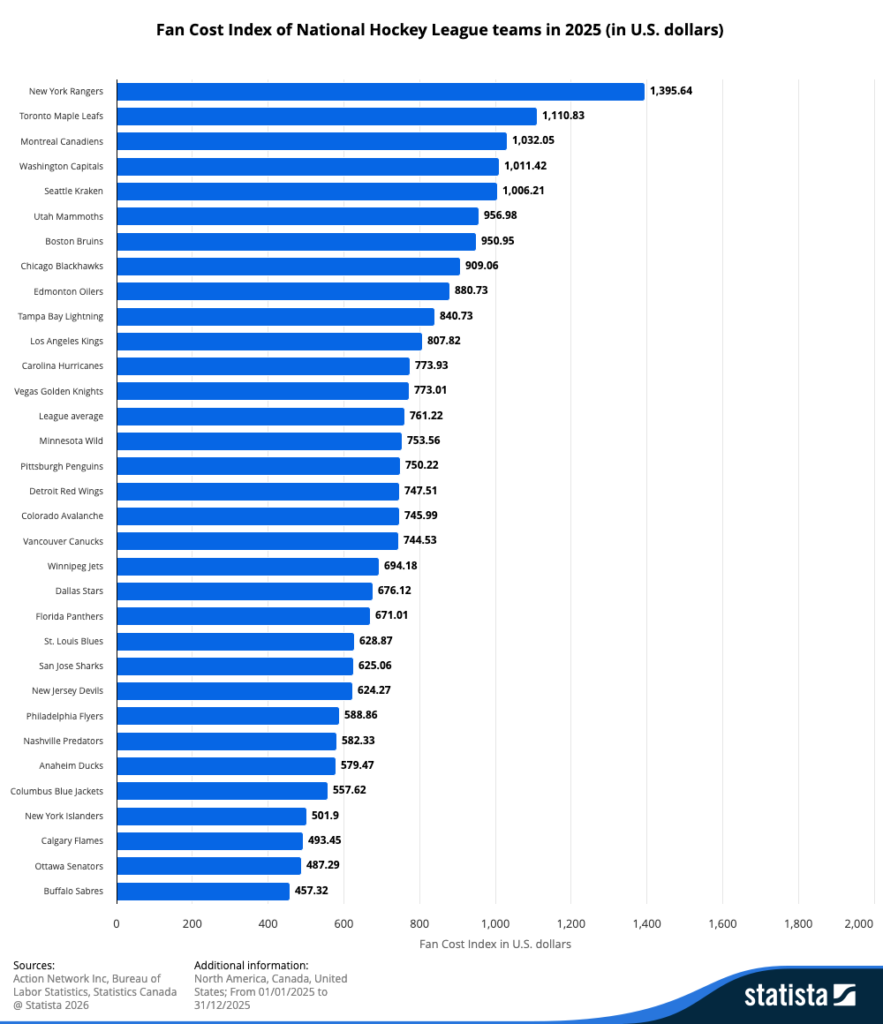
Where you watch matters as much as when you buy. The Fan Cost Index, published by Team Marketing Report and charted below via Statista, measures what one game night costs a family of four: four tickets, parking, two beers, two soft drinks, and four hot dogs. It is a useful yardstick because it captures the whole evening rather than the ticket alone.
On the 2025 index, the New York Rangers sat at the top, where a family of four could expect to spend close to US$1,400 at Madison Square Garden. At the other end, the Buffalo Sabres came in as the cheapest night out in the league. The chart below shows where every club falls in between.
Gaps that wide are worth planning around. A game in a nearby market, or in a city you have wanted to visit anyway, can cost a fraction of what the same evening runs at home. If you are pricing out a single market in detail, our breakdown of the real cost of a game night in Toronto walks through the full bill.
Beyond the strategies above, one thing is left: how you pay. Putting the tickets on the right credit card earns flexible points on a purchase you were making anyway.
Those points then come back as statement credits that cover part or all of what a hockey trip costs you: the tickets themselves, but also the hotel, the flights, and the transit to get there.
The Scene+ program fits this use case well, because its points can be applied to a purchase after the fact rather than only at checkout. With the Scotiabank Passport Visa Infinite +* Card, you earn 2 Scene+ points per dollar on eligible entertainment, the category most ticket purchases land in, along with 3 points per dollar at Sobeys, IGA, Safeway, Foodland and participating Co-ops, and 1 point per dollar on everything else.
Once the points are in your account, you can put them toward groceries, gift cards, and restaurant meals. For NHL trips, the two that matter most are travel purchases and general statement credits.
on Scotiabank's website
The most useful Scene+ feature here is timing: you have up to 12 months after the purchase date to go back and apply points to an eligible travel charge. You can also cover only part of a charge, so you do not need a full balance before you start putting points to work.
What your points are worth, however, depends entirely on the category the purchase falls into:
| What you apply points to | Rate | Value per point |
|---|---|---|
| Eligible travel purchases | 1,000 points = $10 | 1 cent |
| Groceries and pharmacy, participating stores | 1,000 points = $10 | 1 cent |
| General statement credit, any other purchase | 1,500 points = $10 | 0.67 cent |
We’ve got detailed guides on how to use your Scene+ points to save money on travel, plus a guide that gives you the 6 best ways to redeem your points. Take a look at both to maximize the value and utility you can get from all the Scene+ points you earn.
Tickets to sporting events usually code as “Entertainment” rather than “Travel” on a credit card statement. In practice, that means covering an NHL ticket with Scene+ points will most often go through as a general statement credit at 1,500 points = $10, not at the better travel rate.
That said, we have seen tickets show up as eligible travel purchases on some statements. It costs nothing to check your account before you apply points, since the difference between the two rates is roughly one third of their value.
Even when the tickets themselves do not qualify, the travel rate still applies to everything else the trip involves: airfare, hotels, Airbnb stays, transit, and car rentals. On a road trip to see a game in another city, that is usually where most of the money goes anyway.
Seeing an NHL game live sits on a lot of bucket lists, and the price is rarely gentle. Still, the 84-game season gives you 42 home dates per team to work with, and the strategies above turn that volume into an advantage: buy on the on-sale date, take a pre-season or midweek game, watch the resale market late, or drive to a cheaper market.
On top of that, paying with a Scene+ card such as the Scotiabank Passport Visa Infinite +* Card lets you claw back part of the cost afterwards as a statement credit. Just keep the two rates straight: 1,000 points = $10 on travel, 1,500 points = $10 on the tickets themselves.
Card offers and presale windows move quickly, so sign up for our newsletter to catch the good ones as they land. In the meantime, our destination guides cover many of the cities that host one of the NHL’s 32 teams:
Each team plays 84 games in 2026-27, up from 82 in previous seasons. That works out to 42 home dates and 42 on the road, and 1,344 games across the league.
The regular season opens on September 29, 2026 and ends on April 10, 2027. Pre-season games run in the weeks before opening night, and the Stanley Cup Playoffs begin in mid-April.
The NHL has 32 teams, split into 4 divisions across 2 conferences. Seven of them are in Canada and 25 are in the United States.
Twenty-eight of the 32 teams sell through Ticketmaster, an official partner of the league. The Florida Panthers, Utah Mammoth, and Minnesota Wild sell through SeatGeek, and the Vegas Golden Knights sell through AXS.
Yes. NHL tickets are resold on StubHub, SeatGeek, and Gametime. Prices on those sites often fall in the hours before puck drop, when sellers would rather take a low offer than lose the sale entirely.
There are two cheap windows. The first is the single-game on-sale date, when seats are still at face value. The second is the day of the game, when resale prices soften. Midweek games against non-rivals are the least expensive dates on any team’s calendar.
Eligible American Express cards give early access through American Express Front Of The Line in Canada and American Express Experiences in the US. You can sign up for alerts through those services so you hear about an on-sale before the general public does.
Not usually at the point of sale, but you can apply points to the charge afterwards. With Scene+, tickets normally code as entertainment, so the rate is 1,500 points = $10 as a statement credit. Travel purchases tied to the same trip, such as flights and hotels, get the better rate of 1,000 points = $10.
on BMO's website
Our reviews and rankings are based on an objective assessment. Advertisers do not influence our content. We may receive compensation through some links; our analysis and opinions remain independent.