Yes, a sole proprietorship is enough to get a business credit card in Canada. No incorporation is required, and the most accessible cards ask for no minimum personal income. The real question becomes this one: which card pays more than it costs, at your spending volume?
Limited-time offer: 10% cash back for three months on gas, office supplies and mobile and internet bill payments. Plus a 0.00% welcome interest rate on balance transfers for nine months, with a 3% balance transfer fee.
Your self-employed status already opens the door. BMO lists the eligible business types on its application page, and both "sole proprietorship" and "single-owner business" sit there next to the incorporated company.
Next, look at what the issuer actually asks for. The documents are about you, not about a balance sheet: your name, your address, your date of birth and your personal identification. A business name registration is added only if you operate under one.
At TD, the stated criterion fits on one line. The TD Business Travel Visa Card page lists a single condition: being a Canadian resident who has reached the age of majority in their province.
In other words, a business credit card with no personal income requirement stays within reach even if your first year of activity has just started.
What the business card changes
A dedicated card separates your business spending from your personal spending, and that separation saves you time every spring. Your statements turn into a list of deductible expenses ready to carry over to your T2125, instead of a line-by-line sort.
Separating business receipts from personal ones takes seconds per purchase when the card does it for you.
Your rebates grow as well. A personal card rarely pays a bonus rate on office supplies or phone bills, while several business cards do exactly that.
RBC adds an argument few cardholders notice: the card builds a credit history in the business's name. That history counts the day you apply for an operating line of credit.
Finally, your business purchases stop taking up room on your personal card's limit. For the accounting side, our guide to bookkeeping for the self-employed explains how to feed those statements into software.
Under $25,000 a year
Two no-fee cards do the job, and they differ mainly in how they pay you.
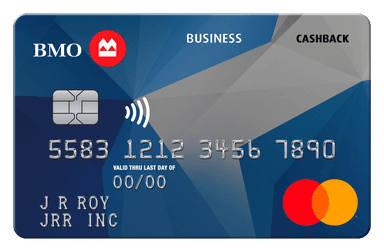
The BMO CashBack Business Mastercard pays 1.5% on gas, office supplies and your mobile and internet bills. Everything else earns 0.75%. You pay no annual fee, and the purchase rate sits at 20.99%.
BMO adds a limited-time offer on top: 10% back for three months in those same categories, plus a 0.00% rate on balance transfers for nine months, with a 3% transfer fee.
Limited-time offer: 10% cash back for three months on gas, office supplies and mobile and internet bill payments. Plus a 0.00% welcome interest rate on balance transfers for nine months, with a 3% balance transfer fee.
The BMO CashBack Mastercard for Business is one of the best cashback Mastercard credit cards in Canada.
You can get a 10% discount for three months on purchases:
gas purchases
office supplies
cell phone/internet payments
After that, you’ll get 1.5% on these purchases and 1.75% at Shell.
You can also benefit from a welcome interest rate of 0% on balance transfers for nine months (a 3% transfer fee applies).
Legal
*Terms and conditions apply
BMO is not responsible for maintaining the content on this site. Please click on the Apply now link for the most up to date information
Annual fee
Primary card$0
Additional card$0
Annual income required
Individual$0
Household$0
Conversion fees
2.5%
Earning rate
1.5xGas & EV
1.5xTelecom
1.5xOffice
1.5xBills & recurring payments
0.75xAll spending
Value
1st Year Value$351
2nd Year Value$234
Purchase protection
Purchase ProtectionIncluded
Extended Warranty+1 years
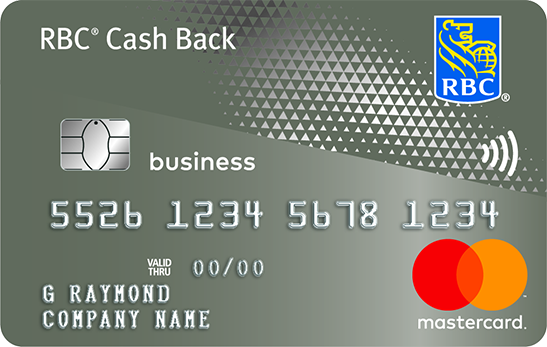
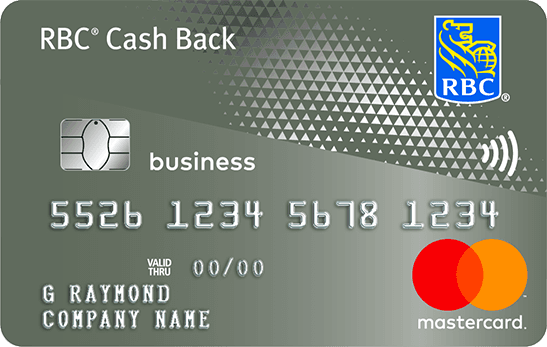
The RBC Business Cash Back Mastercard goes for simplicity instead. It pays 2% on every purchase for the first three months, then 1%, with no annual fee and no fee for the additional card. RBC does cap the account at a single additional card.
You can take your cash back out as soon as it reaches $25. Otherwise, RBC applies it to your balance automatically in January.
The RBC Business Cash Back Mastercard is a cash-back business credit card with no annual fee. It suits small businesses that want a simple return on their professional spending.
You earn 2% cash back on purchases charged to the card for the first three months, then 1% cash back afterward, with no categories to manage.
The annual interest rate is 19.99% on purchases and 22.99% on cash advances. A 2.5% foreign transaction fee applies to purchases made in a foreign currency.
Annual fee
Primary card$0
Additional card$0
Annual income required
Individual$0
Household$0
Conversion fees
2.5%
Earning rate
1xAll spending
Value
1st Year Value$270
2nd Year Value$240
Purchase protection
Purchase ProtectionIncluded
Extended Warranty+1 years
Above that, the tiers decide
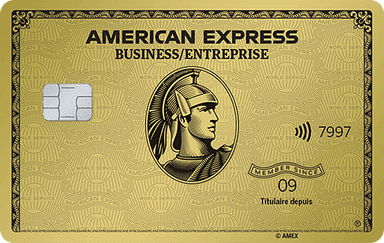
The TD Business Travel Visa Card carries the biggest welcome offer among Canadian business cards: up to 200,000 TD Rewards Points, a value TD puts at $1,300, with the annual fee rebated in the first year for you and up to four additional cardholders.
That offer splits into four tiers, though, and this is where your volume decides.
The four tiers of the TD Business Travel Visa Card welcome offer, and the monthly spending each one assumes
Tier
Condition
TD Rewards Points
Monthly spending needed
1
First purchase charged to the card
30,000
None
2
$15,000 within 180 days
120,000
$2,500
3
$25,000 within 365 days
30,000
$2,084
4
Any purchase during the 15th statement cycle
20,000
None
Total
All four tiers together
200,000
$2,500
At $2,000 of monthly spending, you collect the first tier and miss the next two. You are $3,000 short over six months for the big one, then $1,000 short over the year for the third.
At $2,500 a month, on the other hand, all four tiers land. The gap between those two profiles comes down to $500 of monthly spending, not to the card itself. That is why a tiered welcome offer deserves a read before the application, never after.
Our valuationMilesopedia first-year estimateFirst-year valueWelcome bonus$1,000Annual fee rebated$149Total$1,149Rewards on your spending are not included. The calculator that adds them from your own profile is on the card's page.
The TD Business Travel Visa* Card is a business credit card built to turn your company's everyday spending into travel points, with expense-management tools.
With the current welcome offer, you can earn up to 200,000 TD Rewards Points (a value of up to $1,300):
30,000 TD Rewards Points when the Primary Cardholder makes their first purchase
120,000 TD Rewards Points when spending $15,000 within the first 180 days
30,000 TD Rewards Points when spending $25,000 within the first 365 days
20,000 TD Rewards Points for a purchase during the 15th-month billing cycle
Plus, the $149 annual fee is rebated for the first year for the Primary Cardholder and first four Additional Cardholders ($49 each).
The card earns 9 points per $1 on travel booked online through ExpediaForTD.com, 6 points per $1 on dining, EV charging, public transit, recurring bill payments and foreign-currency purchases (up to $80,000 per category annually), and 2 points per $1 on all other purchases. It also includes a suite of travel insurance and the TD Card Management Tool.
What $24,000 of business spending pays in the first year, for a self-employed owner who charges $4,000 of gas and office supplies and $3,000 of recurring mobile and internet bills
Your personal card often remains the better payer on groceries, restaurants and transit. Nothing forces you to move everything over on day one.
The rule fits in one sentence: keep the personal card for the categories where it pays more, and move everything deductible onto the business card.
One nuance deserves your attention. A business expense paid with your personal card stays deductible, but you will have to trace it yourself in your statements. That is precisely the work the business card saves you.
What to set up right away
Before your first purchase, a few settings will save you round trips later.
A separate business account: your payments and your cash back run through it, which saves round trips with your personal account.
Your business name registration, if you use one: BMO asks for the master business licence that goes with it.
Your statement cycle date: TD's fourth tier triggers during the 15th statement cycle, not the 15th calendar month.
Bookkeeping software connected to the card: your statements then export without re-entry.
A clear rule for mixed expenses: a half-personal meal gets noted at the time of purchase, never in April.
Business credit card for the self-employed: frequently asked questions
Do you need to be incorporated to get a business credit card?
No. BMO accepts a sole proprietorship and a single-owner business on the same footing as an incorporated company. You provide your personal identification, then a business name registration only if you operate under one.
What personal income do you have to declare?
The three cards covered here ask for none. TD lists a single eligibility condition on its product pages: being a Canadian resident who has reached the age of majority. Other business cards, World Elite ones in particular, do ask for a personal income.
Which card works best if you carry a balance?
Look at the rate before the rewards. The TD Business Select Rate Visa Card charges 11.99% on purchases and cash advances with no annual fee, with an 8.99% option for a $49 annual fee. A 1% rebate never offsets nine points of interest.
Can you keep paying business expenses with a personal card?
Yes, and the expense stays deductible. You will have to find it yourself in your statements, though, and justify it if you are reviewed. That is exactly the sorting a business card saves you.
Is cash back or are points from a business card taxable?
The answer depends on who pays the expense and on how you use the rewards. Our tax guide for businesses, linked above, covers the common cases. A specific situation deserves your accountant's opinion.
How many additional cards can you add?
It varies widely between issuers. RBC caps its Business Cash Back Mastercard at a single additional card, at no charge. TD charges $49 per additional card on the Business Travel Visa Card, and rebates those fees in the first year for up to four cardholders.
Does a business card come with insurance?
Yes, and the level follows the annual fee. The TD Business Travel Visa Card includes seven travel insurance coverages, including travel medical. No-fee cards generally stop at purchase protection and extended warranty.
Which card should you start with when launching a business?
Take a no-fee card while you measure your real volume over twelve months. You will move to a card with a fee the day your spending reaches the tiers that make it pay.
Our valuationMilesopedia first-year estimateFirst-year valueWelcome bonus$469Annual fee rebated$120Total$589Rewards on your spending are not included. The calculator that adds them from your own profile is on the card's page.
The BMO eclipse Visa Infinite* Card is one of the best Visa Infinite rewards credit cards in Canada. Its welcome offer lets you earn up to 70,000 BMO Rewards points, for a total value of up to $1,150*.
It also includes a monthly statement credit for streaming services, an annual $50 lifestyle credit, and no annual fee for the first year (a $120 value)*.
With the BMO eclipse Visa Infinite* Card, you also get:
5x BMO Rewards points for every dollar spent on groceries, meal delivery or takeout, rideshare, public transit, and gas*
1 BMO Rewards point for every dollar spent on all other purchases*
10% more points when you add an authorized user to your account*
Mobile device insurance offering coverage up to $1,000*
The Pay with Points feature, which allows you to redeem your points on recent purchases starting at $1*
Six months of Instacart+ membership plus a monthly $10 Instacart credit with an eligible card*
Legal
*Terms and conditions apply
BMO is not responsible for updating the content of this site. For the most up-to-date information, please click on the Online Application link.
Annual fee
Primary card$120
Additional card$50
Annual income required
Individual$60,000
Household$100,000
Conversion fees
2.5%
Earning rate
5xTransit
5xGas & EV
5xRestaurants
5xGroceries
1xAll spending
Value
1st Year Value$1,128
2nd Year Value$365
Travel insurance
Travel medical (under 55)Up to $5,000,000 / 21 days
Travel medical (55-64)Up to $5,000,000 / 21 days
Travel AccidentUp to $500,000
Purchase protection
Purchase ProtectionIncluded
Extended Warranty+1 years
Mobile DeviceUp to $1,000 / 1 years
Auto Rental CollisionUp to $65,000 / 48 days
Our editorial integrity
Our reviews and rankings are based on an objective assessment. Advertisers do not influence our content. We may receive compensation through some links; our analysis and opinions remain independent.