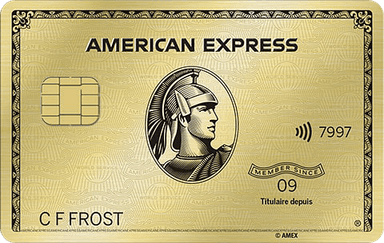
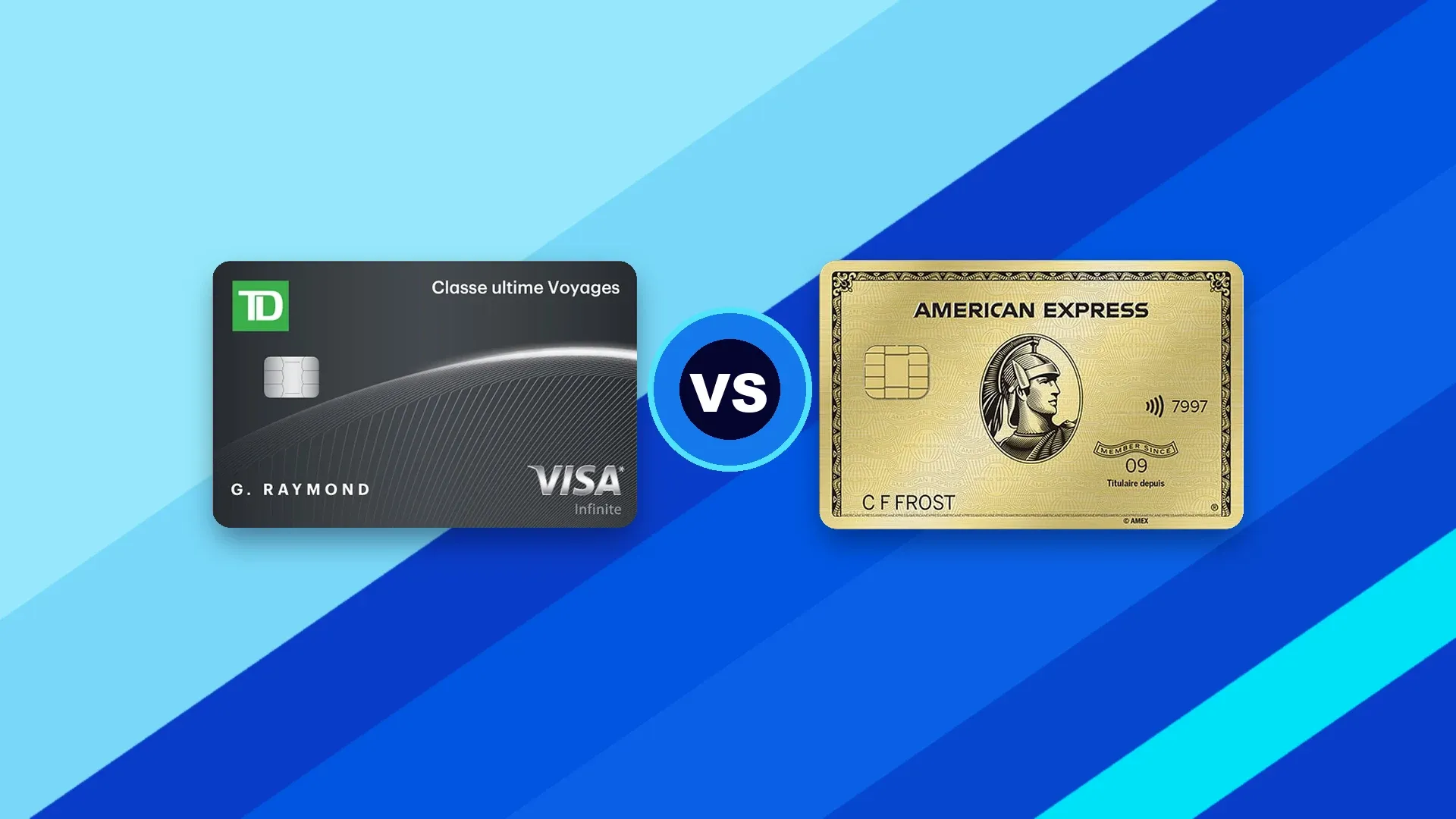
Head to Head: TD First Class Travel Visa Infinite vs American Express Gold Rewards Card
Loading article…
The TD First Class Travel Visa Infinite* Card suits you if you want points with a predictable value and a big first-year bonus. The American Express Gold Rewards Card wins if you transfer your points to Aeroplan or Avios.
Here are two travel credit cards that differ in annual fee ($139 and $250) and in how they value your points:
TD pays fixed-value TD Rewards points that you mostly redeem on Expedia® For TD. American Express pays Membership Rewards points that transfer 1:1 to Aeroplan or Avios. So the TD First Class Travel vs Amex Gold question comes down to one thing: do you want a predictable value, or are you willing to work your points to get more out of them? If you're weighing other cards, our TD First Class Travel vs Scotiabank Passport and Cobalt vs Gold Rewards comparisons round out the picture.
We base our analysis on the key differences between these two credit cards:
Here are both cards side by side. We then break down each item to help you choose.
| Feature | TD First Class Travel Visa Infinite* Card | American Express Gold Rewards Card |
|---|---|---|
| Annual fee | $139, rebated in year one | $250 |
| Additional card | $50 for the first | First one free, then $50 |
| Income requirement | $60,000 personal or $100,000 household | None |
| Welcome offer | Up to 160,000 TD Rewards Points | Up to 60,000 Membership Rewards points |
| Spending requirement | $7,500 within 180 days | $1,000 a month for 12 months |
| Earn rates | 8 pts/$ Expedia For TD; 6 pts/$ groceries, dining, transit; 4 pts/$ bills; 2 pts/$ elsewhere | 2 pts/$ travel, gas, groceries, drugstores; 1 pt/$ elsewhere |
| Transfers to Aeroplan or Avios | No | Yes, 1:1 |
| Milesopedia valuation | 0.5¢ per point | 1.7¢ per point |
| Annual travel credit | $100 (hotel or vacation package of $500 and up, Expedia For TD) | $100 (American Express Travel Online, $100 and up) |
| Airport lounges | 4 visits a year (Visa Airport Companion) | 4 Plaza Premium visits in Canada; Priority Pass membership |
| Emergency medical | $2,000,000, 21 days | $5,000,000, 15 days (under 65) |
| Foreign transaction fee | 2.5% | 2.5% |
The two offers work in very different ways. TD pays a large bonus after a six-month spending target and rebates the first-year annual fee. American Express spreads its bonus over twelve monthly statements and leaves the fee untouched.
The TD First Class Travel® Visa Infinite* Card offers up to 160,000 TD Rewards Points, plus a first-year annual fee rebate:
At Milesopedia's valuation of 0.5¢ per point, those 160,000 points are worth about $800. The $139 fee rebate comes on top.
The American Express® Gold Rewards Card offers up to 60,000 Membership Rewards points over one year:
Here is what that bonus is worth:
This is where the two cards differ most, and where your budget makes the difference. TD rewards everyday spending with big multipliers, while American Express rewards travel, gas and groceries at a lower rate, on points that are worth more.
The TD First Class Travel® Visa Infinite* Card earns TD Rewards Points:
The American Express® Gold Rewards Card earns Membership Rewards points:
At TD, each accelerated category is capped at $25,000 in purchases per year. Beyond that, the rate drops to 2 points per dollar. If you spend less than $2,083 a month on groceries, you will never hit that cap.
American Express applies no cap to the Gold Rewards Card's earn rates. However, the card doesn't boost restaurants, a category where TD pays 6 points per dollar.
To compare the two cards, multiply each earn rate by the value of the point. Here is the return in cents per dollar at Milesopedia's valuations: 0.5¢ per TD Rewards Point and 1.7¢ per Membership Rewards point. The last column shows the Gold Rewards Card redeemed as a statement credit, at 1¢ per point.
| Spending category | TD First Class Travel Visa Infinite* Card | American Express Gold Rewards Card (1.7¢) | Gold Rewards as statement credit (1¢) |
|---|---|---|---|
| Expedia For TD | 8 pts/$, or 4.0¢/$ | 2 pts/$, or 3.4¢/$ | 2.0¢/$ |
| Groceries | 6 pts/$, or 3.0¢/$ | 2 pts/$, or 3.4¢/$ | 2.0¢/$ |
| Restaurants | 6 pts/$, or 3.0¢/$ | 1 pt/$, or 1.7¢/$ | 1.0¢/$ |
| Public transit | 6 pts/$, or 3.0¢/$ | 1 pt/$, or 1.7¢/$ | 1.0¢/$ |
| Recurring bills and streaming | 4 pts/$, or 2.0¢/$ | 1 pt/$, or 1.7¢/$ | 1.0¢/$ |
| Gas and drugstores | 2 pts/$, or 1.0¢/$ | 2 pts/$, or 3.4¢/$ | 2.0¢/$ |
| Travel booked elsewhere | 2 pts/$, or 1.0¢/$ | 2 pts/$, or 3.4¢/$ | 2.0¢/$ |
| Everything else | 2 pts/$, or 1.0¢/$ | 1 pt/$, or 1.7¢/$ | 1.0¢/$ |
TD wins on dining, public transit, recurring bills and Expedia For TD. The Gold Rewards Card takes the lead on gas, drugstores, travel booked elsewhere and everyday purchases, but only if you value your points at 1.7¢.
How you use your points decides the matchup: the two currencies work very differently.
TD Rewards Points get their best value on Expedia For TD, where 200 points equal $1 off a flight, hotel or package. That's the basis of our 0.5¢-per-point valuation. Elsewhere, the value drops:
TD Rewards Points don't transfer to any airline program. Their value stays roughly the same no matter where you go. Our TD Rewards program page covers every option.
Membership Rewards points have a floor and a ceiling. The floor: 1,000 points equal $10 as a statement credit, or 1¢ per point. The ceiling: a 1:1 transfer to Aeroplan, Avios or Flying Blue, then a business class ticket. Our valuations put that use at 2.0¢ per point, versus 1.2¢ for an economy ticket.
Our American Express Membership Rewards program page lists every transfer partner.
Here is what a 100,000-point balance is worth in each program, depending on how you use it.
| Redemption | 100,000 TD Rewards Points | 100,000 Membership Rewards points |
|---|---|---|
| Transfer for business class (Aeroplan, Avios) | Not available | $2,000 (2.0¢ per point) |
| Transfer for economy class | Not available | $1,200 (1.2¢ per point) |
| Expedia For TD | $500 (0.5¢ per point) | Not available |
| Travel credit or statement credit | About $250 (0.25¢ per point) | $1,000 (1¢ per point) |
| Statement credit, gift cards or merchandise | About $250 (0.25¢ per point) | Up to $1,000 (0.5¢ to 1¢ per point) |
Keep in mind that this table compares equal balances, not equal spending. On the same budget, TD gives you about 2.6 times more points, as the next example shows.
Take a household that spends $30,000 a year on a single card:
Here is what each card earns on that budget:
From year two, after fees and both $100 travel credits:
In other words, you need to get about 1.7¢ per Membership Rewards point to match the TD card on this profile. If you redeem for statement credits, TD earns almost twice as much.
The first year tilts further toward TD:
The TD First Class Travel® Visa Infinite* Card costs $139 a year. TD rebates it in the first year when you are the primary cardholder, as long as you activate the card and make a first purchase within 3 months of account opening. The first additional card costs $50; further ones are free.
The American Express® Gold Rewards Card costs $250 a year, with no rebate. The first additional card is free, then each one costs $50.
Both cards charge a 2.5% foreign transaction fee. They also share the same 21.99% purchase interest rate.
Here the Gold Rewards Card has a clear edge: American Express has no minimum income requirement. To get the TD card, you need a personal income of $60,000 or a household income of $100,000.
American Express also lets you check whether you'd be approved before applying, with no impact on your credit score.
Both cards offer solid travel coverage, but in different places.
| Coverage | TD First Class Travel Visa Infinite* Card | American Express Gold Rewards Card |
|---|---|---|
| Emergency medical | $2,000,000, 21 days (4 days at 65 and over) | $5,000,000, 15 days (under 65 only) |
| Trip cancellation | $1,500 | $1,500 |
| Trip interruption | $5,000 | $1,500 |
| Flight delay | $500 | $500 |
| Delayed baggage | $1,000 | $500 |
| Lost baggage | $1,000 | $500 |
| Travel accident | $500,000 | $500,000 |
| Car rental | Up to $65,000, 48 days | Up to $85,000, 48 days |
| Hotel burglary | $2,500 | $500 |
| Mobile device | $1,000 | Not offered |
| Purchase protection and extended warranty | 90 days and 1 year | 90 days and 1 year |
For emergency medical, the Gold Rewards Card has the higher limit, $5,000,000, but for 15 days. The TD card covers $2,000,000 for 21 days, or 4 days from age 65. For a three-week trip, TD keeps you covered longer. From age 65, the Gold Rewards Card no longer covers emergency medical, while TD keeps 4 days of coverage.
TD also covers trip interruption, baggage and hotel burglary better. The Gold Rewards Card keeps an edge on car rentals, covering vehicles up to $85,000. The exact terms are in the insurance certificates from TD and American Express.
Both cards include a $100 annual travel credit, under different conditions:
For airport lounges, the TD card includes 4 complimentary visits a year to more than 1,200 lounges through the Visa Airport Companion Program. The Gold Rewards Card includes a Priority Pass membership, but each visit there is paid. Instead, it offers 4 complimentary visits per calendar year to Plaza Premium lounges in Canada.
The Gold Rewards Card adds a $50 statement credit on NEXUS application or renewal fees. The TD card adds its Birthday Bonus and Visa Infinite Concierge.
Visa is accepted almost everywhere in Canada, with a few exceptions such as Costco warehouses, which only take Mastercard. American Express is less widely accepted: many merchants don't take it. If your usual grocery store doesn't accept Amex, the Gold Rewards Card's 2-point rate loses some of its appeal, and you'll need to carry a second card.
Your profile decides the right card. Here are three typical profiles.
You transfer your points to Aeroplan or Avios and you aim for business class. In that case, the American Express® Gold Rewards Card serves you better. At 2.0¢ per point, it earns about $150 more per year than TD on our profile, and its points stay flexible.
You want to know in advance what your points are worth, without hunting for award availability. The TD First Class Travel® Visa Infinite* Card is the pick. Its welcome offer is bigger, its fee is lower and its value doesn't depend on how well you transfer. It also wins if you spend a lot at restaurants.
You don't want to wonder at every checkout whether your card will work. The TD card, on the Visa network, settles that at the vast majority of merchants. With the Gold Rewards Card, plan on a second card for merchants that don't take American Express.
So which card wins? The TD First Class Travel® Visa Infinite* Card comes out ahead if you spend mostly on groceries and dining. Its 160,000-point bonus, its fee rebate and its multipliers on groceries and dining give it a clear first-year lead.
However, the American Express® Gold Rewards Card takes back the lead for people who transfer their points. It has no minimum income requirement, and its value climbs as soon as your points go toward a business class ticket.
Finally, nothing forces you to pick just one. To compare with the rest of the market, see our best credit cards page or our best credit cards for airport lounges.
To access member-only offers, create your free member account.
Here are the answers to the questions to ask yourself before choosing between these two cards.
The TD First Class Travel® Visa Infinite* Card offers up to 160,000 TD Rewards Points, about $800 at Milesopedia's valuation, plus a first-year fee rebate. You need to spend $7,500 within 180 days to earn the extra 140,000 points. The American Express® Gold Rewards Card offers up to 60,000 Membership Rewards points if you charge $1,000 to the card every month for a year. Current and former holders of the Gold Rewards Card are not eligible for this offer. That's $600 as a statement credit, or about $1,020 at 1.7¢.
No. TD Rewards Points can be redeemed on Expedia For TD, as a travel credit or as a statement credit, but not transferred to an airline program. That's the main difference with Membership Rewards points, which move 1:1 to Aeroplan, Avios and Flying Blue. Our TD Rewards page details the redemption options.
Milesopedia values a Membership Rewards point at 1.7¢ and a TD Rewards Point at 0.5¢. The gap looks huge, but TD earns far more points per dollar. On a $30,000 annual budget, TD earns about 117,600 points, versus 45,000 for the Gold Rewards Card. Our points value page explains our valuations.
It's close. The TD card earns 6 TD Rewards Points per dollar on groceries, or 3¢ in value per dollar. The Gold Rewards Card earns 2 Membership Rewards points per dollar: 3.4¢ at 1.7¢ a point, but only 2¢ as a statement credit. At restaurants, TD wins easily with 6 points per dollar, versus 1 for the Gold Rewards Card.
Both, in different ways. The TD card includes 4 complimentary visits a year to more than 1,200 lounges through the Visa Airport Companion Program. The Gold Rewards Card includes a Priority Pass membership with paid visits, plus 4 complimentary visits per calendar year to Plaza Premium lounges in Canada. See our best credit cards for airport lounges for more options.
For the TD card, yes: a personal income of $60,000 or a household income of $100,000. American Express has no minimum income requirement for the Gold Rewards Card. That's a real advantage for young professionals and households below those thresholds.
Yes, since they come from different issuers. You can put groceries, dining and bills on the TD card, then gas, drugstore and travel purchases on the Gold Rewards Card. Both welcome offers can be earned, as long as you meet each card's spending requirements.
on TD's website
Our reviews and rankings are based on an objective assessment. Advertisers do not influence our content. We may receive compensation through some links; our analysis and opinions remain independent.