Head to Head: Rogers Red World Elite Mastercard vs National Bank World Elite Mastercard

Loading article…
Here are two World Elite credit cards that seem to have nothing in common:
On one side, the Rogers card costs nothing and pays simple cash back, with a higher rate on U.S. dollar purchases. On the other, the National Bank card costs $150 a year, but it pays heavily on groceries and restaurants, reimburses travel expenses and carries some of the most complete insurance on the market. In this Rogers World Elite vs NBC World Elite matchup, the real question is not "which one replaces the other". It is: "which card comes out of your wallet for which purchase?"
The figures in this comparison come from our card pages and from the official Rogers Bank and National Bank websites, as of October 20, 2026.
Here are both cards side by side. We then go through each item.
| Feature | Rogers Red World Elite Mastercard | National Bank World Elite Mastercard |
|---|---|---|
| Annual fee | $0 | $150, refunded in year one until November 4, 2026 |
| Additional card | $0 | $50 |
| Income required | $80,000 personal or $150,000 household | $80,000 personal or $150,000 household |
| Welcome offer | None | First-year annual fee refunded ($150) |
| Rewards | 2% with an eligible Rogers service (1.5% otherwise); 3% on U.S. dollar purchases; $61,000 annual cap | 5 pts/$ on groceries and restaurants; 2 pts/$ on gas, recurring bills and À la carte Travel; 1 pt/$ elsewhere |
| Foreign transaction fee | 2.5% | 2.5% |
| Travel credit | None | Up to $150 a year |
| Airport lounges | Mastercard Travel Pass, paid visits | National Bank Lounge at YUL, unlimited |
| Emergency medical | $1,000,000, 10 days (15 days from November 18, 2026) | $5,000,000, 60 days (15 days from 65 to 75) |
| Trip cancellation | $1,000 per person, removed November 18, 2026 | $2,500 per person |
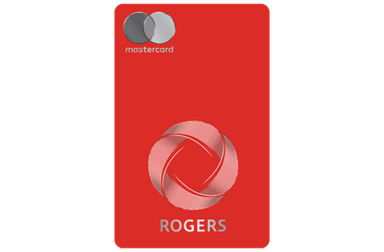
The Rogers Red World Elite Mastercard has no welcome offer right now. It relies on everyday cash back and the absence of an annual fee.
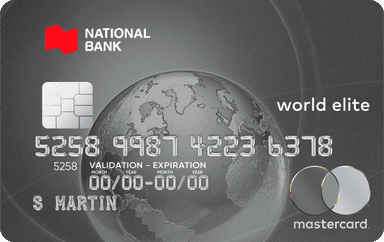
The National Bank World Elite Mastercard has an offer exclusive to the Milesopedia network: the first-year annual fee ($150) is refunded. The bank charges the fee to your account, then credits it to your statement within five months of opening, as long as the account stays open and in good standing. You must not have held a National Bank personal Mastercard credit card in the past 24 months.
This is the first gap. The Rogers Red World Elite Mastercard has no annual fee, and authorized users are free too.
The National Bank World Elite Mastercard costs $150 a year, and $50 for an additional card. However, its annual travel credit of up to $150 offsets that fee if you use it.
Despite the price gap, both cards require the same gross income: $80,000 personal or $150,000 household. Here are the interest rates:
Outside Quebec, Rogers Bank may also open an account at higher rates, namely 25.99% on purchases and 27.99% on cash advances, if you are not approved at the standard rates. Finally, note that you can only hold one Rogers Bank credit card at a time.
The two cards reward you in completely different ways. Rogers pays an almost flat percentage, while National Bank concentrates its points in a few categories.
The Rogers Red World Elite Mastercard pays:
These rates apply to the first $61,000 in purchases in your account year. Beyond that, everything earns 1.5% until your reset date. You redeem cash back as a credit against purchases from the last 90 days, starting at $10, or as an annual statement credit.
The National Bank World Elite Mastercard earns:
The 5-point rate only applies to the first $2,500 in gross monthly purchases, all categories combined. Beyond that, groceries and restaurants earn 2 points per dollar. Milesopedia values an À la carte point at 0.9¢: 10,000 points are worth $100 through the À la carte Travel agency. Our full National Bank World Elite review details the redemption options.
This is the angle that justifies this comparison. Both cards charge a 2.5% foreign transaction fee. So neither is a no-foreign-transaction-fee card. What changes is what each card gives back.
At Rogers, the 3% cash back on U.S. dollar purchases outweighs the 2.5% fee. You keep about 0.5% net on every purchase in the United States or from a merchant that bills in U.S. dollars.
At National Bank, a regular U.S. dollar purchase earns 1 point, or 0.9¢. After the 2.5% fee, you lose about 1.6%. According to our card data, the bonus categories also apply to foreign currency purchases: a restaurant meal or groceries in the United States still earn 5 points per dollar, or about 2% net after the fee.
For euros, pounds or pesos, Rogers pays no bonus. A Rogers customer earns 2% cash back, minus the 2.5% fee, for a loss of about 0.5%. Without a Rogers service, the loss rises to about 1%.
If you spend a lot in euros, neither card is ideal. A card with no foreign transaction fees will do better for those purchases. See our best credit cards with no foreign transaction fees.
Here is the net return per dollar spent, at our valuation of 0.9¢ per À la carte point. For Rogers, we show the Rogers customer rate first, then the non-customer rate.
| Spending category | Rogers Red World Elite Mastercard | National Bank World Elite Mastercard |
|---|---|---|
| Groceries and restaurants in Canada (under $2,500 a month) | 2% (1.5% without a Rogers service) | 5 pts/$, or 4.5¢ per dollar |
| Gas and recurring bills | 2% (1.5%) | 2 pts/$, or 1.8¢ per dollar |
| Other purchases in Canada | 2% (1.5%) | 1 pt/$, or 0.9¢ per dollar |
| Eligible Rogers purchases from November 18, 2026 | 5% | 1.8¢ per dollar if recurring bill, otherwise 0.9¢ |
| U.S. dollar purchases | About +0.5% net | About -1.6% net (about +2% on groceries and restaurants) |
| Other currencies | About -0.5% net (-1% without a Rogers service) | About -1.6% net (about +2% on groceries and restaurants) |
Groceries and restaurants lean clearly toward National Bank. Almost everything else leans toward Rogers, especially for a Rogers customer.
Take a Rogers customer household that spends $24,000 a year in Canada and the equivalent of $5,000 in U.S. dollars while travelling. Its Canadian split:
Here is its estimated net gain, foreign transaction fees included, assuming its U.S. dollar purchases are neither meals nor groceries:
The pair wins. For a Rogers customer, National Bank only handles groceries and restaurants, where it returns 4.5¢ per dollar versus 2¢. Rogers takes everything else, since its 2% beats National Bank's 1.8¢ on gas and bills. Without a Rogers service, the split changes: gas and recurring bills move to National Bank too.
This is where the gap is widest, and it will widen further on November 18, 2026.
The National Bank World Elite Mastercard covers up to $5,000,000 in emergency medical care, for trips of:
The Rogers Red World Elite Mastercard covers up to $1,000,000, for the first 10 days of a trip at age 64 and under, and the first 3 days from 65 to 75. From November 18, 2026, the limit rises to 15 days at age 64 and under; it does not change after 65.
Today, Rogers covers trip cancellation and trip interruption up to $1,000 per person. However, Rogers Bank is removing both, along with trip delay coverage, on November 18, 2026. Travel charged to the card before that date is still covered under the current terms.
National Bank, for its part, keeps cancellation coverage up to $2,500 per person and interruption coverage up to $5,000 per person.
Here is how each card stacks up for the rest:
For full details on the National Bank side, see our National Bank World Elite insurance guide.
The National Bank World Elite Mastercard reimburses up to $150 in travel expenses each year: airport parking, baggage fees, seat selection, airport lounge access or upgrades. It also gives free, unlimited access to the National Bank Lounge at Montréal-Trudeau, with one guest and two children aged 12 and under. According to National Bank, the lounge has been temporarily relocated since October 5, 2026, because of renovations.
The Rogers Red World Elite Mastercard includes a Mastercard Travel Pass membership with no free visits: each lounge visit in the network costs US$32 per person. Rogers customers get 5 Roam Like Home days a year until January 11, 2027. From January 12, 2027, those days are replaced by an annual $75 roaming credit.
Our article on the Rogers Red card changes covers these new rules.
No single answer fits everyone. Here are three distinct profiles.
The Rogers Red World Elite Mastercard wins. Its 3% wipes out the foreign transaction fee and leaves about 0.5% net, while National Bank costs you about 1.6% on a regular purchase. Keep it for trips to the United States and online purchases billed in U.S. dollars.
The National Bank World Elite Mastercard is the clear pick. Its 60-day medical coverage, trip cancellation, baggage protection, Montréal-Trudeau lounge and $150 travel credit form a package Rogers does not offer, especially after November 18, 2026.
It depends on how you travel. If you travel little and are a Rogers customer, the Rogers card earns more, with no fee. If you take at least one trip a year, National Bank is the safer choice: without trip cancellation or baggage insurance, the Rogers card will leave you underinsured from November.
For most travellers, the best answer is to carry both. Use the National Bank card for groceries, restaurants and plane tickets, to benefit from its insurance. Use the Rogers card for U.S. dollar purchases and the rest of your everyday spending. Since the Rogers card has no fee, keeping it costs nothing.
So which card wins this head-to-head? Neither replaces the other. The National Bank World Elite Mastercard dominates on groceries, restaurants and insurance, and it is the card to use when paying for your trips. The free Rogers Red World Elite Mastercard softens U.S. dollar spending and returns 2% on the rest for a Rogers customer.
Together, they cover almost everything. To compare with the rest of the market, see our best credit cards page or our Neo vs Rogers World Elite comparison.
| Credit card | Annual fee | Welcome offer | |
|---|---|---|---|
| $0 | |||
| $0 |
To get new card offers and our analysis every week, sign up for our free newsletter.
No. The Rogers Red World Elite Mastercard charges a 2.5% fee on foreign currency purchases, just like the National Bank card. It does compensate on U.S. dollars with 3% cash back, which leaves about 0.5% net. For euros or pesos, a card with no foreign transaction fees is still the better choice.
The National Bank World Elite Mastercard, without hesitation. It earns 5 points per dollar on groceries and restaurants, or about 4.5¢ in value per dollar, within the first $2,500 of purchases each month. The Rogers card returns 2% for a Rogers customer and 1.5% for everyone else.
The National Bank card, clearly. Its emergency medical coverage reaches $5,000,000 and covers trips of 60 days at age 54 and under. At Rogers, coverage reaches $1,000,000 for 10 days, or 15 days from November 18, 2026. Rogers is also removing trip cancellation and interruption coverage on that date.
Three things. Cash back rises to 5% on eligible Rogers purchases, such as bills paid online. The 1.5x redemption bonus on Rogers purchases disappears. Finally, trip cancellation, interruption and delay coverage is no longer included. On January 12, 2027, Roam Like Home days become a $75 roaming credit. Our article on the Rogers changes covers each point.
No, but it pays more. Without a Rogers, Fido, Shaw or Comwave service, the base cash back rate drops from 2% to 1.5%. The 3% on U.S. dollars applies to all cardholders. The income requirement remains $80,000 personal or $150,000 household, the same as at National Bank.
Yes, and that is our recommendation for most travellers. The cards come from different issuers, and the Rogers card has no annual fee. Put groceries, restaurants and travel bookings on the National Bank card, then U.S. dollar purchases and everything else on the Rogers card.
on National Bank's website
Our reviews and rankings are based on an objective assessment. Advertisers do not influence our content. We may receive compensation through some links; our analysis and opinions remain independent.