

Air Canada Surcharge: What it Means for Your Flights

In summary: The Air Canada surcharge (officially « Carrier Surcharge, » rule 115) is a fuel supplement added to the price of paid tickets. It primarily applies to international and transborder routes, varies by route and class, and is not charged on tickets redeemed with Aeroplan points. To avoid it, book with Aeroplan points or choose a carrier without a surcharge.
Air Canada has discreetly updated its fare structure: a fuel surcharge now applies to a long list of routes. This Air Canada surcharge, officially called “Carrier Surcharge” (rule 115), applies only to paid tickets. It is added to the base fare and existing taxes. Here’s everything you need to know.
This decision is part of a trend already started by other carriers. Air France-KLM had reinstated its surcharges on several medium- and long-haul routes following tensions in the Middle East. Porter Airlines also announced surcharges on certain North American routes. Air Canada is following suit with a detailed chart, updated on March 26, 2026.
What is the Air Canada surcharge?
The Air Canada surcharge is a fare supplement applied by the carrier on certain routes. It appears on the ticket under the code Q or YQ. This amount is added to the base fare and government taxes. It varies depending on the geographical zone, flight direction, and class of service.
Specifically, this surcharge covers additional operational costs related to fuel, insurance, and the geopolitical situation. Air Canada publishes the amounts in its fare rule 115, a PDF document accessible on its website. The latest update is dated March 26, 2026.
Surcharge Routes and Amounts
The Air Canada surcharge applies to a large number of international and transborder routes. Amounts vary considerably depending on the destination and booking class. Here is a summary of the main affected areas.
Transatlantic Flights (Europe and Middle East)
Routes between Canada and Europe are among the most affected. Surcharges vary by destination country and fare class.
| Route | Economy (one-way) | Business (one-way) |
|---|---|---|
| Canada – United Kingdom | $405 to $645 CAD | $1,189.50 CAD |
| Canada – France / Germany | $450 to $705 CAD | $1,275 CAD |
| Canada – Switzerland / Belgium | $450 to $705 CAD | $1,275 CAD |
| Canada – Spain / Portugal / Italy | $430 to $705 CAD | $1,275 CAD |
| Canada – Israel | $485 to $730 CAD | $1,305 CAD |
| Canada – Turkey / Egypt | $485 to $730 CAD | $1,320 CAD |
Exact amounts depend on the fare subclass (Y, B, M, etc.) and direction (one-way vs. round-trip). In particular, flights to the Middle East show some of the highest surcharges due to the geopolitical context.
Transpacific Flights (Asia-Pacific)
| Route | Economy (one-way) | Business (one-way) |
|---|---|---|
| Canada – Japan | CA$226 | CA$226 |
| Canada – South Korea | CA$250 to CA$350 | CA$350 |
| Canada – Hong Kong / China | CA$225 to CA$260 | CA$335 to CA$470 |
| Canada – India | CA$490 to CA$715 | CA$1,225 |
| Canada – Australia / New Zealand | CA$84.30 to CA$402 | CA$200 to CA$500 |
Contrary to what one might think, surcharges to Europe are generally higher than those to Asia-Pacific, despite sometimes comparable distances.
Flights to the Americas and the Caribbean
| Route | Economy (one-way) | Business (one-way) |
|---|---|---|
| Canada – Mexico | CA$42 to CA$134 | CA$134 |
| Canada – Caribbean (Cuba, Jamaica, etc.) | CA$46 to CA$90 | CA$90 |
| Canada – South America (Brazil, Colombia) | CA$115 to CA$195 | CA$265 to CA$315 |
| Canada – United States (selected routes) | CA$40 | CA$40 |
Flights to the United States show the most modest surcharges. In contrast, routes to South America are closer to transatlantic amounts.
Flights to Africa
African routes are also included in the schedule. Surcharges to Morocco, South Africa, or other destinations on the continent generally range from $100 to $250 CAD in Economy and between $200 and $500 CAD in Business Class, per one-way trip.
Why Air Canada is Imposing This Surcharge
Several factors explain this decision. First, jet fuel prices have remained high since early 2025, fueled by geopolitical tensions in the Middle East and supply constraints. Second, aviation insurance costs have increased on certain routes, particularly those flying over conflict zones.
Air Canada is not an isolated case. As mentioned above, Air France-KLM and Porter Airlines have adopted similar measures. At Air France-KLM, fuel surcharges (code Q or YQ) have been gradually reinstated on medium-haul and long-haul routes since 2024. Porter has also added surcharges on certain North American routes.
For Air Canada, the objective is clear: to pass on a portion of operational costs to the ticket price rather than uniformly increasing base fares. This allows the carrier to display competitive base fares while adjusting the surcharge according to the routes.
Concrete Impact on Your Ticket Price
In practice, this Air Canada surcharge increases the total cost of your ticket.
How to Spot the Surcharge on Your Ticket
The surcharge appears on your booking confirmation under the code Q or YQ. You will find it in the details of taxes and fees, separate from the base fare (fare code) and government taxes (codes CA, XG, SQ, etc.).
- Q or YQ Code: Carrier surcharge, this is the one we are interested in here
- Base Fare: Ticket price before taxes and surcharges
- Taxes (CA, XG, SQ, etc.): Government taxes and airport fees
Example for a Toronto – Paris flight in Economy Class in summer 2026
Here is an example of a round-trip flight in summer 2026 between Toronto and Paris in economy class. The carrier surcharge shown is $1,010.
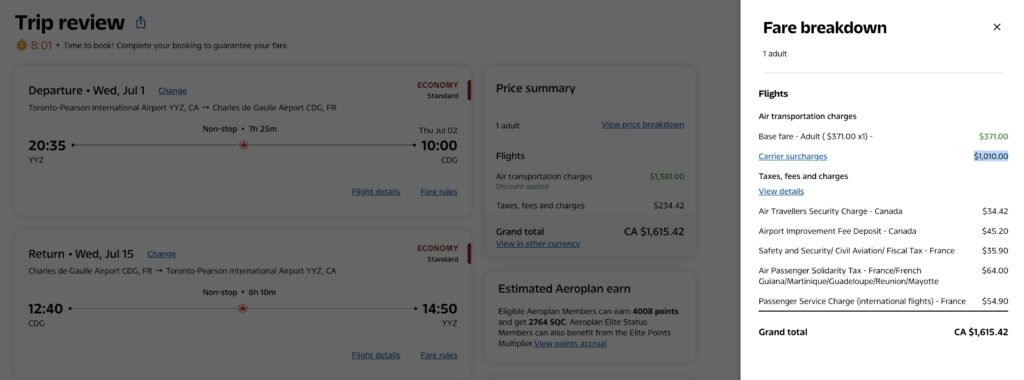
In detail, the fare breaks down as follows:
| Fees | Amount |
|---|---|
| Air transportation charges – base fare | $371 |
| Carrier surcharge | $1,010.00 |
| Air Travellers Security Charge – Canada | $34.42 |
| Airport Improvement Fee deposit – Canada | $45.20 |
| Security and safety / Civil aviation / Fiscal tax – France | $35.90 |
| Air passenger solidarity tax – France/French Guiana/Martinique/Guadeloupe/Reunion/Mayotte | $64.00 |
| Passenger service charge (international flights) – France | $54.90 |
| Grand Total | $1,615.42 |
Who is Affected and Who is Not
The distinction is important. Here is what this Air Canada surcharge covers – and does not cover.
Paid Flights: Surcharge Applicable
If you purchase an Air Canada ticket with money (credit card, transfer, etc.), the surcharge applies to the listed routes. This includes tickets purchased directly on aircanada.com, through a travel agency, or a consolidator.
Exemptions and Special Cases
Infants traveling without a seat are exempt from these surcharges, and certain routes remain free, including several Canada-Hong Kong connections. Air Canada also offers reduced rates for Round-the-World tickets ($45 to $255 CAD per segment).
Starting January 2026, for flights to/from the United Kingdom, additional fees will apply: CA$55 for business class and CA$26 for economy class, in addition to the basic surcharge.
Amounts vary depending on your exact fare class, departure city, and flight direction. The rates presented are from Air Canada’s official document dated March 26, 2026 – always verify the exact amount when making your booking.
Point Redemptions: Not Affected for Now
Tickets redeemed with Aeroplan points are not affected by this surcharge for the moment. Air Canada had historically removed fuel surcharges on Aeroplan redemptions – a decision that remains in effect to this day.
Comparison with Other Carriers
Air Canada is not the first carrier to reintroduce surcharges. Here’s how the situation compares.
| Carrier | Surcharge on Paid Tickets | Surcharge on Point Redemptions |
|---|---|---|
| Air Canada | Yes (since March 2026) | No (for now) |
| Air France-KLM | Yes (reinstated in 2026) | Yes (on certain routes) |
| Porter Airlines | Yes (introduced in 2026) | N/A |
| British Airways | Yes | Yes (high surcharges) |
| WestJet | No (to date) | N/A |
The good news for Canadian travelers: WestJet has not yet announced a similar surcharge. This could make it an interesting alternative on certain routes, particularly to Europe and the Caribbean.
How to Limit the Impact of the Surcharge
Some strategies to reduce the effect of this surcharge on your travel budget.
- Prioritize Aeroplan redemptions: As long as point tickets remain exempt, this is the best way to avoid this surcharge on Air Canada
- Compare with other carriers: WestJet, Flair, or foreign airlines do not necessarily apply the same surcharges. Use Google Flights or a comparison tool to check the total cost
- Book early: Surcharges apply on the departure date, but base fares are generally lower when booking in advance
- Earn points with the right cards: Maximize your Aeroplan points with the best Aeroplan cards to fund your next flights with points instead of cash
What This Means for Canadian Travelers
This Air Canada surcharge is a clear signal: the cost of air travel is increasing. Fuel surcharges, which had been largely eliminated in recent years, are making a comeback amid high oil prices and geopolitical instability.
For travelers who purchase their tickets with cash, the impact is direct and immediate. A round-trip to Europe now costs $900 to $1,460 CAD more than before this surcharge – in economy alone. In business class, the addition can exceed $2,500 CAD.
For travelers using Aeroplan points, the situation remains favorable. As long as point redemptions are exempt, the relative value of Aeroplan points increases. Each point is worth slightly more, as it saves you from paying these surcharges.
This is an additional argument for accumulating points via the best credit cards and using your points for long-haul flights, where surcharges are highest.
Conclusion
The Air Canada surcharge is a reality to factor into your travel planning. On paid tickets, it adds between $40 CAD (short-haul) and $1,320 CAD (long-haul business to Europe) per one-way trip. The list of affected routes is extensive and covers virtually all of Air Canada’s international network.
The current exemption for Aeroplan redemptions reinforces the appeal of points programs. If you travel regularly with Air Canada, now is the time to review your accumulation strategy. Consult our comparison of the best Aeroplan cards and our page on the best travel credit cards to maximize your points.
We are monitoring this situation closely. Subscribe to our newsletter to be informed if Air Canada modifies the conditions – particularly if Aeroplan redemptions also become affected.
Air Canada Surcharge – Frequently Asked Questions
What is the Air Canada surcharge?
This is a fare supplement (code Q or YQ) added to the price of paid Air Canada tickets. It covers fuel and insurance costs. The amount varies depending on the route, direction, and booking class.
Which flights are affected by this surcharge?
The majority of Air Canada’s international and transborder routes are affected: Europe, Asia-Pacific, Middle East, Africa, the Americas, and certain routes to the United States. The complete list is published in Air Canada’s Rule 115, updated on March 26, 2026.
Are Aeroplan tickets affected?
No. For now, tickets redeemed with Aeroplan points are not subject to this surcharge. Only paid tickets (purchased with money) are affected. However, this exemption could change in the future.
How much does the Air Canada surcharge cost?
Amounts range from CA$40 (Canada – U.S. transborder) to CA$1,320 (business class to Europe) per one-way. Routes to Europe and the Middle East generally carry the highest surcharges.
How do I see the surcharge on my ticket?
Look for the code Q or YQ in the taxes and fees section of your booking confirmation. This amount is distinct from the base fare and government taxes.
Do other airlines apply similar surcharges?
Yes, several airlines like Porter Airlines and Cathay Pacific have announced surcharges. WestJet has not yet announced a similar measure.
How to avoid the Air Canada surcharge?
The most effective method remains to use your Aeroplan points for your flights, as long as point redemptions remain exempt. You can also compare with carriers that do not apply a surcharge on the same routes, such as WestJet.
Can the surcharge be refunded?
The surcharge is an integral part of the ticket price. In case of cancellation, it follows the same refund rules as the base fare – meaning it depends on your ticket’s fare policy (refundable, non-refundable, flexible, etc.).
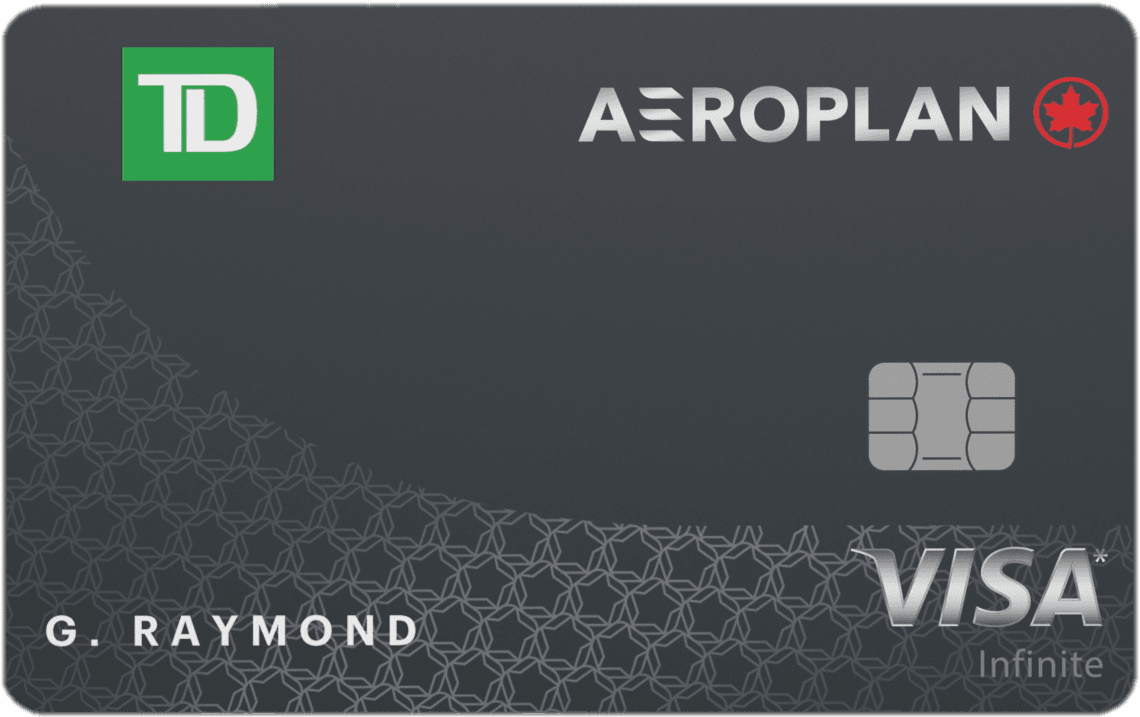
Our featured card

- Annual fee
- $0 $139No annual fee the first year
- No annual fee the first year
- Our valuation
- $1,139Milesopedia first-year estimate First-year valueWelcome bonus$1,000Annual fee rebated$139Total$1,139Rewards on your spending are not included. The calculator that adds them from your own profile is on the card's page.
- Milesopedia first-year estimateFirst-year valueWelcome bonus$1,000Annual fee rebated$139Total$1,139Rewards on your spending are not included. The calculator that adds them from your own profile is on the card's page.
- Welcome offer
- Up to 50,000 points
- + First Year Annual Fee Rebate
on TD's website
Our editorial integrity
Our reviews and rankings are based on an objective assessment. Advertisers do not influence our content. We may receive compensation through some links; our analysis and opinions remain independent.