

Booked With Points? Here’s the Card That Still Insures Your Trip

You book a return flight with Aeroplan points. The fare drops to zero and all that is left are the taxes and carrier charges on your credit card. Two weeks before departure, a hospital stay grounds you. You call your card’s insurer, and the answer lands hard: the trip was not paid for with the card, so nothing is covered.
That is the points traveller’s paradox. The more you pay in points, the less you pay in dollars, and the less your card’s trip cancellation insurance protects you. Most cards require the entire trip cost, or a large portion of it, to be charged to the card. Two National Bank cards use noticeably looser wording. Before you compare, take a look at our ranking of the best credit cards in Canada.
The award ticket trap
Go back to that Aeroplan ticket cancelled for illness. The seat cost you points saved over months, plus the taxes and carrier charges you put on a card. Aeroplan returns your points, minus whatever fees apply to the fare you chose. Everything else evaporates: the non-refundable hotel night, the airport transfer, the tour you prepaid.
That is precisely the moment trip cancellation insurance should step in. However, most credit card contracts tie coverage to paying for the trip with the card. When you pay with points, that payment barely exists. Your « free » ticket then costs you the taxes, the fees, and your vacation.
The problem hits all three programs Canadians use most: Aeroplan, Avios and Flying Blue. It hits award hotel nights too. Our guide on trip cancellation and interruption insurance on credit cards walks through what each type of contract asks for.
Transferred points: the Cobalt example
The rule gets stricter when you transfer points to a partner program. As of September 2026, the American Express Cobalt® Card certificate of insurance, in effect since July 1, 2025, requires 100% of the airline ticket price, including taxes, to be charged to the card. It makes one exception: a ticket obtained with Membership Rewards points, with the taxes charged to the card.
An Aeroplan ticket paid with points transferred from Membership Rewards does not fall under that exception. The certificate excludes flight delay, baggage delay, lost baggage and hotel burglary whenever the ticket or accommodation is purchased with points from another reward program. By the same wording, a ticket paid partly with Aeroplan points and partly on the card does not meet the condition either. The Cobalt also carries no trip cancellation insurance. Our guide to Amex Cobalt travel insurance walks through each coverage.
The clause that changes everything
National Bank’s certificates do not ask for the full cost. They ask that « at least a portion of the cost of the trip » be charged to the card account. A portion. The taxes and fees on an award ticket clear that bar.
What the World Elite covers
| Coverage | World Elite | Platinum |
|---|---|---|
| Trip cancellation | $2,500 per person | $1,000 per person |
| Trip interruption | $5,000 per person | $1,500 per person |
| Baggage loss or theft | $1,000 per person | $1,000 per person |
| Baggage delay (over 6 hours) | $500 | $500 |
| Departure flight delay (over 4 hours) | $500 per person | $500 per person |
| Eligibility condition | At least a portion of the trip cost charged to the account | Same |
Those three pillars, cancellation, interruption and lost or stolen baggage, share the same trigger. In addition, the purchase protections travel with the card: 180 days against theft and damage, manufacturer’s warranty tripled up to 2 extra years, and $60,000 lifetime. Mobile devices are covered up to $1,000 against damage, loss and theft.
How to switch the coverage on
- Charge the taxes and fees to the card: when you finalize an award booking, pick your National Bank card for the cash portion.
- Keep the statement: that transaction is your proof the trip meets the condition.
- Save every confirmation: the loyalty program itinerary, the tax receipt, and receipts for non-refundable hotels and activities.
- Write down the emergency line: CanAssistance answers at 1 888 235-2645 while you are travelling.
An award booking made inside a loyalty account leaves almost no banking trail. As a result, the card statement becomes the centrepiece of any claim file. Without it, the insurer has no way to tie the trip back to the card.
Three real world scenarios
Aeroplan ticket, taxes on the card
You redeem points for two seats to Europe. The fare goes on points, the taxes and fees go on the World Elite. The condition is met for both insured travellers. If illness forces a cancellation, the protection opens up to $2,500 per person. If the trip is cut short once you are there, the ceiling rises to $5,000 per person.
Marriott award nights, paid flights
This time the hotel goes on Marriott Bonvoy points and the flights are paid in cash on the card. The logic runs the same way: part of the trip cost sits on the account. Consequently, the trip falls inside the coverage, not just the airfare.
A package paid half in points
Last case: a package settled half with National Bank À la carte Rewards points and half on the card. The cash half is enough to open the coverage. Note, though, that anything paid out stays subject to the certificate’s limits and terms.
The limits worth naming
A flexible cancellation clause does not make the whole contract flexible. Three caveats deserve to be stated plainly before you lean on this coverage.
- Medical coverage depends on age: on the World Elite, the $5 million per person emergency medical benefit runs 60 days at age 54 and under, 31 days from 55 to 64, and 15 days from 65 to 75. At 76 and over, there is no medical coverage.
- Authorized users are not covered: emergency medical insurance excludes them.
- Baggage delay is stricter: that benefit requires the total cost of the trip to be charged to the card, unlike loss and theft where a portion is enough.
- Provincial health coverage is required: the medical benefit assumes you are covered by your province’s public plan.
- This is not a full policy: for a long stay, card insurance does not replace a standalone travel insurance policy.
The baggage distinction is worth a second look. An award ticket where you only paid the taxes opens the loss and theft protection up to $1,000, but not necessarily the $500 benefit for a delay of more than 6 hours. Two protections, same suitcase, different conditions.
The Platinum, no income requirement
The World Elite asks for $80,000 in personal income or $150,000 in household income. That threshold rules out a good share of points travellers, students and younger workers in particular. The National Bank Platinum Mastercard® has no minimum income requirement at all, and it carries the exact same eligibility clause.
The amounts drop: $1,000 per person for cancellation, $1,500 for interruption. On the other hand, baggage stays at $1,000 and flight delay at $500, same as the World Elite. Platinum medical coverage is limited to trips of 10 days or less, for travellers under 76. In other words, it is a card for getaways, not for long stays. Our comparison of the Platinum versus the World Elite covers the rest of the gaps, and our piece on the Platinum for young professionals digs into that profile.
The Milesopedia exclusive offer
Both cards carry an offer exclusive to the Milesopedia network, good until November 4, 2026.
- World Elite: no annual fee for the first year, a $150 value, refunded as a statement credit within 5 months, with no spending requirement. No welcome points come with this card.
- Platinum: up to 40,000 points, roughly $362, plus a first year free worth $70.
Beyond the insurance, the World Elite keeps its standing perks: a $150 annual travel credit, unlimited access to the National Bank lounge at YUL, and 5x points abroad. Our review of the National Bank lounge at Montreal Trudeau shows what that access looks like in practice. Furthermore, our 8 reasons to apply for the World Elite cover the rest of the case.
- National Bank World Elite Mastercard® card page (rates, conditions and insurance)
- World Elite exclusive offer page (first year with no annual fee)
- National Bank Platinum Mastercard® card page (no minimum income)
- Platinum exclusive offer page (up to 40,000 points in 3 parts)
- Best credit cards for insurance coverage
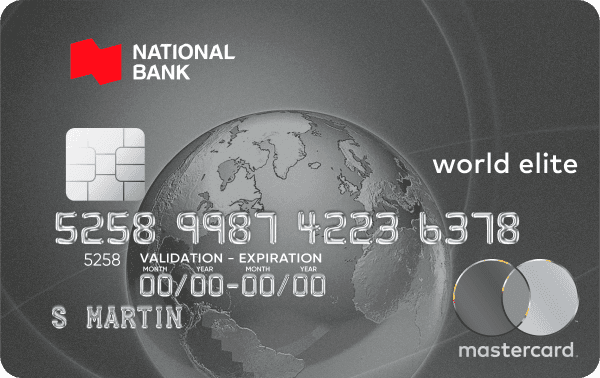

- Annual feeNo annual fee the first year
- $0 $150
- Our valuationMilesopedia first-year estimate First-year valueAnnual fee rebated$150Total$150Rewards on your spending are not included. The calculator that adds them from your own profile is on the card's page.
- $150
- Welcome offer$150 annual fee rebated
- First Year Annual Fee Rebate
- Ends Nov 4, 2026
on National Bank's website
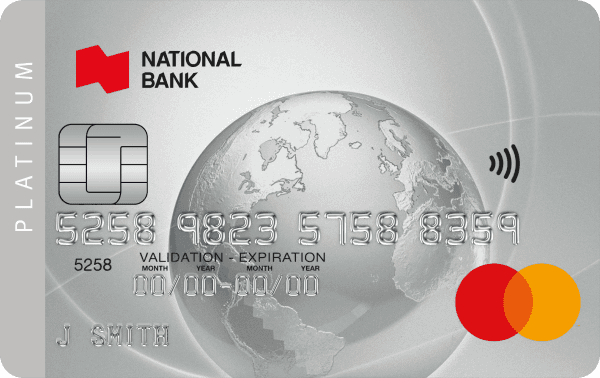
- Annual feeNo annual fee the first year
- $0 $70
- Our valuationMilesopedia first-year estimate First-year valueWelcome bonus$360Annual fee rebated$70Total$430Rewards on your spending are not included. The calculator that adds them from your own profile is on the card's page.
- $430
- Welcome offerAfter $12,500 in 12 months
- 40,000 points
- Ends Nov 4, 2026
on National Bank's website
To follow offers and condition changes week after week, subscribe to our newsletter.
Booking with points and insurance – Frequently Asked Questions
Is a ticket booked with Aeroplan points covered by trip cancellation insurance?
On the National Bank World Elite Mastercard® and the National Bank Platinum Mastercard®, the condition fits in one sentence: at least a portion of the trip cost must have been charged to the account. Paying the taxes and fees on an award ticket with the card meets that condition. Most other cards ask for the entire trip cost, or a large portion of it.
Do points transferred to Aeroplan stay insured?
Not on the American Express Cobalt® Card. As of September 2026, its certificate covers tickets charged in full to the card or obtained with Membership Rewards points, with the taxes on the card. A ticket booked with Aeroplan points, even points transferred from Membership Rewards, loses flight delay, baggage delay and lost baggage coverage. On the National Bank cards, charging a portion of the cost to the account is enough for cancellation, interruption and lost or stolen baggage.
How much does the cancellation insurance pay out?
Trip cancellation reaches $2,500 per person on the World Elite and $1,000 per person on the Platinum. Trip interruption goes up to $5,000 per person on the World Elite and $1,500 on the Platinum. These amounts appear in certificates 713705-10 and 713705-11.
Is an award hotel night covered?
Yes, as soon as part of the trip cost runs through the card. If your flights are paid with the card and your nights come from points, the eligibility condition is met. Anything paid out still falls under the certificate’s limits and terms.
Does the medical coverage have an age limit?
Yes. On the World Elite, the $5 million per person emergency medical benefit runs 60 days at age 54 and under, 31 days from 55 to 64, and 15 days from 65 to 75. At 76 and over there is no coverage. On the Platinum, medical coverage applies to trips of 10 days or less, for travellers under 76.
Are authorized users insured?
Not for emergency medical insurance, which excludes them. Check this before adding a spouse or an adult child to the account expecting to insure them at the same time.
Does baggage delay follow the same rule?
No, and this is the easiest nuance to miss. Baggage loss and theft, up to $1,000 per person, follow the portion of the cost rule. Baggage delay of more than 6 hours, worth up to $500, requires the total cost of the trip to have been charged to the card.
Is there a minimum income to get these cards?
The World Elite asks for $80,000 in personal income or $150,000 in household income, with a $150 annual fee. The Platinum has no minimum income requirement, with a $70 annual fee. Both carry the same eligibility clause for cancellation, interruption and baggage.
Who do I call for an emergency during the trip?
CanAssistance handles emergencies tied to National Bank insurance, at 1 888 235-2645. Call before incurring costs whenever the situation allows, then keep every receipt and booking confirmation.
Our featured card

- Annual feeNo annual fee the first year
- $0 $120
- Our valuationMilesopedia first-year estimate First-year valueWelcome bonus$469Annual fee rebated$120Total$589Rewards on your spending are not included. The calculator that adds them from your own profile is on the card's page.
- $589
- Welcome offerAfter $12,000 in 12 months
- Up to 70,000 points
on BMO's website
Our editorial integrity
Our reviews and rankings are based on an objective assessment. Advertisers do not influence our content. We may receive compensation through some links; our analysis and opinions remain independent.