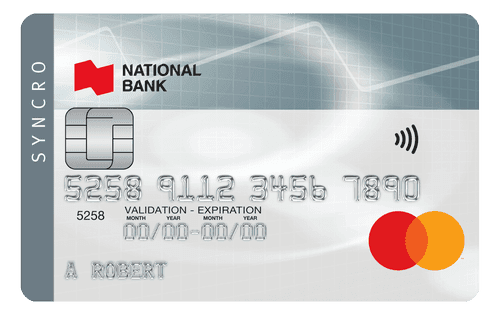
Review: National Bank Syncro MastercardMD

Loading article…
Do you sometimes carry a balance from one month to the next and interest ends up getting expensive? I took a close look at the National Bank Syncro MastercardMD to see whether its lower rate really changes the bill, with the numbers to back it up. Here’s my expert credit card review of this low-rate card at $35 a year, with no points or cash back.
The National Bank Syncro MastercardMD stands apart in the Canadian market. While most cards compete on points, cash back, and welcome bonuses, this one focuses on one thing: a low interest rate. At 9.20% on purchases, it charges about half the interest of a typical rewards card.
This review explains who this positioning makes sense for, who it doesn’t, and how much a lower rate can actually save when you carry a balance.
This card targets someone who pays their balance in full most of the time, but sometimes carries part of their bill from one month to the next. For this profile, the interest rate weighs more heavily on the wallet than the points-earning rate. Every dollar of interest avoided is worth more than a point earned.
On the other hand, the card won’t be a fit if:
In these cases, a points or cash back card will give you more value. The traveller or points optimizer profile is already well served elsewhere, for example by the National Bank World Elite Mastercard, geared toward rewards and travel insurance!
| Feature | Details |
|---|---|
| Annual fee | $35 |
| Purchase interest rate | 9.20% (variable rate) |
| Cash advance rate | 13.20% (variable rate) |
| Balance transfer rate | 13.20% (variable rate) |
| Foreign currency conversion fee | 2.5% |
| Network | Mastercard |
| Rewards | None (no points or cash back) |
| First additional card | $0 |
| Minimum annual income required | None (minimum credit limit of $500) |
Two details deserve your attention. First, the 2.5% conversion fee applies to any purchase in a foreign currency: the Syncro is therefore not a travel card, and an online purchase billed in U.S. dollars will cost 2.5% more. Second, the lower rate mainly applies to purchases and, to a lesser extent, to a balance transfer: cash advances should still be avoided, as with any card, because interest starts accruing from day one.
This is where the Syncro shows its purpose. To illustrate, let’s compare the annual interest cost between the Syncro (9.20%) and a typical rewards card with a rate around 20.99%, assuming an average balance carried over the year. This 20.99% rate is a market benchmark and isn’t tied to any specific card.
| Average balance carried over the year | Interest with the Syncro (9.20%) | Interest with a ~20.99% card | Annual difference |
|---|---|---|---|
| $1,000 | ~$92 | ~$210 | ~$118 |
| $3,000 | ~$276 | ~$630 | ~$354 |
| $5,000 | ~$460 | ~$1,050 | ~$590 |
On an average $3,000 balance carried all year, the gap is close to $354. Even after subtracting the $35 annual fee, that’s about $319 in net savings. A rewards card might have returned, say, 1% to 2% cash back on the year’s spending, but that cash back is calculated on purchases, not on the carried balance, and it doesn’t offset such an interest gap. In other words, as soon as you carry a balance on a recurring basis, points lose the race against the rate.
The Syncro remains a budget card, and its coverage reflects that. It includes the basic protections tied to the network, without the travel insurance found on higher annual-fee cards.
No travel medical, trip cancellation, car rental, or flight delay insurance is included. For this type of coverage, you’ll need to look at travel cards or purchase separate insurance.
In summary:
Our rating: 7/10. The National Bank Syncro MastercardMD isn’t trying to win over the points optimizer, and that’s perfectly fine: that’s not its job. For someone who carries a balance on a recurring basis, 9.20% instead of 20%+ translates into hundreds of dollars in interest avoided each year—an amount no cash back would offset in this scenario. The $35 annual fee is quickly absorbed as soon as a balance of a few thousand dollars is carried.
The opposite logic is just as true: if you pay off your card every month, the rate never affects you and a rewards card will give you more value. The Syncro is a targeted tool, to be chosen based on your repayment habits, not your desire for points.
To receive our card analyses every week, subscribe to our newsletter.
The annual fee is $35. The first additional card is free.
The purchase rate is 9.20%, and the rate for cash advances and balance transfers is 13.20%. These rates are variable: National Bank calculates them based on a base rate plus 4% for purchases and 8% for advances and transfers.
No. The card has no rewards program. Its value rests entirely on its lower interest rate, not on earning points or cash back.
For people who sometimes carry a balance from one month to the next and want to reduce the interest they pay. If you pay your balance in full every month, a points or cash back card will suit you better.
On an average $3,000 balance carried all year, the 9.20% rate costs about $276 in interest, versus about $630 with a 20.99% card—nearly a $354 difference. Even after the $35 annual fee, net savings are close to $319. These amounts are simplified estimates.
Yes, a 2.5% conversion fee applies to purchases made in another currency. The Syncro isn’t designed as a travel card.
No minimum annual income is required. The minimum credit limit is $500. Approval remains subject to National Bank’s credit assessment.
Yes. The Syncro is a Mastercard, the network accepted in Costco warehouses in Canada.
Our reviews and rankings are based on an objective assessment. Advertisers do not influence our content. We may receive compensation through some links; our analysis and opinions remain independent.